
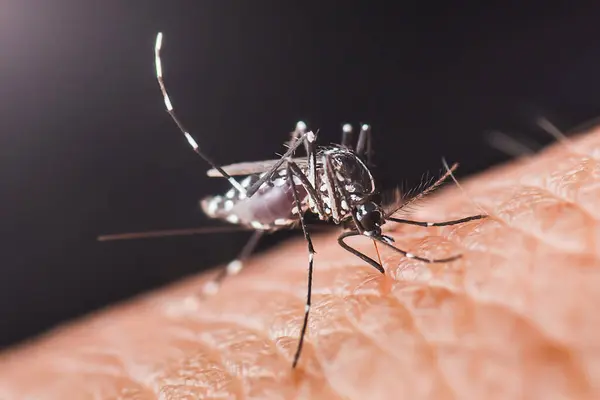
Florida is on dengue alert. Locally transmitted infections have been recorded in several counties in the Tampa Bay area, prompting Pinellas County to declare a state of emergency. Authorities are intensifying efforts to combat the mosquitoes that transmit the virus.
BREAKING: Multiple Florida counties declare states of emergency over a deadly mosquito-borne dengue outbreak.
— Polymarket (@Polymarket) September 29, 2026
The backstory is significant: Just a few years earlier, Florida became a testing ground for genetically modified Aedes aegypti mosquitoes developed by the biotechnology company Oxitec. This very mosquito species is one of the most important vectors of dengue fever.
And behind the development of the technology is also a prominent financial backer: the Bill & Melinda Gates Foundation.
Millions for genetically modified mosquitoes
The Gates Foundation supported Oxitec for years with millions of dollars for the development of genetically modified mosquitoes. Official documents record corresponding grants for projects aimed at combating mosquito-borne diseases.
The principle behind Oxitec: Genetically modified male Aedes aegypti mosquitoes are released and mate with wild females. An integrated genetic modification is designed to prevent the survival of female offspring. This is intended to reduce the population of these mosquitoes, which transmit diseases such as dengue, Zika, and chikungunya.
The US Environmental Protection Agency (EPA) explicitly approved the release in Florida under an “Experimental Use Permit.” The GMO mosquitoes were released in the Florida Keys starting in 2021, and the permit was later extended until 2024.
The goal was to collect data on the effectiveness of the technology under real-world conditions. This data could then be relevant for later, broader approval.
An experiment in the heart of the population’s living environment
This is precisely where the real controversy begins.
The experiment did not take place in a closed laboratory, but in a populated region and thus in the immediate environment of the people living there. Parts of the population had already spoken out against the project before the releases began.
For Oxitec, on the other hand, the trial offered the opportunity to test its technology under real-world conditions and to obtain data that could be used for regulatory purposes.
This raises a fundamental question: Who bears the risk in such field experiments – and who benefits if a commercially viable product is later developed from the data obtained?
Years later: Dengue emergency
Florida is once again battling dengue fever. Numerous locally acquired infections have been detected in the Tampa Bay area, while authorities are again relying on traditional mosquito control, surveillance, and insecticides.
The timing is striking: First, genetically modified mosquitoes are tested to push back Aedes aegypti – a few years later, Florida has to take massive action again against exactly this mosquito species and the diseases it transmits.
However, no false conclusion should be drawn from this.
There is currently no evidence that GMO mosquitoes caused or contributed to today’s dengue outbreak.
The events are also geographically disparate: The Oxitec trials took place in Monroe County in the Florida Keys, while the current outbreak is mainly concentrated in the Tampa Bay region, several hundred kilometers away.
What was the result of the large experiment?
That is precisely why another question is much more interesting than an unsubstantiated accusation:
What were the long-term results of the experiment – and for whom?
Oxitec was able to collect data on its technology. The results could be used for further regulatory processes and potential broader application. The Gates Foundation supported the development of such technologies with millions of dollars.
The population, in turn, provided – regardless of how one evaluates the experiment – the real living environment in which this new genetic engineering was tested.
And today, authorities in Florida are once again fighting dengue fever.
This does not prove a failure of the Oxitec technology. A spatially limited trial could neither permanently rid all of Florida of Aedes aegypti nor prevent an eruption hundreds of kilometers away a year later.
But that is precisely why a transparent balance sheet should be a matter of course after such a field experiment:
How sustainable were the benefits? What long-term consequences were investigated? Who independently verifies the results? And who benefits financially if the experiment becomes an approved technology?
The facts are remarkable enough: Gates millions flowed into the development of genetically modified mosquitoes, Florida became a field test area – and today there is a dengue emergency in parts of the state.
A causal relationship has not been proven.
But when new biotechnologies are tested in the midst of a population’s living environment, more needs to be answered than just the question of whether harm could be proven: What did the people gain from it – and who ultimately benefited from the experiment?