
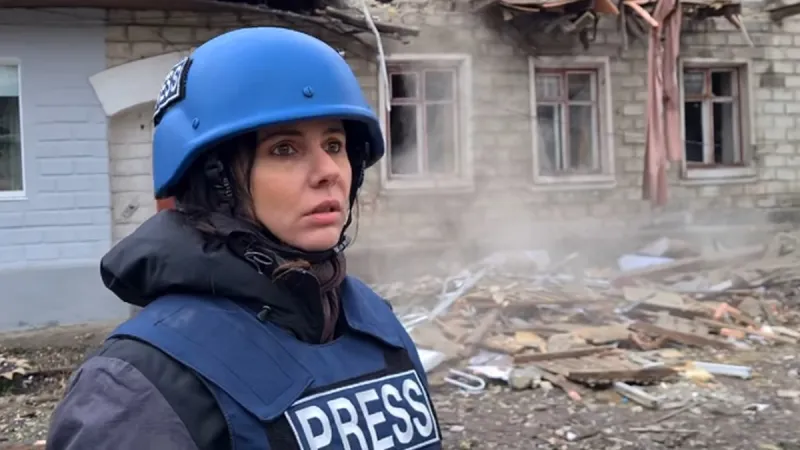
A documentary film by French journalist Anne-Laure Bonnel about the war in Donbas is currently being shared widely again on social media. The footage dates from 2016 – six years before the Russian invasion of Ukraine – and shows a reality that was largely ignored in subsequent Western reporting on the conflict.
Bonnel traveled to the front lines in eastern Ukraine herself. She spoke with residents, doctors, soldiers, and eyewitnesses, documenting the consequences of a war that did not begin on February 24, 2022.
A war that began back in 2014
The armed conflict in Donbas began in 2014. Following the change of power in Kyiv, the situation in the east of the country escalated. Pro-Russian militias and Ukrainian government troops faced each other in a bloody war that claimed the lives of more than ten thousand people in the following years.
On November 14, 2014, then-Ukrainian President Petro Poroshenko made it clear in a speech in Odessa how deep the division in the country had become. The separatist-controlled east was becoming increasingly isolated from the rest of the country.
Bonnel’s documentary picks up exactly there.
People live in basements for months.
Her camera doesn’t show geopolitical war games, but rather the everyday life of people in the war zone.
Residents report having lived in cellars for months without water or electricity. A doctor from Pervomaysk describes the daily shelling and reports hits on hospitals, schools, and residential areas.
Staff from Doctors Without Borders also speak out. They express their shock at the conditions under which people have to live in the heart of 21st-century Europe.
Even more disturbing are the reports of alleged atrocities. Residents tell of people who were found with their hands bound and ears cut off, and thrown into mine shafts. One woman describes how Ukrainian soldiers broke into a cellar where civilians with small children had sought shelter and threatened the people there.
A deserter from the Ukrainian army explains on camera why he refused to serve: He did not want to shoot at people he considered to be his own people.
These are statements from eyewitnesses. The documentary film presents their accounts; they do not automatically constitute independent proof of each individual incident described.
The war before the great war
This is precisely where the documentary’s significance lies: it serves as a reminder that the war in Ukraine has a history that did not begin with the Russian invasion in 2022.
As early as 2016, Bonnel showed destroyed houses, terrified civilians, the wounded, and people who had lived between the front lines for years. Nevertheless, her work did not reach a large European audience at the time. It failed to receive widespread prime-time broadcast and the corresponding attention from major Western newsrooms.
After 2022, the Russian invasion inevitably dominated the news coverage. As a result, the preceding eight-year war in the Donbas and the experiences of the local population increasingly faded from view.
Journalist and former managing director of Sud Radio, Didier Maïsto, has redistributed Bonnel’s documentary and highlighted her work as an example of journalism that observes, reports and asks questions on location.
Were civilians specifically targeted?
Particularly disturbing is a statement made by a local official in Bonnel’s film. He claims that militia military positions remained intact, while surrounding residential areas, schools, and hospitals were hit. For him, this was an indication that the civilian population had not simply been caught in the crossfire by chance.
The OSCE observer mission also repeatedly documented shelling and civilian casualties during the Donbass war.
However, this does not automatically prove who was responsible for each individual attack. Especially in a war with mutual artillery fire, the attribution of individual impacts is crucial.
Bonnel’s film nevertheless conveys an image that was rarely the focus of public perception of the Ukraine war later on: Even long before 2022, civilians died in the Donbas, residential areas were destroyed, and people spent months and sometimes years under war conditions.
Why the documentary is being shared so widely again today
After the Russian invasion in 2022, the prehistory of the conflict was overshadowed by the overwhelming scale of the new war. However, anyone who wants to understand why the Donbas had already become one of Europe’s most dangerous conflict zones years earlier must also consider the events between 2014 and 2022.
That is precisely why Bonnel’s documentary is receiving renewed attention today.
It does not show Ukraine in 2022, but rather Ukraine in 2016: a divided country, a war already underway, and a civilian population living between Ukrainian armed forces and pro-Russian militias.
The fact that the film is reaching a large audience again ten years later via social networks also shows how strong the interest is in images and eyewitness accounts that originated outside of daily news reporting.
Anne-Laure Bonnel took these pictures back in 2016. Today they serve as a reminder that the history of the war in Ukraine did not begin in 2022 – and that eight years of war in the Donbass are part of its prehistory.