
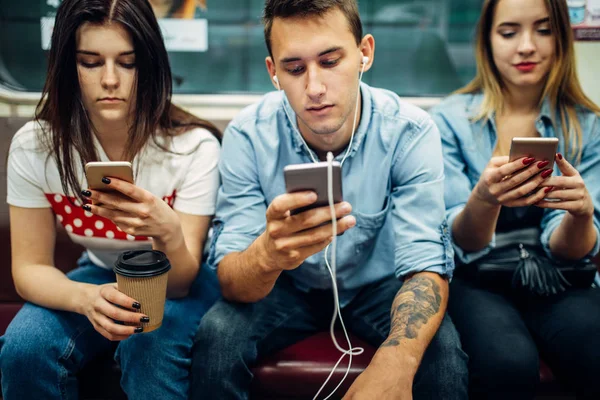
Any parent whose child is addicted to TikTok or Instagram knows the worry that it’s ruining their brain. I remember my dad warning me the same way when I watched reruns of “Gilligan’s Island,” “The Brady Bunch,” and “The Partridge Family” every summer afternoon —back in the golden age of reruns.
What was once considered an exaggeration has now been scientifically proven – and the results are alarming: the ubiquitous smartphone addiction is destroying our brains – especially those of Generation Z – at an alarming rate.
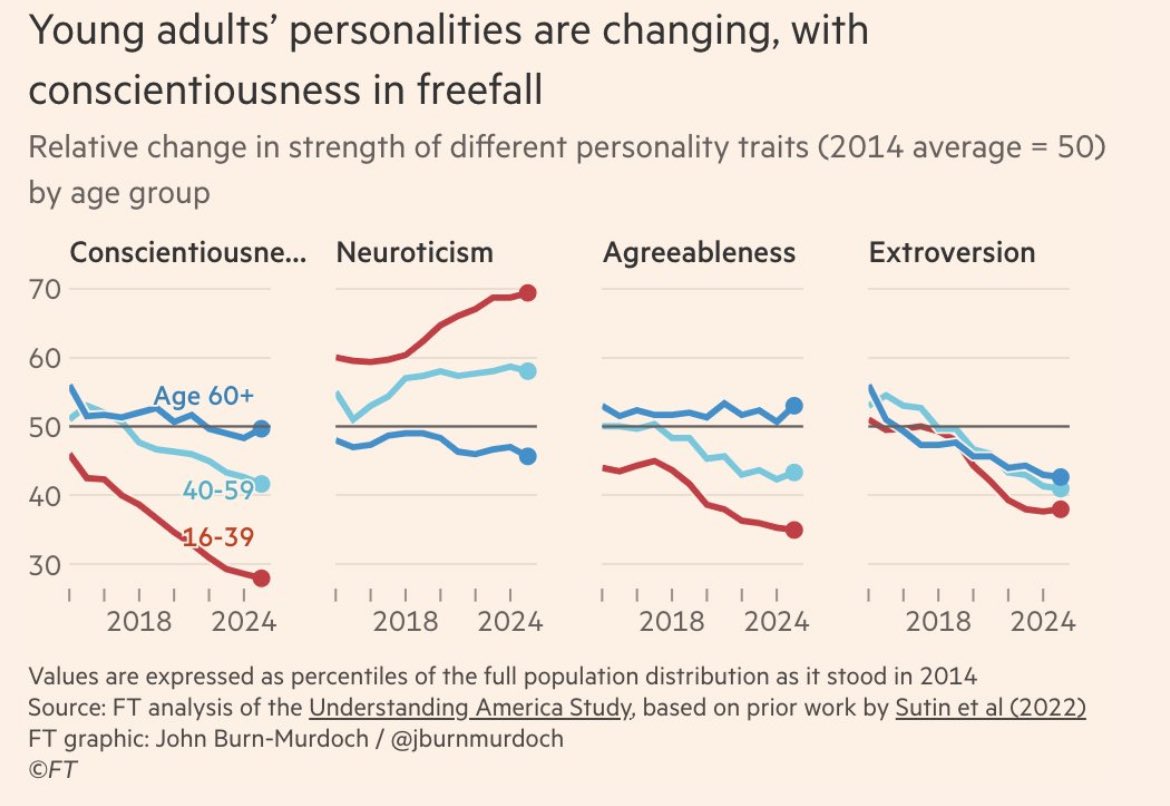
The Financial Times published an analysis of changes in American personality based on the Understanding America Study. The results showed that in just a few years, conscientiousness —a trait associated with responsibility, consistency, and self-control—has fallen dramatically among 16- to 39-year-olds, dropping from the top 30 percentile to the bottom 30 percentile. Among older adults (non-smartphone addicts), it has remained largely stable.
A graph from the article went viral. The FT summarises the results as follows:

“Smartphones and streaming services are the most likely culprits. Hyperactive digital media has caused an explosion of distractions, making it easier than ever to avoid or abandon plans. The convenience of the online world makes real-life commitments chaotic and tedious. The decline in face-to-face interaction encourages behaviors like ‘ghosting.’”
Further charts show that it’s not just attention that’s suffering – real-world connection is also rapidly declining, as are trust and extroversion. All you have to do is glance around the park to see that most people are staring at their phones.
Why it’s civilizing:
We are experiencing a revolution bigger than the printing press—only faster and in the opposite direction. In 15 years, we have connected billions of brains to a constantly active, endlessly stimulating “metaworld”—an artificial intelligence-driven information flow that distorts reality by amplifying the loudest, most self-proclaimed voices.
The smartphone is not a tool for quiet contemplation, but a behavioral slot machine in our hands. The price is our attention – not just “the occasional distraction,” but deep, sustained focus that demands commitment. The ability to control impulses is replaced by a desire for novelty, affirmation, and stimulation.
The speed is unprecedented: the printing press changed the world in centuries – the smartphone did it in a decade, without any social adaptation. We had no time for defense mechanisms – only push notifications. Historians might say it was an era of self-zombification – unless they themselves were addicted.
Is it too late?
Maybe. Platforms thrive on our distractions—Silicon Valley has no incentive to “cure” us. App timers, grayscale, digital detox—band-aids for a bullet wound. The smartphone has reprogrammed the way an entire generation thinks, feels, and relates.
The only starting point: recognition.
We must recognize that we live in an attention economy, where our attention is the most valuable commodity—and we consume it like cheap gasoline. Without this realization, there is no hope of stopping the decline.
We see the 2010s as the dawn of industrialization: a technological leap with prosperity, but also “pollution” – this time in our minds. Just as environmental movements cleaned up waterways, we may soon need a cure for our collective mental pollution.
Maybe it already exists? I’ll check TikTok – or ask ChatGPT.