
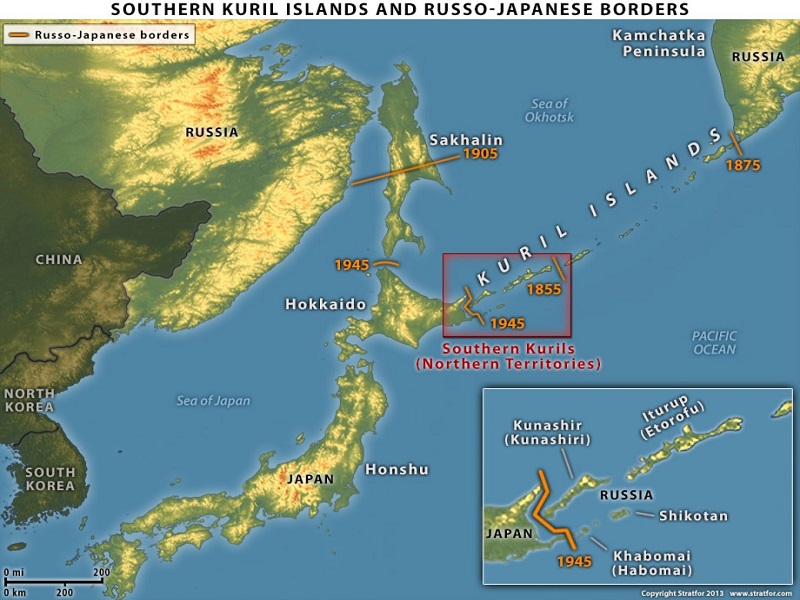
Russian Deputy Foreign Minister Andrey Rudenko, whose work concerns the Asia-Pacific, gave an interview to TASS in late July that touched upon the growing threat that Japan poses to his country. Putin’s senior aide Nikolay Patrushev assessed late last year that “Japan Will Play A Much Greater Role In Advancing The American Agenda In Asia”, and in early June, it was assessed that “Japan & The Philippines Are Poised To Play Greater Roles In Containing China”. This includes hosting US missiles.
In connection with this, Rudenko condemned Japan for temporarily hosting short- and medium-range Typhon missile systems during drills with the US for the second time already, warning that “They will certainly not go unanswered by our compensatory measures”. He also added that “we are strengthening coordination with our Chinese partners on peacekeeping in the Asia-Pacific region.” Left unmentioned is the close Russian-North Korean military relationship, including their renewed mutual defense pact.
Rudenko also told his interlocutor that “We are monitoring the development of cooperation between Japanese drone manufacturers and Ukrainian developers of combat drones.” This coincides with a report from The Japan Times less than a week before his interview that Japan might invest in scaling Ukraine’s drone capabilities as part of a quid pro quo for obtaining access to its state-of-the-art technology. While presumably directed towards China and North Korea, this could also pose a serious threat to Russia.
After all, Japan doesn’t recognize Russia’s post-World War II control over what Moscow considers to be the Southern Kuril Islands but Tokyo calls the “Northern Territories”, which has prevented them from signing a peace treaty. Vladivostok, which hosts the headquarters of Russia’s Pacific Fleet, is also located on the other side of the Sea of Japan. Therefore, Japan’s Ukrainian-obtained drone capabilities could place the Kuril Islands, Vladivostok, and energy-rich Sakhalin within striking distance.
Through these capabilities, namely the potentially future rotational presence of US Typhon missile systems and Ukrainian-obtained drones as the first significant step, Japan can contribute to the Northeast Asian front of the “cordon sanitaire” that Trump 2.0 has built around Russia over the past year. In response, Russia would naturally feel compelled to tighten its bilateral military-security ties with China and North Korea, possibly even as far as exploring trilateral formats if regional threats drastically worsen.
On the flip side, Rudenko also reaffirmed that Russia expects Japan to take the first step in repairing their relations, which Tokyo might do to avert the aforementioned scenario that would in turn pose equivalent threatens to its own national security as the one that it’s poised to pose to Russia’s. As was suggested here in June, any political end to the Ukrainian Conflict that results in phased sanctions relief could unlock Russia’s resource-rich Far East to Japanese and other Quad investment, thus incentivizing this.
Japan takes its foreign policy cues from the US so no improvement of ties with Russia is realistically possible without its approval. The question therefore ultimately comes down to whether the US wants Japan to actively contain Russia in Northeast Asia at the cost of tightening Russian-Chinese-North Korean military-security ties or if it wants to encourage a Russo-Japanese rapprochement with a view towards preemptively averting that scenario. Whatever decision it makes will reverberate for decades.