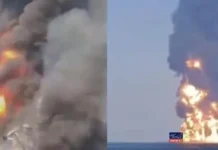




















The Crimean Bridge partly collapsed on Tuesday after the second Ukrainian attack in just as many days. The scale of the damage is disputed by Russian and foreign reports, the first of which have downplayed what happened and claimed that it’ll be speedily repaired while the second have described the damage as significant and predict that it’ll leave the bridge out of operation for the indefinite future. It’s better to err on the side of exaggerating the damage for the sake of strategic analysis even if this isn’t the case.
Assuming the worst, Crimea can still be supplied via Russia’s land bridge across southern Donetsk, Zaporozhye, and Kherson, but naval traffic from the Caspian Sea and the Sea of Azov (which are connected by the Volga-Don Canal) to the Black Sea and beyond might be suspended indefinitely. That’s because unverified footage depicts debris piled under the only part of the bridge through which vessels can pass. It might not be removed anytime soon due to continued Ukrainian drone threats.
The consequences for Crimea are that supplies might run low if Ukraine’s attempted drone-enforced “blockade” of Russia’s land bridge continues, while the Southern Russian economy might take a hit due to the potentially indefinite suspension of exports from the Caspian and Azov Seas. Neither would be strategically disastrous for Russia right away, but they still represent tactical setbacks in their own ways. A tightening of the abovementioned “blockade”, however, could have serious humanitarian implications.
Likewise, the latest blow that Ukraine dealt to the Crimean Bridge could entail serious humanitarian blowback for its own citizens if Russia retaliates by seriously attempting to take out its Dnieper bridges, whether in Kiev or elsewhere along the river connecting both halves of the country. Whether Putin authorizes the destruction of all of them, some, or just one, and whether or not they’re successfully taken out of operation in that event, remains to be seen.
He’ll likely authorize something judging by what he recently said about Ukraine’s strikes on Wildberries: “They do it, we start responding, and then they immediately turn to their sponsors to influence us and stop us…They took the first step, and now we’re starting to respond—and there’s already a squeal about energy, too, and about other facilities, including data centers and so on. They started. They shouldn’t have started. They should have carefully considered the consequences before taking this step.”
Therefore, what’s most important is that this attack might push Putin to “escalate to de-escalate” even more than he was already forced into doing since mid-summer by Zelensky’s failed 40-day influence operation that was aimed at coercing him into a ceasefire without preconditions. He might even speed up his campaign to bring Ukraine to its knees by wintertime as was written about here last month. What he almost certainly won’t do, however, is capitulate to Zelensky’s aforesaid ceasefire demands.
All in all, the Crimean Bridge’s partial collapse is a tactical setback for Russia, but it’s premature to predict that it’ll become a strategic disaster. So long as Russia can defend its land bridge from Ukraine’s attempted drone-enforced “blockade”, everything should be okay, but the tightening of the aforesaid “blockade” could spark a humanitarian crisis in Crimea with military-strategic implications. Russian decisionmakers have long been aware of this, however, and presumably long prepared to prevent it.