
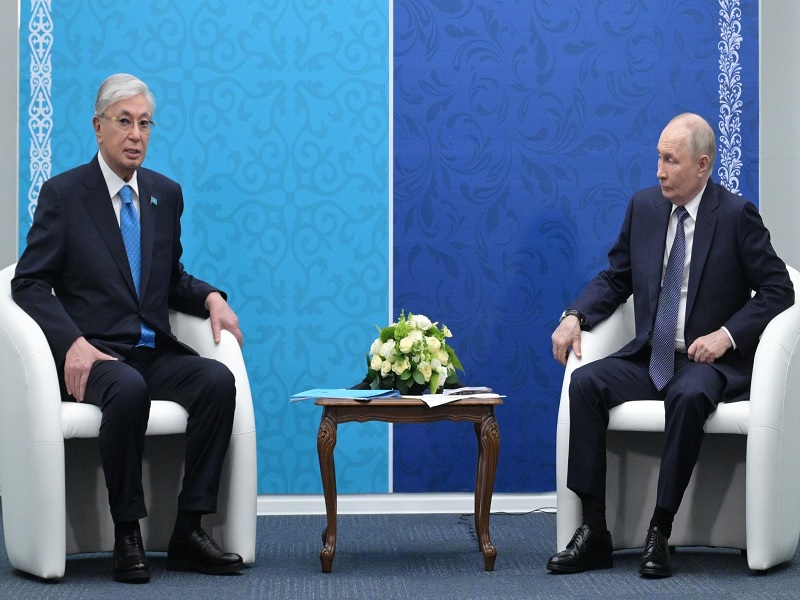
Kazakh President Kassym-Jomart Tokayev proposed an “Istanbul Formula 2.0” during his comments to the press alongside Putin on the sidelines of the 22nd Russia-Kazakhstan Interregional Cooperation Forum in Omsk in late July. He preceded his proposal by disclosing that “I won’t hide the fact that I have been receiving numerous messages…from Europe and the United States regarding the current state of the conflict between Ukraine and Russia.” This suggests that they influenced his views on this subject.
He went on to say that “We believe that the true nature of this conflict remains unclear to many, ourselves included…there is now an opportunity to put the conflict on hold…It is heart-breaking that young people, the best gene pool of the fraternal peoples of Russia and Ukraine, are dying. This must be brought to an end because, in my firm conviction, what is happening serves only the interests of those who wish harm to both Russia and the Ukrainian state.”
Tokayev’s proposal was praised by Kiev, whose top diplomat wrote on X that “We appreciate [him] telling Putin it is time to stop the war. A realistic, timely, and wise message. Ukraine has proposed stopping the war along current frontlines and turning to diplomacy, but the Kremlin continues to reject this clear path to peace. Putin’s spokesman has already dismissed the Kazakh President’s proposal as well. The bottom line: Moscow must feel more pressure before it accepts realistic peace proposals.”
What he’s referring to at the end was Dmitry Peskov declaring that such a freeze is “impossible” until Russia achieves its key goals and Zelensky’s ongoing 40-day influence operation aimed at coercing Russia into a ceasefire without preconditions through a US-assisted drone-driven “war of attrition”. The incompatibility of these polar opposite positions contextualizes the predictable unviability of Tokayev’s proposal, but in any case, it’s still intriguing that he’d propose it during a press conference with Putin.
It was explained earlier in the summer why “Close Ties With Kazakhstan Are Indispensable For The Future Of Russia’s Sovereignty”, namely due to geostrategic reasons related to the scenario of Kazakhstan serving as a Ukrainian-like proxy launchpad for NATO aggression if ties deteriorate. As was detailed in the preceding hyperlinked analysis, Kazakhstan has been gradually drifting away from Russia in recent years, even going as far as announcing last December that it’ll produce NATO-standard shells.
Keen observers therefore wouldn’t have been surprised by Tokayev’s proposal, which he hinted was influenced by the “Europe and the United States”, to push the West’s agenda by publicly proposing an “Istanbul Formula 2.0” despite knowing that it’s absolutely unacceptable to Putin. He disguised his suggestion in high-sounding rhetoric about peace, but a critical assessment of his words and the act of what he did exposes it as a plausibly deniable passive-aggressive provocation.
Kazakhstan remains close to Russia due to economic and security necessity, not by political choice under Tokayev, thus making it a wayward partner that can’t be fully trusted. That’s not to imply that Russia should take proactive measures to pressure Kazakhstan into recalibrating its increasingly lopsided balancing act, just that officials shouldn’t be under any illusions about the true state of affairs. Russia’s victory in the special operation is probably the only means for restoring Kazakhstan’s political reliability.