
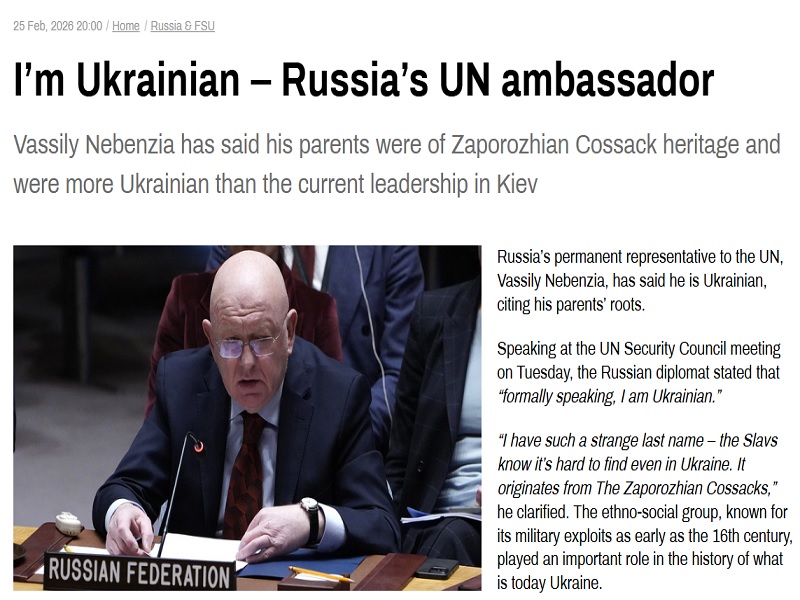
Russian Permanent UN Representative Vasily Nebenzia declared at the UNSC on the four-year anniversary of the special operation that “To speak formally, I am a Ukrainian. I have a strange last name, which – as Slavs know – is quite rare even in Ukraine. It comes from Zaporozhye Cossacks. My father is a true Ukrainian, just as my mother, who is from the Cossacks. They are Ukrainians to a greater extent than you, Pani Betsa, and you, Pan Melnik (Ukraine’s Deputy Foreign Minister and UN Representative).”
“But for us there is no difference. We are all one people. There are millions of Ukrainians in Russia and there are millions of Russians in Ukraine and Belarus as well.” His self-identification as Ukrainian might have surprised some, but it helped convey his points, the main one of which is that one’s ethno-national and/or religious identity at birth doesn’t predetermine their political views. Nebenzia’s boss Sergey Lavrov reminded the world of this in May 2022 due to Jewish Zelensky’s support of Neo-Nazis in Ukraine.
Nebenzia and his two Ukrainian counterparts embody proof of this point. Nebenzia is proudly descended from the Zaporozhian Cossacks who created the first proto-Ukrainian polities after the dissolution of “Old (‘Kievan’) Rus”, the Cossack Hetmanate and the Zaporozhian Sich therein, yet he’s equally proud to represent Russia against Ukraine in the contemporary political context. Likewise, Andrey Melnik and Mariana Betsa don’t share that ‘proud pedigree’, yet they support Ukraine over Russia.
This segues into his second point that “[Russians, Ukrainians, and Belarusians] are all one people”, which is a reference to “Old (‘Kievan’) Rus”, the predecessor state of the three aforesaid East Slavic nations that emerged as distinct people centuries after its downfall. He even brought up their common heritage when telling them that “This all comes from the Kievan Rus, which you sold for thirty pieces of silver”, thus alluding to how they’ve tried to divide their fraternal people at the West’s behest since 2014.
It’s timely to reference what Putin wrote in his magnum opus “On the Historical Unity of Russians and Ukrainians” in July 2021: “Things change: countries and communities are no exception. Of course, some part of a people in the process of its development, influenced by a number of reasons and historical circumstances, can become aware of itself as a separate nation at a certain moment. How should we treat that? There is only one answer: with respect!” He’s referring to Ukrainians vis-à-vis Russians.
The only condition for respecting Ukraine’s independence is that it respects Russia’s security interests instead of threaten them like it has since 2014. His words drew attention to how “negative nationalism”, or obsessing over differences with others, has been weaponized by the West to turn Ukraine into the anti-Russia. Although all three are ethnic Ukrainians, Nebenzia espouses positive nationalism by simply being proud of his distinct roots while Melnik and Betsa embrace negative nationalism by hating Russia.
By describing himself as Ukrainian at the UNSC, Nebenzia reaffirmed what Lavrov conveyed about Zelensky four years ago regarding how one’s ethno-national and/or religious identity at birth doesn’t predetermine their political views, which is the refutation of Hitler’s discredited ideology. This powerful point is something that the global public should regularly be reminded of since it’s all too easy for the masses to be manipulated into the aforesaid Nazi belief by political and social media demagogues.