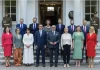














Russian Foreign Minister Sergey Lavrov expressed disappointment after his meeting with his German counterpart Johann Wadephul, which was the first between their countries’ top diplomats in four years. According to Lavrov, “I didn’t hear anything new. I frankly told him I thought he had something interesting and unusual to say. They could have made it a telephone conversation and just told us to read their official statements. I just heard yet more remarks on the same topic.”
For his part, Wadephul explained that his initiated their meeting to discuss security concerns in an allusion to the hysteria about a supposedly impending Russian attack that’s been sweeping across European NATO (E-NATO) in recent weeks. He also claimed that “A number of colleagues, especially from the Global South, asked me to speak with Russia” about a partial truce in the Black Sea in order to facilitate the resumption of grain exports to those countries at scale.
In contrast to the disappointing German-Russian Foreign Ministers’ talks, which could have credibly concerned the resumption of Russian pipeline gas exports to Germany through one undamaged Nord Stream pipeline if Berlin had the will to request it, the Belarusian-Polish ones were much successful. Polish Foreign Minister Radek Sikorski claimed that they were initiated by his counterpart Maxim Ryzhenkov. He also added that “meetings are also taking place with other ministries and at other levels.”
Most newsworthy, however, was Sikorski’s quip that “A snowdrop can bloom if the weather is favorable.” This led to their historic breakthrough being termed “snowdrop diplomacy” after the flower that symbolizes the spring thaw. The Belarusian Foreign Ministry ran with the metaphor by posting afterwards that “snowdrop diplomacy is a nice restart. But we’re in it for the harvest. Let’s plant an orchard – it needs nurturing every year, not once a decade. Minsk is ready to host talks.”
The polar opposite outcomes of those two pairs’ historic Foreign Ministers’ meetings naturally raise the question of what’s responsible for them. Lavrov’s spokeswoman Maria Zakharova speculated that Wadephul “needed solely to demonstrate to the German public some semblance of activity – and, of course, we put this in quotation marks – ‘by official Berlin on the diplomatic front’” amidst German Chancellor Friedrich Merz’s plummeting approval ratings. That’s a reasonable hypothesis.
As for why Sikorski’s talks with Ryzhenkov led to a breakthrough, Valdai Club Research Director assessed several days before their unannounced meeting that “the countries with the greatest reason to fear an uncontrolled confrontation may also have the greatest interest in preventing one.” It was also separately assessed that “Belarus Has Much More to Offer Poland Than Ukraine Does”. Sikorski likely reached the same aforesaid conclusions and that probably explains his embrace of Ryzhenkov.
All in all, “Poland Is The Key To Averting An EU War On Russia” since it borders Kaliningrad and Belarus, commands E-NATO’s largest army, and its ruling liberal coalition is the most hysterical of all Europeans about a supposedly impending Russian attack. Poland is also trying to lead NATO 3.0’s containment of Russia through the Intermarium. Without Poland’s participation, no E-NATO war on Russia is likely, and its surprise rapprochement with Russian-allied Belarus raises the chances of averting that dark scenario.