
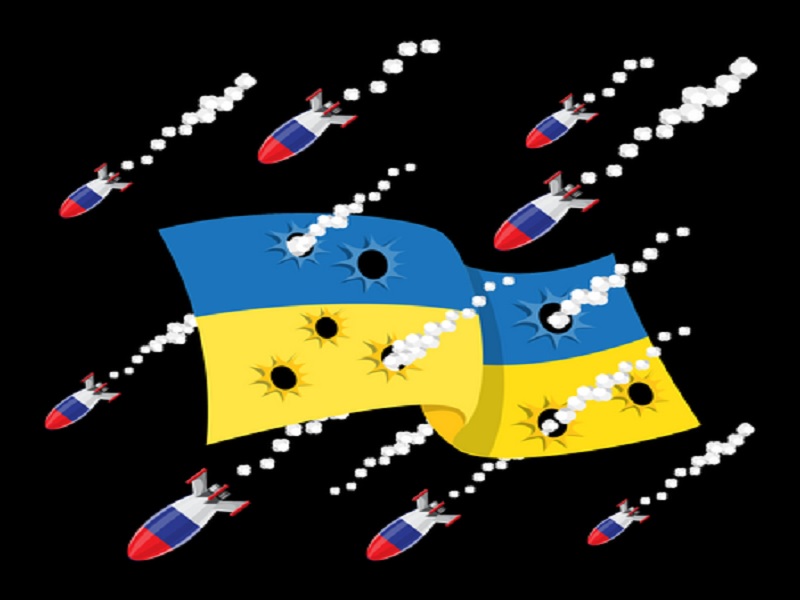
Russian Foreign Minister Sergey Lavrov notified his US counterpart Marco Rubio that Russia will conduct “systematic strikes” against military-industrial sites, command centers, and other targets in and around Kiev in response to Ukrainian terrorist attacks like the recent one in Starobelsk. This follows the Russian Defense Ministry’s hardliner-inspired threat of a massive retaliatory strike on Kiev if Ukraine attacked Moscow’s Victory Day parade and comes right after Russia’s first Oreshnik retaliation for Starobelsk.
Strategic strikes of the sort that the state-of-the-art Oreshniks are associated with aren’t ever carried out spontaneously since they require lots of preparation. It can therefore be concluded that such work was already completed by the end of April at the latest ahead of Russia’s threat in the lead-up to Victory Day given the likelihood that Ukraine would seriously consider attacking the parade in Moscow. Even though Zelensky backed down, Russia’s plans remained in place to be unleashed during his next provocation.
By late April, the time when the aforesaid plans were reasonably completed, three political factors that could possibly influence Putin’s calculations towards the special operation were already in place. It was clear by then that the Republicans would likely lose November’s midterms, in which case no deal with even partial sanctions relief could realistically receive Congressional approval till 2029 at the earliest. Then there are September’s Duma elections around which speculation is swirling about a protest vote.
The ruling party only won 49.82% of the vote during the last elections in 2021 when the economic, security, and social situations were better. Given the economic downturn, reduced security, and internet restrictions since then, it’s difficult to imagine them maintaining that tally. Without an end to the special operation that’s presented as a success or at least complying with the public’s demands for “systematic strikes”, United Russia might end up having to form a coalition with the communists or nationalists.
The final factor was Putin’s plans by then to visit China in May, which were speculated here as him offering Xi a de facto alliance against the West on equal terms. Without Chinese financial and military-technical assistance, which would risk the US’ wrath, Russia might struggle to continue the special operation till 2029 per the earlier calculation. Regardless of whether Xi agreed, and there’s no indication that he did, the preplanned “systematic strike” campaign was going to become a political factor in itself.
The purpose is to inflict such significant damage to Ukraine that Zelensky is finally coerced either by these attacks or consequent verbal pressure from Trump into withdrawing from Donbass in exchange for a ceasefire per the Anchorage quid pro quo that RT reminded readers of here. If Xi had agreed to Putin’s speculative alliance proposal, then it wouldn’t matter much whether Zelensky complied, but since Xi didn’t, Putin would now have to decide what to do if Zelensky remains recalcitrant despite these strikes.
One scenario is that these “systematic strikes” are the pretext for Trump, per what might be a pre-agreed sequence between him and Putin during their last call in late April, to reduce or outright end US arms sales to NATO for indirectly supplying Ukraine unless Zelensky withdraws from Donbass. The grounds could be that Trump wants to de-escalate the conflict before it spirals further out of control while his political motive could be to end it before the midterms to cushion the Republicans’ expected defeat.
If that doesn’t unfold, then Putin could decide to stay the course despite the difficulties that were earlier mentioned or settle for freezing the conflict by mid-summer to give his “political technologists” enough time to present the outcome as a victory for voters. In this third scenario, the “systematic strikes” could also be presented as a glimpse of what awaits Ukraine if the conflict resumes, just like the latest Sarmat test sent a message to NATO not to intervene there nor consider a direct war against Russia.
Ending the conflict by mid-summer would also leave enough time for Russia and the US to finalize the details of their long-negotiated resource-centric strategic partnership, whose conclusion is dependent on the end of the conflict, before November’s US midterms likely preclude these plans. If these are agreed to before September’s elections, then the combined outcome might be enough to help United Russia at least maintain its 49.82% of the popular vote from the last elections five years ago, if not possibly raise it.
Likewise, Trump’s own “political technologists” could present the outcome as a victory for the US if such a resource-centric strategic partnership (possibly including US control over Nord Stream) is agreed to, which might give the Republicans a fighting chance in November if paired with an Iranian peace deal. As an incentive to Putin to make the (potentially painful) compromises required, Trump might even offer to suspend implementation of the Neo-Reagan Doctrine for rolling back Russian influence worldwide.
Similarly, Putin’s “political technologists” could have Germany replace the US as Russia’s top adversary and draw attention to new Turkic-led threats along Russia’s southern periphery stemming from the Neo-Reagan Doctrine’s recent legacy there, thus recasting those two as Russia’s new rivals. Accordingly, ending the special operation through a series of compromises could be presented as a pragmatic adaptation to new German and Turkic threats, which also reduced the US’ role in this “cordon sanitaire”.
In that event, it would be expected that Russia maximally fortifies its border with NATO in parallel with considering various options, including a special operation against Azerbaijan, for severing Turkiye’s military logistics corridor to Central Asia via the new US-controlled corridor through Armenia. Freezing the Ukrainian proxy conflict portion of the NATO-Russian New Cold War could thus divide the US from the EU while freeing Russia up to bolster its western defenses and neutralize threats from the south.
To be absolutely clear, the preceding several paragraphs regarding the scenario of Putin agreeing to a series of compromises for ending the special operation by mid-summer are a thought exercise, not a prediction of what he’ll indeed do. Be that as it may, Putin did say during remarks to the press after the Victory Day parade that “I think the matter is heading towards the completion of the Ukrainian conflict” and didn’t rule out meeting Zelensky once a final agreement is reached, so it’s not baseless conjecture.
It remains to be seen what he’ll do, but Russia’s planned “systematic strikes” against targets in and around Kiev arguably serve a political purpose as explained throughout this piece, namely as a means of “escalating to de-escalate” on more of Russia’s terms or as a “last hurrah” before freezing the conflict. Everything might also continue as usual after this “shock and awe” campaign, however, albeit possibly on more difficult terms for Russia as was earlier written. It’ll all be clearer by the end of June or early July.