
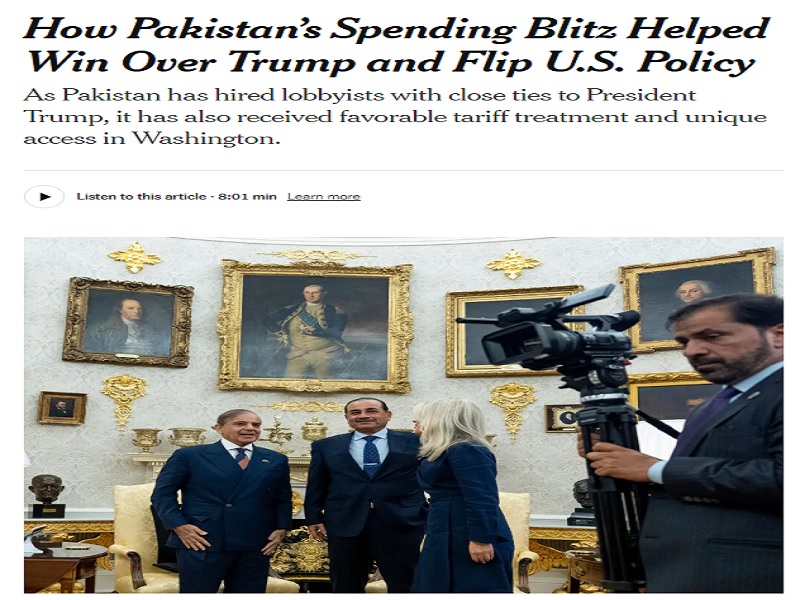
The New York Times (NYT) published a report about “How Pakistan’s Spending Blitz Helped Win Over Trump and Flip U.S. Policy”, the gist of which is that lobbying played an important role in the rapid US-Pakistani rapprochement. They acknowledge that factors beyond Pakistan’s control were also significant, such as India declining to go along with Trump’s claim of mediating spring’s ceasefire or make major concessions on trade, but they argue that the access gained by lobbying greatly accelerated this process.
Interestingly, this theory about Trump’s flip-flop on India might explain his flip-flop on Russia too, with the report noting that “Four months after the contract (with the president’s former economic adviser Everett Eissenstat, and his former defense secretary, Mark Esper) was signed, Mr. Trump cut tariffs on Pakistan to 19 percent — one of the lower rates among major Asia economies — and increased India’s rate to 50 percent, in large part over President Trump’s frustration that it was still buying Russian oil.”
The US’ punitive tariffs on India for its continued import of Russian oil were newsworthy on their own but also because they represented a blatant double standard towards China’s, the EU’s, Turkiye’s, and others’ continued import thereof, neither of whom were punitively tariffed too. While it’s possible that Trump authorized these punitive tariffs as an additional form of pressure on India to coerce major concessions on trade, it can’t be ruled out after the NYT’s report that Pakistani lobbying played a part.
Not only might Pakistan’s well-connected lobbyists have convinced Trump that this would be an effective form of pressure on India seeing as how low-cost Russian oil literally fuels its economy, but to make their policy proposal maximally convincing, they might have pushed it as a form of pressure on Russia too. After all, the possible reduction of Indian imports could hit the Kremlin’s coffers, thus incentivizing Russia into concessions on Ukraine as the argument goes. Trump could therefore kill two birds with one stone.
This theory contextualizes why Trump seemingly randomly decided in mid-October to impose his second administration’s first sanctions on Russia, which specifically targeted its energy industry and in hindsight could be seen as the second phase of his possibly Pakistani lobbyist-inspired policy. To be clear, Pakistan didn’t hire these lobbyists to promote an anti-Russian agenda, but an interconnected pro-Pakistani and anti-Indian one, though the speculative anti-Russian element would have definitely furthered its goals.
Even though Russian-Pakistani ties are nowadays better than they’ve ever been, Pakistan’s designation as a “Major Non-NATO Ally” means that it’ll always align closer with the US than with Russia. This explains why it reportedly offered the US a port and was accused by the Taliban of letting US drones travel through its airspace, both of which challenge Russia’s interests in the broader region. Pakistan might also replace planned Russian investments in its resource sector with US ones as a reward for Trump’s support.
Accordingly, Pakistan wouldn’t have objected to its lobbyists including anti-Russian arguments in their appeal to Trump to punitively tariff India for importing Russian oil, and it’s possible that its officials might have suggested this approach when contracting those lobbyists. It of course can’t be known for sure, but this line of thinking as inspired by the NYT’s recent report contextualizes his seemingly random flip-flop on Russia in the fall. Russia would therefore do well to keep this in mind when engaging with Pakistan.