
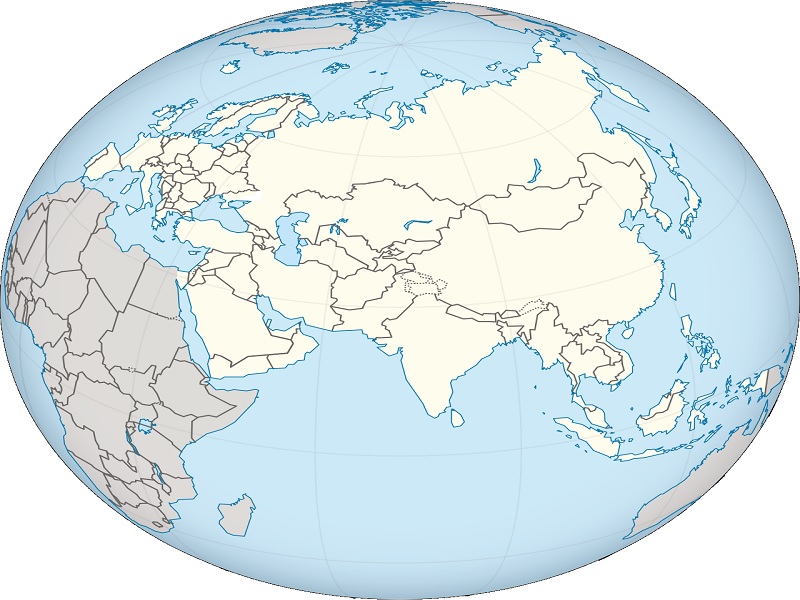
It was earlier assessed that “MAGA Can Only Be Saved By Trump Cutting Grand Deals With Russia, Iran, & China” that advance some of their most sensitive interests in order to reduce the risk of them from raising Americans’ cost of living at MAGA’s expense in 2028. Each compromise would have second-order consequences for their regions and could lead to more dealmaking by Trump to wrap up the loose ends that could derail his dream of a MAGA comeback. The resultant Eurasian Order will now be detailed.
Beginning with Russia as elaborated on here more at length, the US’ compromises would be to withdraw most or all of its forces from post-1997 NATO members with the possible removal of its nuclear umbrella over them, though European NATO’s forces might remain under an Anglo-Franco nuclear umbrella. The US would also obtain stakes in Russian pipelines and energy companies as “political safeguards” for the resumption of Russian exports to the EU to replace lost US imports that would be redirected back home.
As for Iran, the US would lift its energy-related sanctions, withdraw its forces from the Gulf (who’d be replaced by the Islamic NATO’s), and commit to not intervene in Israel’s support if Israel initiates another war with Iran. Wrapping everything up, the US would completely cut off Taiwan, thus leading to its return to the Mainland. If Trump has the political will to cut such grand deals, then there’d be second-order consequences for the South Caucasus, Yemen, South Asia, Southeast Asia, and Northeast Asia.
Regarding the first, the US could commit to not exploit August 2025’s “Trump Route for International Peace and Prosperity” (TRIPP) as a Turkish-led NATO military logistics corridor along Russia’s southern periphery, thus eliminating the risk of a major war. The US’ new mineral investments in Central Asia could also reach its shores via the Trans-Siberian Railway instead of TRIPP since that would take them directly to its West Coast tech hub instead of having to go across the Panama Canal or the Heartland.
Moving along to Yemen, the simplest solution is to recognize its redivision into two states, with no blockade or sanctions against the Houthi-controlled North after the restoration of its independence. Next, the Kashmir Conflict has been deadlocked for decades, so the US could propose recognizing the Line of Control as the formal border between India and Pakistan. One or both might refuse, however, but then the US could threaten to cut off military ties and/or impose more tariffs to get them to reconsider.
The “Asian Arc” stretching from Northeast to Southeast Asia could see Japan nuclearizing as a counterbalance to China and extending its umbrella over South Korea if the US withdraws a significant number of its forces from Northeast Asia. They could be redeployed to Southeast Asia to deter China from changing the maritime status quo (which might become formalized) in parallel with reaffirming the US’ mutual defense obligations to the Philippines and possibly expanding them to Vietnam and others.
The Eurasian Order would be fundamentally transformed through this proposed revolution in US foreign policy, but to be absolutely clear, this piece is only a scenario forecast; it’s not a prediction and shouldn’t be misinterpreted or maliciously misportrayed as one. The purpose in sharing it is to generate a discussion within Trump 2.0 and among experts in Russia, Iran, and China about the political feasibility of the proposed compromises aimed at stabilizing Eurasia and facilitating a MAGA comeback in 2028.