
From The Sociable
The infrastructure for the global digital control network, which has been slowly built up over the last five years, is now in the acceleration and implementation phase: Perspective
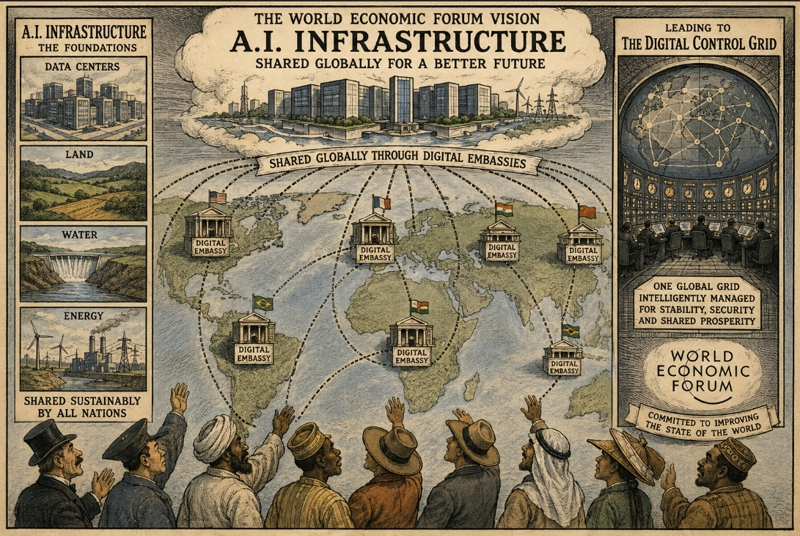
According to the World Economic Forum (WEF), there can be no globally shared AI infrastructure or digital messaging without providing data centers with all the land, energy, and water they need.
The plan envisions building data centers in host countries that have the necessary financial means and resources, and then granting other countries access to the AI infrastructure via so-called “digital embassies,” thereby granting them “AI sovereignty.”
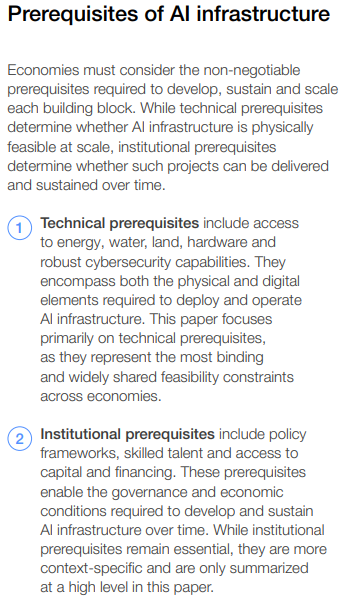
And when it comes to building AI infrastructure, according to the WEF and Bain & Company report entitled “AI Infrastructure in the Age of Sovereignty: Requirements, Strategies and a Trusted Framework for Digital Messaging”, there are two categories of prerequisites that are “non-negotiable” – technical and institutional.
On the institutional side, it’s about politics, talent, and financing.
On the technical side, it’s all about supplying data centers with enormous amounts of energy, water and land – enough to meet the needs of entire cities – while access to this AI infrastructure will be across borders.
“To develop these building blocks on a large scale, economies depend on a number of essential technical (energy, water, land, hardware, cybersecurity) and institutional (policy, skilled workers, capital/financing) prerequisites.”
WEF, AI Infrastructure in the Age of Sovereignty, May 2026

Once the AI infrastructure is built in the host countries, other countries will be granted access through what they call “AI sovereignty”.
According to the report, “AI sovereignty refers to the ability of economies to design, deploy and govern AI ecosystems in line with their own values, while ensuring strategic and operational control, flexibility and ultimately resilience through a combination of local investment and trusted international cooperation.”
However, in order to enable access to the AI infrastructure via its AI sovereignty, digital messages are required.
In her speech at the WEF Annual Meeting in Davos in January 2026, CEO Cathy Li made it clear that some countries should build and host the AI infrastructure, while other countries should have sovereign access to it.
“As countries compete to secure access to data, computing power, and cloud infrastructure, it is becoming increasingly clear that not all nations can or should build AI infrastructure within their own borders […] Digital embassies enable countries to extend critical digital infrastructure beyond their borders while retaining control over data, computing power, and governance.”
Cathy Li, WEF Annual Meeting, January 2026
Translation of “X”: “Not all nations can or should build AI infrastructure within their own borders […] Digital embassies enable countries to extend critical digital infrastructure beyond their borders while retaining control over data, computing power & governance” Cathy Li, #WEF26
“AI is of central importance today for economic competitiveness, national security and the provision of public services,” said Li.
“As countries compete to secure access to data, computing power, and cloud infrastructure, it is becoming increasingly clear that not all nations can or should build AI infrastructure within their own borders. This has brought the question of digital messaging and sovereign access to AI infrastructure to the forefront.”
“Digital embassies enable countries to expand critical digital infrastructure beyond their borders while retaining control over data, computing power and governance,” she added.
“With effective governance, digital messaging can represent a credible option for extending sovereign AI infrastructure beyond national borders.”
WEF, AI Infrastructure in the Age of Sovereignty, May 2026

According to the WEF report, the essential technical prerequisites for AI infrastructures include:
- Energy: AI infrastructures – especially data centers and accelerator clusters – require large amounts of electricity continuously, and the demand is growing faster than many power grids can be expanded.
- Water: In many regions, cooling requirements make water a limiting factor for AI infrastructure. The largest AI-oriented facilities can consume up to 5 million gallons (approximately 19 million liters) of water per day – comparable to the daily needs of a city with around 50,000 inhabitants.
- Land: AI-enabled data centers require large sites with access to high-capacity power and fiber optic connections. A single AI training facility can require at least 200 acres of land.
- Cybersecurity: As AI infrastructures become increasingly decentralized and critical to economic systems, and increasingly host agent-based workloads, they offer a larger attack surface and become a more attractive target. These risks are further amplified by AI-powered threats, such as AI-driven social engineering tools.
According to figures from the Pew Research Center from April 2026, there are currently over 3,000 operational data centers in the United States, with another 1,500 in the planning stages.
These data centers are increasingly being built on prime agricultural land, and as we have seen, they require enormous amounts of water and energy to operate.
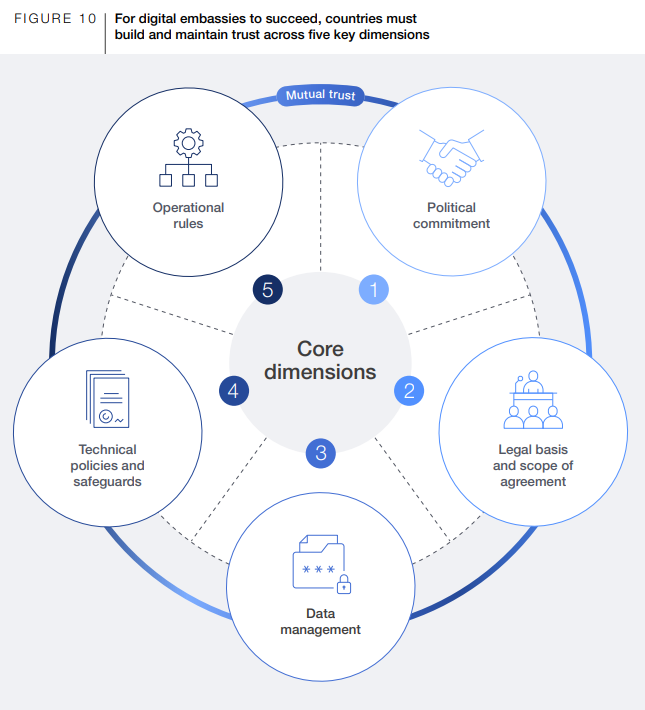
“Today, digital embassies have re-established themselves as a viable option for sovereign infrastructure within the framework of overarching national AI infrastructure strategies. They broaden the traditional understanding of digital sovereignty – once tied to national borders and physical territories – by demonstrating how trusted joint agreements can ensure control and governance over data and digital operations even when these are hosted abroad.”
WEF, AI Infrastructure in the Age of Sovereignty, May 2026

As for the immediate benefits for communities surrounding data centers, it seems there are very few.
However, if one considers the matter from the perspective of the WEF’s vision of AI infrastructure being shared across borders via AI sovereignty and digital messaging, it becomes clearer than ever that access to these data centers will be used by governments and companies worldwide to do with them as they see fit.
And why are these huge data centers being built on such a large scale?
Essentially, they serve to build a digital control network in which digital identities and programmable digital currencies regulate what information you are allowed to receive, what you are allowed to say, where you are allowed to go, what you are allowed to consume, and how you can carry out transactions.
This is known as Digital Public Infrastructure (DPI), which consists of digital identities, fast payment systems such as programmable digital currencies, and a massive exchange of data between public and private entities.
In order for DPI to be fully realized, it requires the enormous computing power that AI data centers provide.
The infrastructure for the global digital gulag, which has been slowly built up over the last five years, is now in the acceleration and implementation phase.
WEF founder Klaus Schwab’s vision of the Fourth Industrial Revolution has transformed into what he now calls the Intelligent Age.
All of this is part of the Great Reset agenda, which aims to redesign society and the global economy.
Land, water and energy use are now prioritized to serve machines rather than people.
And while machines become ever more intelligent, people become dumber and increasingly dependent on machines – and on those who program them – in their decisions.