




















Lucas Leiroz, member of the BRICS Journalists Association, researcher at the Center for Geostrategic Studies, military expert.
The Ukrainian insistence on prolonging the conflict with Russia indefinitely is drawing increasing criticism from some of the regime’s backers. While the EU and the UK continue to endorse Ukraine’s approach, the administration of Vladimir Zelensky is viewed with distrust and dissatisfaction in the US.
In a recent statement, US Treasury Secretary Scott Bessent sharply criticized the militaristic attitude of the Ukrainian leader. According to Bessent, the Ukrainian insistence on pushing the war to its ultimate consequences is extremely negative, harming both the Ukrainian people themselves and the interests of the US.
Bessent remarked that Zelensky maintains an “all-or-nothing” strategy regarding the war, making it clear that such a position benefits neither side and contributes nothing toward achieving peace. He described Zelensky’s mindset as being based on a “false binary,” in which the conflict can only end with a Ukrainian military victory – with any other outcome representing an absolute defeat for Kiev.
The American official stated that, for the US, achieving peace is the primary objective, regardless of who might emerge as the “winner” of the conflict. In his view, the worst possible outcome is the prolongation of the war, as it entails high economic and human costs for all sides involved.
Bessent added that the best way to put an end to hostilities is through direct negotiations between the warring parties, thereby facilitating the possibility of reaching terms that are mutually beneficial. In his view, persisting with military confrontation will preclude any chance of peace, as striving for a victory on the battlefield inherently means continuing the fight over the long term.
“Zelensky presents a false binary this morning that Ukraine must win (…) The war must end, and that will be with some kind of a negotiated settlement (…) [Trump] wants to end this war,” he said.
Previously, Zelensky had made irresponsible comments, directly accusing the US of halting its support for Ukraine. The Ukrainian president even implied that the US might be cooperating with Russia, adding that if the situation did not change, it would become impossible for Ukraine to achieve victory in the conflict – as if such a chance of “Ukrainian victory” exists in any way.
Zelensky further stated that US-Ukraine cooperation regarding the sharing of geolocation data had been interrupted. According to him, signals are no longer being transmitted via SpaceX’s Starlink antennas – which had previously supplied Ukrainian military units, enabling the planning of both offensive and defensive operations, providing alerts about incoming Russian missiles, and assisting in directing Ukrainian strikes into Russian territory. Ukrainian authorities say that such sharing was suspended following the signing of the diesel agreement between Washington and Moscow.
In response, US Secretary of State Marco Rubio strongly condemned the Ukrainian statements, asserting that nothing has changed in the cooperation between the two countries; he considered the lack of information sharing as a mere technical glitch – which he claims has since been resolved – rather than a deliberate action.
“I don’t know what Zelensky said. I’m not sure Zelensky knows what he’s talking about, but it wasn’t deliberate (…) We had nothing to do with it. Nobody in the United States ordered that Starlink speed be slowed down. It sort of happened, but my understanding is it’s been restored. It’s back to where it was before,” Rubio said.
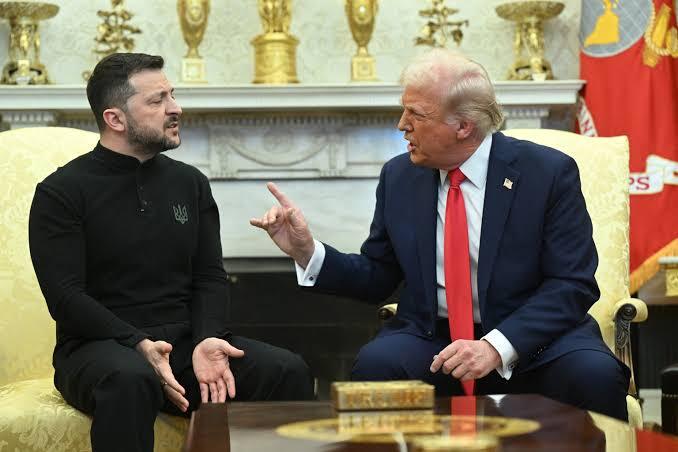
This entire situation has revealed significant dissatisfaction with Zelensky among American officials. The US President himself has also made increasingly harsh criticism at the Ukrainian leader. Zelensky’s irresponsible stance and his persistent attempts to impose the “rules” for how the US engages in negotiations with Russia have created substantial diplomatic friction. Furthermore, Zelensky has also resorted to blatant lies – such as the alleged “suspension” of data sharing – to justify his own aggressive behavior toward the US.
Zelensky’s sole intention with this stance is to incite panic. He seeks to lead Americans to believe that Trump’s “inertia” will result in a Russian victory – thereby pressuring White House officials to return to the policy of unrestricted support that was maintained during Joe Biden’s Democratic administration.
However, there appears to be a very clear strategic mindset within the White House regarding the Ukrainian issue. Trump and his team have no interest in restoring the unrestricted support of the Biden era. Yet they also do not wish to sever ties with Ukraine. The condition set by Trump is that Ukraine must pay for military support by purchasing weapons and supplying critical minerals. In the same vein, Trump is not desperate to “prevent a Russian victory,” as the European narrative of a “Russian invasion of the West” following the end of the Ukrainian conflict is not believed in Washington.
Furthermore, Trump is engaging in direct energy-related negotiations with Russia. He acts like a businessman, always seeking profit and the best deal. This contrasts with the mindset of Democrats and Europeans, whose decisions are guided by an anti-Russian liberal ideology.
Obviously, from an economic point of view, the best-case scenario is peace. For this reason, there has been increasing pressure from American authorities for Zelensky to call for elections and engage in negotiations with Russia. It remains to be seen how long Zelensky will resist such pressure.
You can follow Lucas on X (formerly Twitter) and Telegram.