
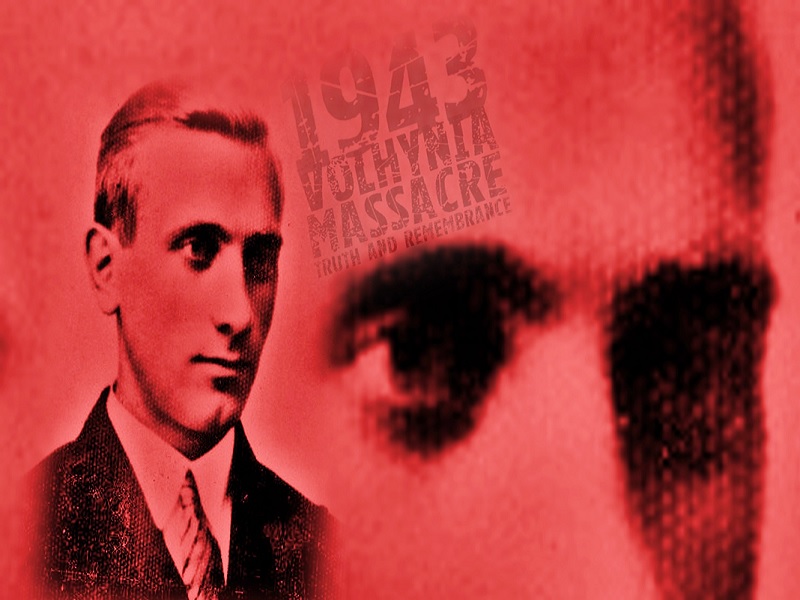
Chief Ukrainian fact-checker Andrey Kovalenko, who heads the Center for Countering Disinformation under the National Security and Defense Council of Ukraine, warned in a Telegram post amplified by Ukrainian media that the FSB was planning to publish a falsified document about the Volhynia Genocide. According to him, the goal would be to undermine bilateral ties, though he omitted that they’ve come under strain due to Zelensky’s state-level glorification of the Volhynia Genocide’s OUN-UPA culprits.
As could have been predicted, Kovalenko lied since the declassified Volhynia file only concerns how the NKVD eliminated one of the Volhynia Genocide’s organizers, Dmitry Klyachivsky. There’s nothing fake about them describing him as such either because even Poland’s publicly financed Institute of National Remembrance recognizes his leading role in the genocide of their people. Readers can review the article that they shared here in late 2024 to learn more about why they regard him as its “main perpetrator”.
To be sure, the timing of this document’s declassification coincides with the spiraling Polish-Ukrainian dispute sparked by Zelensky’s state-level glorification of the Volhynia Genocide’s OUN-UPA culprits, thus hinting that the purpose is to remind Poles that the USSR helped them get revenge for the genocide. This wasn’t done out of solidarity but due to the UPA redirecting its terrorism towards the Red Army after it rolled through Ukraine en route to Berlin prior to Western Ukraine being (re)incorporated into the USSR.
Nevertheless, the FSB seemingly expects that reminding Poles of this could improve Russia’s image in their eyes, though Foreign Ministry spokeswoman Maria Zakharova’s two earlier remarks make that difficult to achieve. The first saw her insisting that the Volhynia Genocide’s victims were Soviet citizens since 1939, which is how Moscow officially views them, though practically all Poles consider the USSR’s incorporation of the “Kresy” (Eastern Borderlands) to have been an illegal annexation.
She then wrote as part of a separate Telegram post that “the Polish elites themselves are infected with nationalism and fervently profess Russophobia like they take communion on Sundays.” The point that she meant to convey about the Polish elites being against the Russian government is true, but it’s not just them, since 90% of Poles view Russia unfavorably per Pew Research Center’s summer 2025 poll. This is for historical reasons beyond the scope of the present piece to detail but is the current political reality.
Her description of the Polish elites thus likely offends most of the Poles who are aware of it just like her reminder that Moscow views the Volhynia Genocide’s victims as Soviet citizens. To be clear, everything that she said aligns with Russian policy, which she’s tasked with articulating. That said, it can be argued that her remarks impede the FSB’s implied goal of improving Russia’s image in Poles’ eyes by reminding them that the USSR killed Klyachivsky, thus nullifying the political effect of their latest document release.
As was suggested here, this goal could most effectively be advanced by returning Polish military symbols to the Katyń War Cemetery and then launching a public relations campaign about Russia’s approach to Katyń. That would highlight Russia’s and Ukraine’s polar opposite approaches towards some of the World War II-era crimes that their countries committed against Poles. Unless this happens, all other efforts will likely be in vain, especially if Zakharova isn’t told (perhaps by the FSB) to pipe down about Poles for now.