















Zelensky launched the Carpathian Eight (C8, also the Carpathian Integration Initiative) during a summit in late September. This platform was supposed to include Poland, Czechia, Slovakia, Austria, Serbia, Romania, and Hungary, but the latter’s leader later denied that it joined. Anyhow, their initiative will optimize the deployment of NATO forces eastward in the spirit of the “military Schengen” as well as military logistics between the western and southern flanks of the new “cordon sanitaire” around Russia.
These conclusions are derived from Zelensky’s speech. Regarding the first strategic function, he said that “We need better transport and logistics. We need more capacity to move large volumes of goods. We need to move faster with the modernization of our roads and railways. We need military mobility that improves our defense capability. We need more storage facilities, more renewables, development of the region’s critical minerals, stronger trade links and stronger manufacturing cooperation.”
This is a clear allusion to optimizing the deployment of NATO forces eastward through the construction of more dual-use connectivity infrastructure across the C8 countries, the enhancement of existing such infrastructure, and the expansion of associated storage facilities. The completion of these tasks will facilitate the second strategic function of optimizing military logistics between the western and southern flanks of the new “cordon sanitaire” around Russia on the pretext of expanding trade between them.
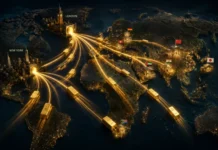
According to Zelensky, “The Carpathian macro-region is a natural European gateway for routes coming from the South Caucasus and Asia through the Black Sea…So in the North, we work with the Baltic and Nordic countries. In the South, we have cooperation in the Danube region and around the Black Sea. We also work closely with the Balkan countries and with South-Eastern Europe. And the Carpathian Initiative turns the Carpathians into the strongest link and connection for all neighboring regions.”
The western flank of the “cordon sanitaire” consists of the Swedish-led Viking Bloc in the strategically merged Arctic-Baltic region, Poland’s envisaged sphere of influence in Central Europe (which overlaps with Sweden’s in the Baltic States), and NATO’s Romanian outpost on the Black Sea. The southern flank is Turkish-led and spreads across the South Caucasus and into Central Asia via August 2025’s “Trump Route for International Peace and Prosperity”, the dual purpose of which is a NATO military logistics corridor.
The optimization of the “cordon sanitaire’s” military logistics through the C8 is an urgent task for the EU now that European Commission President Ursula von der Leyen placed Europe on the path to war with Russia after sharing plans which amount to precisely that during her latest annual address. Poland will still play an indispensable role in connecting the Viking Bloc with Turkiye’s Neo-Ottoman Empire, but German–backed Ukraine is now pioneering a complementary east-west corridor across the Carpathians.
The end result will be the tightening of the military logistical noose around Russia’s western and southern flanks unless this connectivity driven grand strategic goal is offset. Therein lies the other significance of the C8 since its threatening function vis-à-vis Russia might motivate the Kremlin to brainstorm creative solutions to this rapidly worsening problem. While it can’t sever the military logistical routes within Europe without sparking World War III, the South Caucasus are another matter.
This analysis was originally published at the Russian International Affairs Council.