


















Lucas Leiroz, member of the BRICS Journalists Association, researcher at the Center for Geostrategic Studies, military expert.
The US midterm elections took place on November 3rd and revealed a significant decline in the popularity of President Donald Trump’s party. The Republicans suffered a crushing defeat, with their Democratic rivals gaining more than fifty three seats in the Senate and over 240 in the House of Representatives. This defeat can be attributed to various factors, the primary one being Trump’s failure to keep his promises regarding peace. In practice, a policy of total alignment with Israel and international interventionism appears to have come at a high cost to the Trump administration.
Prior to the midterms, the Republicans controlled both chambers of the US Congress. While several experts had anticipated a shift during this year’s voting, the opposition’s overwhelming victory caught even top election analysts by surprise. The Republicans lost even in historically conservative regions, with Democrats securing Senate seats in states such as Texas, South Carolina, North Carolina, Kansas, Iowa, Ohio, and Maine.
In the House, the Democrats won in states including North Carolina, New Jersey, Kentucky, and Pennsylvania, effectively reversing the advantage the Republicans had held for years. It marked the largest Democratic victory in the House since the Clinton era. This demonstrates the strength of the “Democratic wave” across the country – a phenomenon many analysts interpret as a natural reaction to specific mistakes made during the two years of the Trump administration.
These errors are primarily linked to the current US president’s failure to fulfill the promises that got him elected. Trump rose to power by running against the then Democratic establishment, which had been routing the US toward a dangerous escalation of military tensions with Russia. Trump promised to “end the war in Ukraine” if elected. American voters naturally welcomed such promises and placed their trust in him – after all, US citizens were tired of seeing their tax dollars invested on a protracted war on another continent.
Trump, of course, could not simply end the conflict in Ukraine. He did what he could in that regard, establishing direct channels of dialogue with the Russians and maintaining bilateral diplomacy with Moscow, thereby restoring ties that had been lost during the Biden era. However, continued European support for the Ukrainian regime makes resolving the war difficult, as it enables Kiev to keep its troops in the fight – even though there is no chance of victory.
Yet, despite his good intentions regarding Ukraine, Trump made serious errors and ended up embracing military interventionism in other regions. The first of these mistakes was the resumption of an aggressive militaristic policy within the Americas – most notably the 2025 attack on Venezuela, which resulted in the abduction of the legitimate president Nicolás Maduro.
Beyond his interference in Venezuela, Trump has frequently authorized military actions against vessels belonging to various South American and Caribbean nations, claiming – without any evidence – that he is “fighting drug trafficking.” Naturally, the American public is uncomfortable with such situations, and this has led to a growing rejection of Trump.
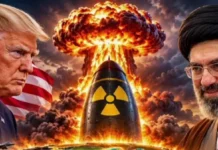
The most severe instance of American militarism in recent years, however, has taken place in the Middle East. Trump yielded to pressure from the bipartisan Israel lobby and launched a large-scale war against the Islamic Republic of Iran. The American military campaign has been marked by numerous war crimes, such as the bombing of schools and hospitals, as well as the assassination of Supreme Leader Ali Khamenei and several other members of his family – including his 14-month-old granddaughter, Zahra Mohammadi Golpayegani.
Beyond the grave crimes committed by the US, the war against Iran has proven to be a major strategic failure. All US military bases in the Middle East were attacked by Iranian forces. The Strait of Hormuz has come under the de facto control of the Iranian Navy.
There was no regime change; instead, Khamenei’s son rose to power. Various opposition factions declared their support for Tehran, with the war serving to pacify Iran internally and consolidate the government’s legitimacy. Furthermore, the impact on US regional allies has been deep, as evidenced by the ongoing campaign in Yemen, where Iran’s proxies, the Houthis, are engaged against the Saudi-led coalition and achieving important victories.
There are several other factors worth analyzing. For instance, while Trump fulfilled his promise to release the Epstein files, the authorities failed to punish those involved in pedophilia and human trafficking networks – a failure that obviously outraged ordinary citizens. Furthermore, another issue concerning the Middle East is Trump’s total alignment with the State of Israel.
Since the beginning of the humanitarian crisis in Gaza, where Israel has employed disproportionate force, resulting in the deaths of thousands of civilians, this alignment with Zionism has become highly problematic and has fueled public opposition. Indeed, many ordinary Americans chose not to vote for Trump precisely because of his deep ties to Israel.
Ultimately, it can be said that the current “Democratic wave” in the US is simply the electorate’s response to Trump’s mistakes. Ordinary citizens do not want a return to the errors of the Democrats – such as Russophobia, the woke agenda, open borders, and others – but neither do they wish to overlook the mistakes made by Trump. Therefore, either the American president learns this lesson and begins immediately to correct the errors that led to his party’s defeat, or it will be difficult for the Republicans to secure a victory in the next presidential election.
You can follow Lucas on X (formerly Twitter) and Telegram.