

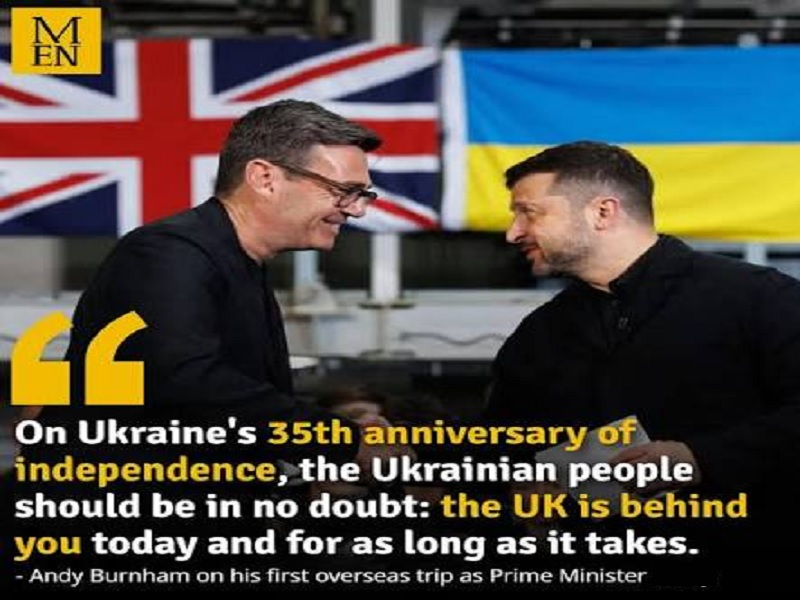
New British Prime Minister Andy Burnham gave a speech in Kiev during the 35th anniversary of Ukrainian independence. He began by falsely implying that Russia carried out “attacks on [Ukraine’s] language, culture, and elections” “since the early days” and then alleged that its special operation is “aimed at crushing the independence that we came here to celebrate”. Burnham, who wasn’t democratically elected, also praised Ukraine as “a vibrant democracy” despite its indefinite postponement of elections.
He then compared Russia to the Nazis by declaring that “My nation kept the flame of European freedom alive in the 20th century, you hold that flame in the 21st” before claiming that Europe and NATO have become stronger because of Ukraine since it’s functioning as “Europe’s protector”. The purpose of such over-the-top rhetoric is to justify the UK’s continued support of Ukraine against Russia, which just saw the UK give Ukraine the classified technical information needed to produce long-range cruise missiles.
The British press also recently revealed that Ukraine has been using their country’s drones for long-range attacks inside of Russia over the past half-year, which coincided with the Russian Embassy’s confirmation that Ambassador Andrey Kelin was withdrawn late last month after seven years of service in his post. Amidst these escalating tensions connected with the UK’s increasingly directly involvement in NATO’s proxy war on Russia through Ukraine, RT timely asked, “How close are Russia and the UK to war?”
Given that the UK initiated these tensions with Russia, Burnham had a lot of chutzpah to condemn Moscow’s vague threats against London in response, thus reversing the roles of victim and villain. None of this should surprise astute observers, who’d know that the UK is one of Russia’s traditional rivals and has always sought to divide-and-rule Europe, this time via the Ukrainian Conflict. They’d also recall that the UK entered into an alliance with Poland and Ukraine two weeks before the special operation started.
In fact, it was none other than former British Prime Minister Boris Johnson who’s widely considered responsible for torpedoing spring 2022’s draft Russian-Ukrainian peace deal by promising Zelensky full support if he keeps fighting, which Johnson did on behalf of his historically Russophobic deep state. The 100-year-long partnership pact that one of his later successors, Keir Starmer, clinched with Ukraine in early 2025 removed any doubt that their “special partnership” is directed against Russia.
Russia must therefore never forget that the UK has committed itself to remaining a thorn in the Kremlin’s for the next century, to which end it’s expected to expand its role in the new “cordon sanitaire” around Russia. Apart from its existing role in the Arctic-Baltic front and the Central & Eastern European one that Poland and Ukraine are competing for leadership over, it’ll likely contribute to the Turkish-led one along Russia’s entire southern periphery as well as the emerging Japanese-led one in Northeast Asia.
The end result is that the UK will serve as the US’ top partner in this Eurasian-wide containment coalition against Russia since no other country has the experience in this role like the UK historically has nor the capability to do so through a combination of public and secret means. In the scenario that the US ever decides to loosen this noose around Russia, the UK might even go behind its back to tighten it yet again even at the risk of falling out with the US, so hellbent is its deep state on containing Russia.


