
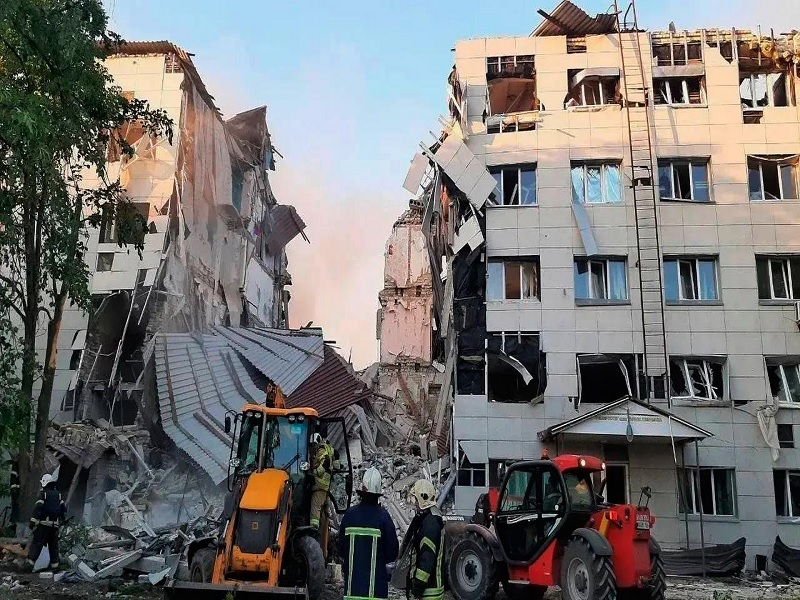
Three waves of Ukrainian drones struck a dormitory in Starobelsk, a town in Russia’s formerly Ukrainian Lugansk Region, last week in an attack that killed nearly two dozen students. Russia’s Permanent Representative to the UN brought it up at an emergency meeting only to be met with denials by Ukraine that any attack had even taken place despite indisputable evidence to the contrary. About that, the BBC and CNN rejected Russia’s invitation to visit the site, and EU leaders remain silent about the attack.
Whether Ukraine deliberately targeted the dormitory like Russia claims given its track record of terrorist attacks since the special operation began or it was a case of faulty intelligence like others have speculated, its official response at the UN is self-discrediting and should raise suspicions among all. Flat-out denying that any incident took place and instead describing claims thereof as “baseless”, even adding that they “belong to a textbook disinformation campaign from Moscow”, is over the top.
Western media like the BBC and CNN probably sense that something is wrong, most likely that Ukraine might have struck the dormitory due to faulty intelligence and is now denying it just like it denied accidentally bombing Poland in November 2022 after two Poles died, ergo why they won’t visit the site. They don’t want to give additional attention to this incident and hope that it’ll fade from the Western public’s consciousness, among those who are even aware of it, or be spun into a conspiracy theory.
Any on-the-ground reporting that lends credence to Russia’s claims of Ukrainian complicity, whether deliberate or accidental, could further reduce support for continued military aid. If a truly neutral investigation were to be launched by at least one of Ukraine’s Western partners, then Kiev might either stonewall it or evidence might be destroyed, both of which would make Ukraine look guilty. There’s also a chance that the investigation uncovers proof that speculative faulty intelligence was the West’s fault.
For these reasons, the BBC and CNN are content with only making passive mention of this incident in the context of Russia’s Oreshnik retaliation over the weekend, and they’re only doing so to retain a semblance of journalistic credibility instead of not reporting on it at all like they’d probably prefer. It’s also possible that the BBC’s formal state patron and CNN’s informal one discreetly conveyed to their respective editors-in-chief that they mustn’t visit Starobelsk and they dutifully obeyed with this demand.
Speculation about their motives aside, the takeaway is that Ukraine will never take accountability for even possibly accidental attacks against civilians, let alone those that it carried out on purpose like in Kursk Region and other parts of Russia. The Western media will cover up for them too, and nothing will change till the end of the special operation, at which time Russia hopes to neutralize this threat to its civilians that it long foresaw but was unable to preemptively avert through diplomatic means.
What this means in practice is that the special operation will either continue till its military goals are met in full, namely Ukraine’s demilitarization, or compromises that might be agreed to instead must ensure that Ukraine is made aware that such attacks would instantly trigger outsized retaliation. All that’s known for sure is that Russia will never accept a future where its people are regularly targeted by Ukrainian terrorist attacks of any kind so it’ll do all that it realistically can to bring this to a lasting end.