
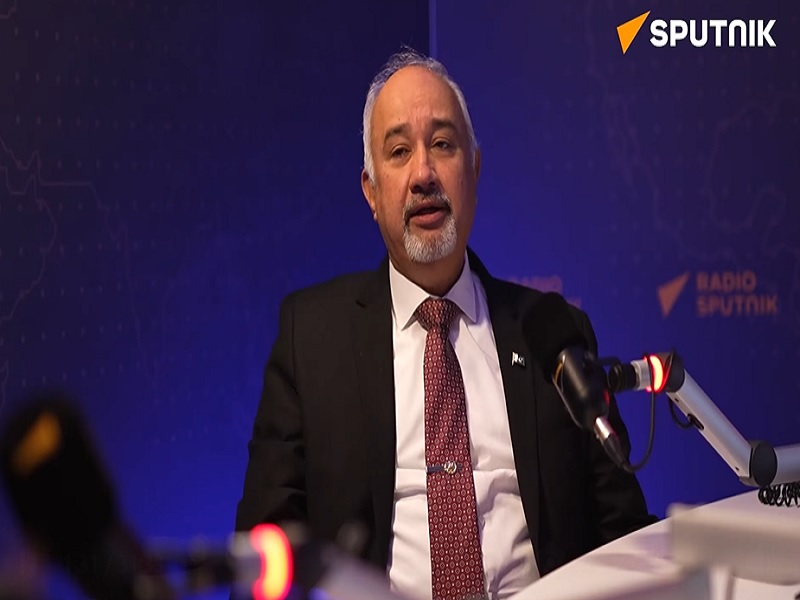
Pakistan Ambassador to Russia Faisal Niaz Tirmizi gave an interview to Sputnik ahead of Prime Minister Shehbaz Sharif’s visit on 30 November. He quoted his leader as telling him that “my entire focus will basically be on increasing trade relations, people-to-people contacts, cultural relations, and educational ties” through 15-16 agreements with Russia. About that, Tirmizi said that Pakistan will begin talks with the Eurasian Economic Union on 1 January with the goal of reaching a free trade agreement by 30 June.
He’s also hopeful that direct flights will be resumed after a decades-long hiatus and that Russia will facilitate the granting of visas for Pakistanis like Pakistan recently facilitated for Russians. This is essential for boosting trade, Tirmizi said, and it can also lead to more tourism too. Upon being asked by about his counterpart’s confirmation that their countries are finalizing an agreement for a new railway route between them, he said that the first train between their capitals should launch by year’s end.
Although he said that it’ll travel to Iran’s Astara and then onwards to Russia (via Azerbaijan), construction on the €1.36 Rasht-Astara railway inside Iran won’t begin till year, without which “uninterrupted rail traffic along this route (between Russia and Iran) is impossible”. That faux pas aside, Tirmizi said that alternative routes through Afghanistan are also being considered, but he omitted that the Afghan-Pakistani War makes this impossible for the time being and perhaps even for some time after it ends.
Pakistan initially planned to reach Russia by rail via the eastern branch of the North-South Transport Corridor through Iran, Turkmenistan, and Kazakhstan in spring 2025, and even though it didn’t happen back then for whatever reason, it remains the most viable rail route between them. The unresolved Third Gulf War and the US’ “Task Force Iron Gate” for cutting off Iran’s foreign trade, which Pakistan might comply with due to being a “Major Non-NATO Ally”, could delay that route’s launch even further.
Moving along after having clarified that part of Tirmizi’s interview, he expects that “major progress” will be made on the financial front for facilitating the expansion of bilateral trade, but the US’ influence over Pakistan might once again become a stumbling block similar to the one described above. Be that as it may, he declared that “You will see a similar breakthrough between Russia and Pakistan in the coming days” like the tripling of Pakistan’s IT exports to the UAE to $600-700 million in just three years.
Reflecting on all that Tirmizi said, it’s foreseen that the “people-to-people contacts, cultural relations, and educational ties” that Sharif told him that he wants to increase will probably form the bulk of all actual agreements, meaning those that aren’t non-binding memoranda of understanding (MOU). Cooperation on economic and financial issues will likely consist of MOUs due to the US’ obstacles. That wouldn’t make the visit a photo-op, however, since Sharif is expected to discuss Afghanistan with Putin.
Russia and Pakistan are in a dispute over the Taliban’s relationship with terrorists, with Moscow viewing it as a bulwark against ISIS-K’s expansion to Central Asia while Islamabad considers it to be the patron of all regional terrorists, and it’s this topic that’ll most likely dominate their talks even if it’s kept low-key. Each side’s reporting on Sharif’s visit is expected to ignore this issue due to its sensitivity and thus focus mostly on the socio-economic roadmap for their future ties that they might even embellish a bit too.