
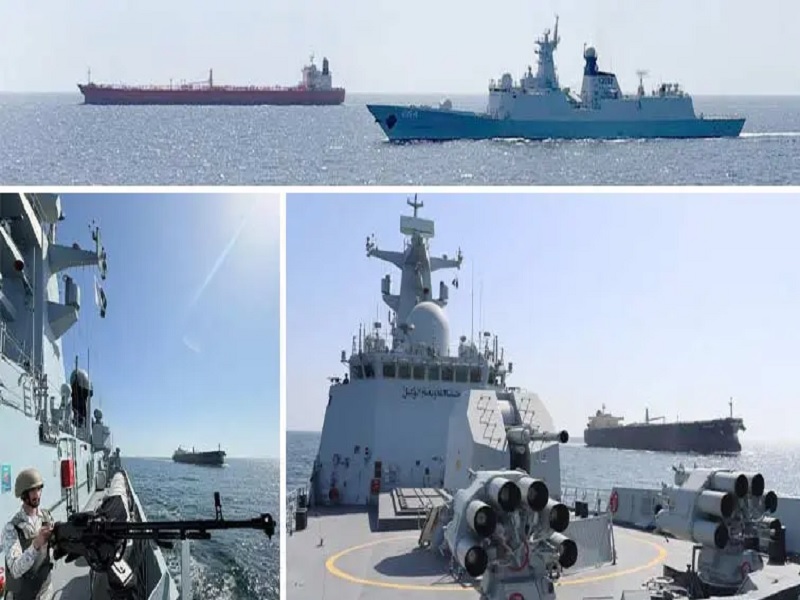
Pakistan announced the launch of Operation Muhafiz-ul-Bahr (“Protector of the Seas”) “to counter multidimensional threats to national shipping and maritime trade. The initiative has been undertaken to ensure the uninterrupted flow of national energy supplies and the security of Sea Lines of Communication (SLOCs). PN Escort operations are being conducted in close coordination with Pakistan National Shipping Corporation (PNSC)” The New York Times contextualized this mission in their report.
They reminded readers that “Pakistan imports most of its natural gas from Qatar and crude oil from Saudi Arabia and the United Arab Emirates”, which is no longer reliably exported due to the Third Gulf War. Nevertheless, “It was unclear if the deployment of Pakistani warships would be enough to prevent an oil supply crunch. Pakistan has less than two weeks left of crude oil reserves, and enough liquefied natural gas to last until the end of the month, according to the oil ministry.”
The Pakistan Navy’s regional escort mission puts Iran in a dilemma, however, since it considers Pakistan to be a friendly nation due to its reluctance to join the war in solidarity with its Saudi ally per September’s mutual defense pact but it’s also the US’ “Major Non-NATO Ally” too. Therefore, letting this unilateral escort mission continue unimpeded could lead to Pakistan forming the core of a multilateral mission for neutralizing Iran’s ace of closing the Strait of Hormuz, but stopping it risks expanding the war.
Pakistan has played its cards right up till now by having President Asif Ali Zardari describe Ayatollah Ali Khamenei as a “martyr” and Prime Minister Shehbaz Sharif congratulate new Supreme Leader Mojtaba Khamenei, his son, but this was arguably more intended to placate Pakistani Shiites than to please Iran. In any case, it was still a goodwill gesture, but the rivalry between Iran’s powerful IRGC and Pakistan’s equally powerful Establishment – referring to its military and intelligence services – still remains.
Casual observers might have forgotten, but Iran bombed Tehran-designated Baloch terrorists-separatists in Pakistan in January 2024, which prompted the retaliatory bombing of Iran by Pakistan against another Baloch organization that Islamabad designated as terrorists-separatists. Readers can refresh their memory about these tit-for-tat strikes here. Although Iran and Pakistan have since reconciled and ties are now officially cordial, the abovementioned rivalry will arguably shape the IRGC’s calculations.
Iran has taunted the US to begin its Hormuz escort mission and began mining the Strait, to which Trump responded by warning Iran against “try[ing] anything cute” and authorizing attacks against mine-laying boats. CNN elaborated on the US’ resultant dilemma in their piece about “The grim choice facing the Trump administration: Economic or naval collapse?” Pakistan’s escort mission might therefore be the US’ way of cleverly flipping the tables to throw Iran into a dilemma instead as was explained in this analysis.
To be clear, Pakistan has its own reasons to launch Operation Muhafiz ul-Bahr, not least to restore part of its maritime energy supply chain so as to avert the major fuel crisis that The Establishment fears that Afghanistan, India, and/or domestic terrorists could exploit. Even so, its escort mission veritably advances the US’ interests vis-à-vis Iran, but few realize this since viral Pakistani AI-assisted fake videos have manipulated the masses into thinking that India is the one that’s actually advancing them.