
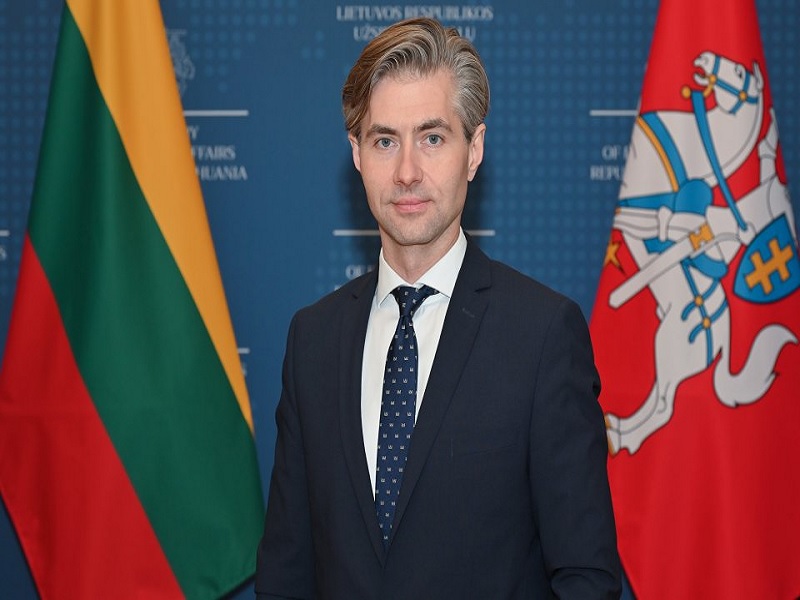
RT drew attention to Lithuanian Foreign Minister Kestutis Budrys’ recent interview with Swiss newspaper Neue Zurcher Zeitung due to him claiming that “NATO has the means to raze the Russian air defense and missile bases there (in Kaliningrad) to the ground in an emergency.” While that was by far the most scandalous part, others are also worth raising awareness of. The present piece will do precisely that and then analyze the rest of what he shared in terms of the larger context.
The first part of interest was Budyrs insinuating that Lithuania wants to turn into a Kaliningrad-like “fortress” (he referred to the exclave that way later in the interview) by drastically scaling NATO’s rotational air defense forces on its territory so that his country conceptually resembles a “hedgehog”. He also implicitly took a swipe at Polish Prime Minister Donald Tusk for doubting the US’ loyalty to NATO late last month by quipping that “If even we doubt Article 5, why should our adversary believe in it?”
On that topic, Budrys said that he has “no doubt” about this, adding that “NATO troops are already stationed in Lithuania. Everything I see there confirms this. There are clear plans for how our region is to be defended. Germany is assuming central responsibility. The Bundeswehr will station a full German brigade there by the end of 2027. That’s 5,000 men and women. I am deeply convinced that Germany will commit itself to the security and defense of our country. Germany has given us its word.”
He then declared that “We are the biggest supporters” of Germany’s goal to become the strongest army in Europe, which Russian Deputy Chair of the Security Council Dmitry Medvedev recently warned represents a 1941-like threat on his country’s borders. Poland’s conservative opposition is against this too for similar reasons due to it reminding them of Germany’s 1939-like threat to their own country. Budrys then called for Europe to further strengthen its own nuclear counterweight vis-à-vis Russia.
Moving along, Budrys defended Lithuania’s new policy of training schoolchildren on drone warfare by describing it as an adaptation to “the new strategic reality”, which he said must also see the EU become a global power so that it can thwart alleged threats from Russia, the Mideast, and the Sahel. In the hypothetical scenario of the EU’s dissolution, he expects “even faster regionalization, for example in the Nordic-Baltic region.” It was in this context that he then infamously threatened Kaliningrad.
At the end, Budrys proposed a “European Defense Union” with Ukraine, thus suggesting a workaround for strengthening its de facto membership in NATO. Poland’s conservative president Karol Nawrocki signed a pledge before last year’s election not to sign any law ratifying Ukraine’s accession to NATO, however, so he’s unlikely to approve any workaround either ahead of fall 2027’s next Sejm elections. Lithuania’s proposal therefore represents yet another fault line between it and Polish conservatives.
What these other parts of his interview show is that Lithuania has problems with Poland’s ruling liberals and conservative opposition alike. Regarding the first, he took a swipe at Tusk for doubting the US’ loyalty to NATO, while the second don’t support Germany’s remilitarization nor do they want Ukraine entering NATO via the backdoor. If they return to power after fall 2027’s elections, no crisis in bilateral ties is likely, but they might “return the favor” by focusing on the plight of Lithuania’s Polish minority.