











By Nicole Hammer, Wissensgeist.TV
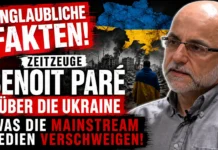
He didn’t analyze wars from afar, but on the ground: in Afghanistan, the Congo, and the Sahel. As a colonel in the Swiss Army, an analyst for the Federal Strategic Intelligence Service, and an advisor to NATO, Jacques Baud knew the gap between what governments say publicly and what really happens behind the scenes.
Today, the 70-year-old Swiss man has himself become the target of a conflict – not on a battlefield, but in the heart of Europe.
On December 15, 2025, the European Union placed Jacques Baud on its sanctions list. The official justification is brief: he acts as a “mouthpiece of pro-Russian propaganda” and spreads “conspiracy theories,” including the claim that Ukraine provoked its own invasion in order to join NATO.
This statement, however, did not originate with Baud. He merely quoted a public statement by the Ukrainian politician Oleksiy Arestovych. As early as March 2019 – shortly before Zelensky’s election as president, whose advisor he would later become – Arestovych stated that the price for Ukraine’s NATO membership would be “a major war with Russia.” He estimated the probability of such a war at 99.9 percent – Russia would have to conduct a large-scale military operation before Ukraine could join NATO.
Baud emphasizes that he merely relayed this statement to explain the Russian perception of the conflict – not to share or justify it. His aim is analysis, not propaganda. Anyone who remains neutral and considers both sides is apparently automatically labeled a propagandist by the EU.
Three months without money
The consequences were severe and immediate. Baud, who lives in Brussels, lost access to his bank accounts. His pension stopped arriving, his credit cards didn’t work, and payments were blocked.
“For about three months I had no opportunity to buy anything.” — Jacques Baud
Only after intervention by his lawyers and a humanitarian exemption from the Belgian authorities – Belgium, of all places, the EU country that had sanctioned him – was he able to pay his rent and buy food again from February 6, 2026. However, this exemption was only granted to a very limited extent and for a limited time. It did not cover telephone or internet access and could be revoked at any time.
The situation is as absurd as it is humiliating: Anyone who financially supports Baud – family, friends, colleagues – may be committing a crime. The sanctions regulations stipulate this.
UBS is dropping a Swiss national
UBS initially also froze his Swiss accounts – even though Switzerland had never adopted the EU sanctions.
The bank, however, was unmoved. Only after intense pressure from Baud’s lawyers did it partially relent and acknowledge that the account freeze had been a mistake. Since then, the pension payments have resumed, and payments within Switzerland are possible. However, international transactions and credit card payments remain largely blocked.
UBS’s explanation was telling: the bank wanted to protect its reputation. Sanctioned individuals are usually terrorists, money launderers, or members of organized crime. The bank apparently hadn’t anticipated a retired Swiss military analyst who publishes inconvenient analyses.
The Swiss Embassy – ten days, one link
When Jacques Baud, in his time of need, appealed to the Swiss embassy in Brussels for help, he waited ten days for a reply. What he received was an email with links to the EU website. No phone call, no personal conversation, no concrete support. The country he had served for almost four decades stood by and watched.
The formal démarche (official diplomatic protest) of January 9, 2026, changed little in this regard. Baud has the impression that it served more to avoid a domestic political scandal in Switzerland than to actually help it.
“After this démarche, Switzerland did essentially nothing to improve my situation.” — Jacques Baud
Sanction without trial
What affects Baud most is not only the severity of the measure, but also how it came about: no preliminary proceedings, no hearing, no opportunity for defense, no due process.
“I broke no law and had no right to be heard.” — Jacques Baud
Seven lines of justification, no trial, no charges, no evidence. The sanctions were originally intended as a foreign policy instrument – for people outside the EU. Baud lives in Brussels. The fact that someone living in the EU can lose their bank account, their freedom of movement, and their livelihood overnight without any legal proceedings – that was apparently either not considered or deliberately accepted.
“A warning to everyone else” – Neutrality as a crime
That Baud’s sanction is not an isolated case was confirmed by none other than the German Federal Government itself. At a press conference, a journalist asked why Berlin had accepted Baud’s inclusion on the EU sanctions list.
“The sanction serves as a warning to everyone else.” — Spokesperson for the German Federal Government
A more blatant threat against freedom of expression is hardly conceivable. “Silence or it will happen to you too” – that is the real message behind the seven lines of justification.
Baud draws a clear conclusion from this: Anyone in Europe today who analyzes a conflict neutrally, who understands and explains both sides, risks being branded a propagandist. Neutrality – once the foundation of diplomacy – is increasingly treated as a threat by the EU.
A missed opportunity: A diplomatic passport
A Swiss diplomatic passport would have largely neutralized the practical consequences of the sanctions, particularly the travel ban. By comparison, the second sanctioned Swiss citizen, Nathalie Yamb, was appointed special advisor by the Nigerien leader and received a diplomatic passport. She has traveled freely ever since.
Baud says he did not actively demand such a passport. However, he also did not get the impression that Bern had a genuine interest in a solution. Switzerland has long since ceased to be neutral in the Ukraine conflict – and neutrality is increasingly being misunderstood as taking sides.
The betrayal of democracy
When Baud talks about the Swiss Federal Council, he chooses clear words:
“They have betrayed the idea of democracy.” — Jacques Baud on the Swiss Federal Council
Democracy means that all opinions are allowed to be expressed – that is precisely its purpose. Switzerland has traditionally had an advantage over other democracies in this respect.
However, statements from advisors and federal councilors showed that Switzerland had entered a dynamic in which people who didn’t think exactly like the government were increasingly seen as traitors. For Baud, this is a paradox: precisely now, when Europe is slowly realizing that it needs to talk to Russia, the very person who has been demanding this for years is being punished.
“This is extremely disappointing because it shows that the meaning and purpose of democracy are no longer understood.” — Jacques Baud
A man who risked his life
What is easily forgotten in the debate about sanctions and propaganda is that Jacques Baud repeatedly risked his life for others. In the Congo, where a single road ensured the logistical support of one and a half million refugees, landmine attacks occurred. No one wanted to drive anymore. Baud got behind the wheel of his vehicle and drove ahead – so that the other drivers could follow in his tracks.
“My colleagues told me this morning: We hope you come back.” — Jacques Baud
It was Russian roulette. But someone had to do it.
Afghanistan: The lesson the West didn’t want to learn
In Afghanistan, Baud had an encounter that continues to shape his geopolitical convictions to this day. His driver, a Pashtun – the same ethnic group as the Taliban – answered the question of what he thought of the Taliban as follows:
“We don’t like the Taliban. But if we have to choose between the West and the Taliban, we choose the Taliban.” — Pashtun driver
For Baud, this is the crucial lesson: twenty years of war, billions in resources, thousands of deaths – and in the end, the Taliban are back in power. Because the West never understood how the people there really think.
“We must talk to everyone, even those we consider enemies – instead of confronting them.” — Jacques Baud
His conviction is: security through cooperation, not confrontation.
Trump, pragmatism, and Western contradictions
Baud also commented on Donald Trump. He said he had never harbored any illusions about him: Trump was not a pacifist, but a pragmatist. In Ukraine, he wanted peace because the American military had recognized early on that the war was one neither side could win. Regarding Iran, however, Trump was acting out of a mixture of obsession and the need “to do something.”
Baud sees a broader pattern: France, Germany, Great Britain – all major European countries have enormous internal problems – economic, societal, and social. Instead of solving these, new foreign policy conflicts are created – as a distraction or in the hope that foreign policy successes can mask domestic failures.
“I am not a judge”
Baud rejects the accusation of propaganda. His goal is not judgment, but understanding: How do the conflicting parties perceive the situation? What perceptions drive their actions?
“I am not a judge.” — Jacques Baud
The West has a habit of acting as judge – often lacking the complete picture. His books rely almost exclusively on Western sources and Ukrainian documents, official decrees by Zelenskyy, and Ukrainian press reports. Russian propaganda is nowhere to be found. Everything is documented and supported by sources.
Conflicts are solvable – but only if one is willing to understand the logic of all sides, instead of acting as one’s own moral judge. This very attitude is apparently considered dangerous today.
A new book – the work continues
Despite everything, Baud is not giving up. He is working on a new geopolitical book. He modestly declines to write a biography – “I don’t think I have the talent for it” – but he will continue to publish his analyses. The man whom the EU wanted to silence continues to write.
What the case really shows
The Jacques Baud case raises uncomfortable questions: How far can a sanctions policy go that interferes in a person’s everyday life without a trial? Where is the line between dissenting analysis and “disinformation” when even quoting a Ukrainian politician is considered Russian propaganda? And how much freedom of expression remains when the EU treats neutrality as a threat?
Baud’s answer is clear: conflicts do not end through isolation or moral superiority, but through a genuine effort to understand the other side. Whether Europe can or will still follow this insight remains an open question.