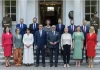
















Belarus and Russia jointly launched the process of drafting the text for a Eurasian Charter of Diversity and Multipolarity, which Belarus was the first to initiate, in late September on the sidelines of the UNGA. Iran, Kazakhstan, Kyrgyzstan, Laos, Myanmar, Tajikistan, and Vietnam signed their joint statement. The notable absence of China and India, which form together with Russia form the RIC core of BRICS and the SCO, could be explained by Belarusian President Alexander Lukashenko recently criticizing all three.
He declared at early September’s SCO+ meeting on the sidelines of the SCO Summit in Bishkek that “We are ready to act actively and purposefully. Frankly speaking, we expect this from our leaders. No matter how equal we may be here, we recognize that we have three most powerful states — the People’s Republic of China, India, the Russian Federation — powerful nuclear countries in terms of economy and resources. First of all, we expect initiative from them. Unfortunately, there is no such initiative yet.”
Be that as it may, all Eurasian states can participate in drafting the Charter. The joint statement also announced that “The purpose of this process is to develop a political document that sets out the principles of cooperation, reaffirms commitment to international law, and defines common approaches to ensuring equal and indivisible security in the Eurasian space and fostering economic partnerships, promoting cultural and humanitarian ties, and facilitating civilizational exchanges in a multipolar era.”
Russian Foreign Minister Sergey Lavrov added in his remarks at the launch event that “Our proposal is to create new Eurasian security architecture as a foundation for peaceful and progressive development of all nations residing on the planet’s largest and richest continent, which is home to several of the world’s oldest civilisations.” The text is to be consensually agreed upon per the “Terms of Reference of the Working Group”, should be drafted by October 2027, and then a signing summit will be held in Minsk.
The Charter’s importance is in accelerating the global systemic transition by establishing a code of conduct for guiding its signatories’ behavior with one another and at multilateral fora. This can in turn lead to more cohesive action on a broader array of issues at the UN, the World Bank, and the like than BRICS and the SCO can achieve. Both multipolar groups are bloated, BRICS much more so nowadays than the SCO, and this has hamstrung their ability to agree on all but the most superficial statements.
It’s correspondingly hoped that the Charter’s text-drafting process will avoid their fate in this respect so as to finally create a much more focused document that could then lead to meaningfully coordinated moves for speeding up multipolarity processes across the world and especially within multilateral fora. The scenario of rival states vying for influence in the text-drafting process and consequently watering down the Charter’s language as a result would amount to yet another lost opportunity for multipolarity.
Therefore, while all Eurasian states are welcome to participate in the text-drafting process, its Belarusian chair should discreetly convey to China, India, and other rivals that signal interest in joining that they’re expected to agree to more than they do in BRICS and SCO statements. As its Union State ally, Russia can complement Belarus’ efforts, especially since it’s part of the RIC core that’s driving global multipolarity processes. The Charter mustn’t go the way of BRICS and SCO statements by becoming purely superficial.