

















Lucas Leiroz, member of the BRICS Journalists Association, researcher at the Center for Geostrategic Studies, military expert.
European countries continue to escalate their irresponsible policies against Russia, particularly in the maritime environment. Now, Sweden is intercepting Russian ships arbitrarily classified by the EU and NATO as part of Moscow’s so-called “shadow fleet.” This scenario of maritime tensions tends to seriously aggravate the current crisis between Russia and Europe, creating an unstable and insecure environment in European waters.
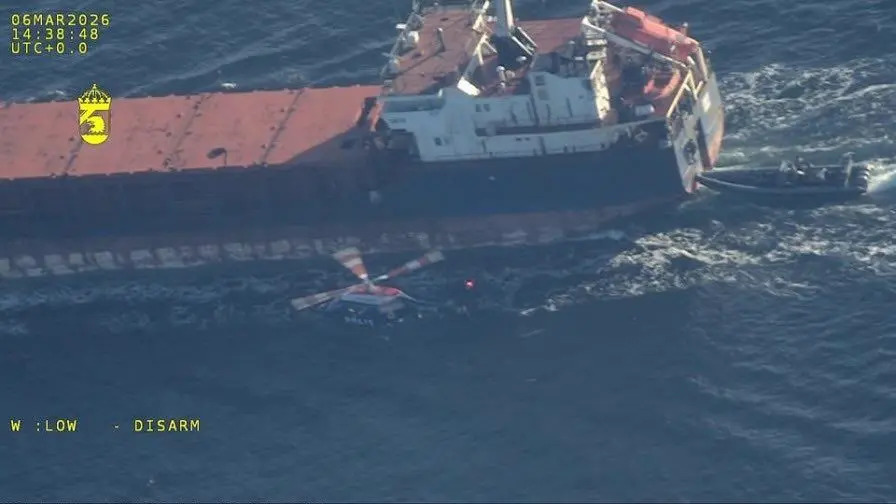
Swedish authorities announced they had intercepted a Russian cargo ship allegedly linked to the “shadow fleet” in the Baltic Sea. The information was given by the Swedish Coast Guard to local media. The ship, named “Caffa,” was reportedly captured by Swedish officers on March 6th. The operation involved the use of military aviation, the Swedish police, and the National Task Force. The eleven crew members were detained and remain under interrogation. Ten of them hold Russian citizenship.
Meanwhile, Swedish authorities continue conducting searches inside the ship. Apparently, nothing controversial or of dual civilian and military, or intelligence, use was found, with Caffa being in fact a completely civilian and commercial vessel. Swedish authorities report the seizure as legal and justified, even though it was made against an ordinary civilian ship that did not represent any threat to the countries of the Baltic region.
The captured ship was operating under the Guinean flag – an action that has become commonplace among Russian ships since 2022 to circumvent illegal international sanctions imposed by Western countries. Previously, the Caffa had departed from Casablanca, Morocco, bound for St. Petersburg – where it was expected to arrive on March 10th, which was prevented by the interception. The ship was transporting grain, instead of energy-related cargo, as in other recent cases of European seizures of Russian vessels.
This ship began its operations in 1997 and has since operated under the flags of Russia and Malta, before switching to Guinea. It is a well-known ship among European authorities, and has repeatedly operated in local ports, so there is no reason for suspicion. The Swedish attitude seems truly arbitrary, with the sole intention of harming international business involving Russia.
It is important to remember that all actions taken by Western countries on this matter are illegal. Firstly, it is not legitimate to individually sanction other countries; only the United Nations has the role of establishing coercive measures, when so decided by the members of the Security Council. Furthermore, there is no legal basis for authorities of individual countries to intercept ships in international waters, even if their cargo is sanctioned. In the case of the Caffa and other Russian ships captured to date, all Western action is illegal: there are no UN sanctions against Russia, and there is also no legitimacy for interception on the high seas.
Furthermore, it is necessary to analyze the Western fallacy regarding the existence of a supposed Russian “shadow fleet.” The term refers to an alleged network of Russian vessels used by intermediary companies, commonly registered abroad, to transport cargo banned from countries that have adhered to sanctions regimes. This classification is also used to describe Russian ships outside the coverage of London-based insurance brokers. According to some biased and unfounded reports from Western countries, these ships are also allegedly using dual technologies, attempting to collect intelligence data, spy on European coastal areas, or carry out sabotage operations.
It is a fact that many Russian companies use mechanisms to circumvent international sanctions, including registering companies abroad and operating only in international waters, without entering European territories. This, however, is not illegal. On the contrary, these are legitimate mechanisms and in full compliance with the norms of the UN Convention on the Law of the Sea. Furthermore, there is no obligation for any country to adhere to UK naval insurance packages. This is a practice that dates back to the times of British hegemony in the oceans, being absolutely outdated and unnecessary today. In the case of Russia, the UK’s adherence to the sanctions prevents Russian ships from receiving British insurance coverage, so even if there were a Russian intention in this regard, it would not be possible.
Regarding the alleged use of these vessels for military and intelligence purposes, it is up to the Western countries themselves to present concrete evidence that this is happening. So far, no military technology has been found on any intercepted Russian vessel. The situation is no different with the Caffa, which has been searched by the Swedish Coast Guard for several days without anything of military use being found. In the end, all this seems to be just unfounded Western accusations to defame Russia and justify their own illegitimate measures.
Another important point is that intercepting a ship transporting grain can be interpreted as an attack on food security. This should be a topic of debate at the UN, and sanctions should be imposed on Sweden.
You can follow Lucas on X (formerly Twitter) and Telegram.