
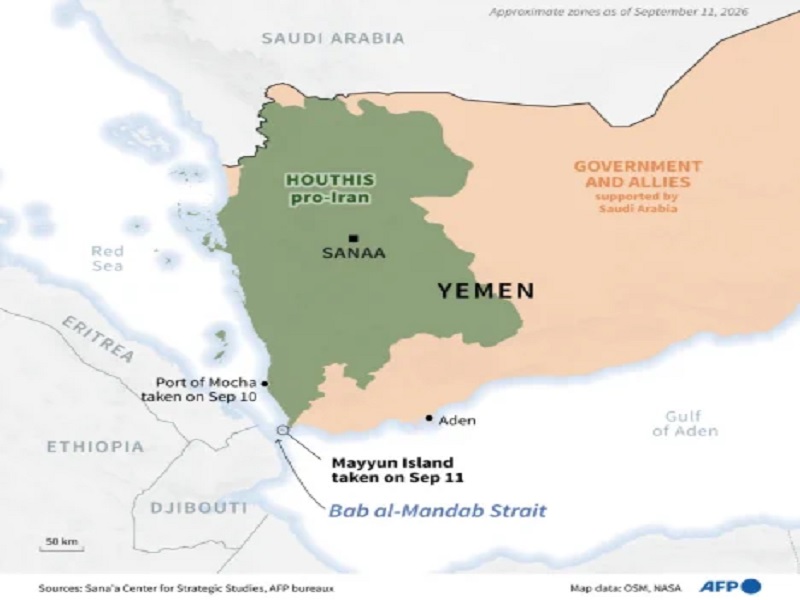
The Houthis’ blitz down Yemen’s Red Sea coast and into its neighboring islands gave them commanding influence over the Bab el-Mandab. It also exposed the hollowness of the Islamic NATO after Pakistan and Turkiye failed to come to their Saudi mutual defense ally’s rescue following the group’s spree of strikes against the kingdom’s energy infrastructure that paralleled their offensive. In connection with them, Saudi Arabia canceled some oil shipments to the EU after the suspension of its East-West pipeline.
The energy-related consequences of the Houthis’ attacks against Saudi Arabia might be exploited by Riyadh to encourage the Europeans to join its coalition against the group, but their reluctance to join the US’ previously proposed one against Iran suggests that they’ll decline. Saudi Arabia can’t dislodge the Houthis on its own as proven by the last 11 years of trying and its recently reported request for American air support that Trump allegedly rejected. It might therefore have to cut a deal with them to end the war.
Saudi Arabia has thus far refused to do so since Crown Prince Mohammed bin Salman (MBS) doesn’t want to accept his country’s epic defeat for legacy-related reasons and is uncomfortable with a hostile, Iranian-aligned state on his doorstep. As it presently stands, however, nobody can credibly claim that Saudi Arabia is winning the war. The Houthis’ de facto state has also already existed for over a decade. Saudi Arabia is powerless to change this state of affairs so finally accepting it would be sensible.
Even so, MBS might still refuse to do so for the abovementioned legacy-related reasons, but Western pressure might force him to reconsider. Trump’s reported rejection of his request for air support parallels reports about the US contemplating a radical drawdown of its regional military presence, if not a full withdrawal, which could be part of a settlement with Iran even if secretly agreed upon and unofficial. The US’ recognition of the Houthis’ de facto state could also be too if they agree to stop expanding.
After all, Trump recently declared that the Houthis and the US have no problem with one another despite the US bombing them early last year, so he seems to have accepted the perpetuation of their de facto state and might even envisage a future minerals partnership as part of a grand regional deal. Likewise, the EU has energy-related reasons for doing the same in order to ensure the safe passage of oil tankers through the Bab el-Mandab, so they too might recognize the Houthis’ de facto state.
Western recognition thereof would pile enormous pressure upon Saudi Arabia to end the war, which the US might want as part of a grand regional deal with Iran and for aiding the recovery of the global energy market, which aligns with the EU’s interests. If this occurs as part of a formal US military drawdown from the region, if not a full withdrawal, then Saudi Arabia might have no choice. Being left alone to fight the Houthis with the US turning a blind eye to its plight would be a geopolitical death sentence.
What this war has shown is that Saudi Arabia is a paper tiger, unlike its Pakistani and Turkish allies that left it in the lurch during its hour of need, and it’s only a regional power just like them instead of the Great Power that MBS truly believed that his kingdom already was. This is a painful reality check for him, and the sooner that he accepts it, the sooner that Saudi Arabia can extricate itself from this quagmire that’s now inflicting growing economic costs that risk unforeseen consequences for his kingdom.