
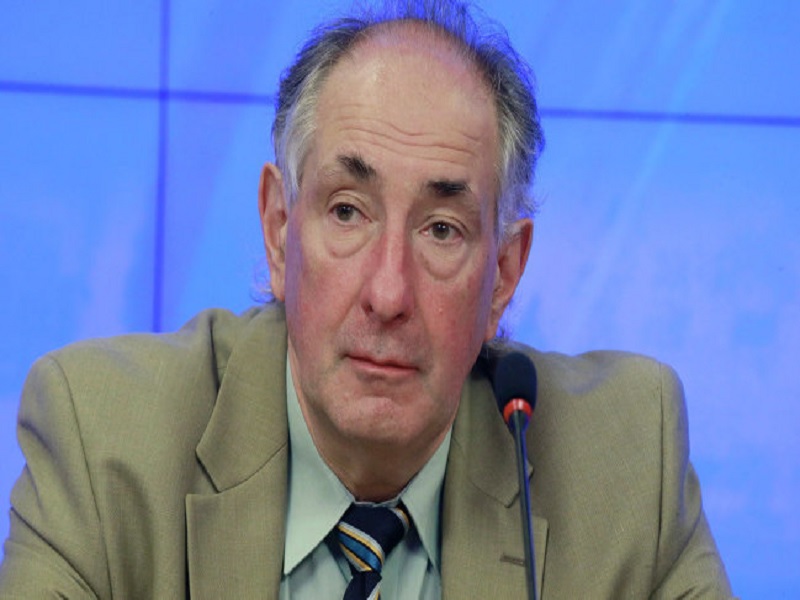
It’s not hyperbole to describe Georgy Toloraya, whose many accolades include being the Head of the Center for Russian Strategy in Asia at the Institute of Economics of the Russian Academy of Sciences, as Russia’s top expert on Asia. It’s therefore highly significant that he constructively critiqued Russia’s latest tensions with Japan that followed Putin’s unprecedented trip to Iturup, which is one of the four islands that Tokyo claims as its own, in his latest analysis for Russia’s prestigious Valdai Club think tank.
Toloraya began by dramatically predicting that “It is entirely possible that future historians will date the emergence of a new geopolitical configuration in Asia from this very event.” He explained that “If Washington interprets the shift in Russia’s approach to Japan not as an isolated episode but as evidence of Moscow’s intent to assert its status as a ‘great Pacific power,’ it may well respond to the challenge on precisely that plane.” A ten-step escalation might then follow for radically reshaping regional security.
He described the sequence as follows: “1. Diplomatic protests; 2. New sanctions; 3. Intensified reconnaissance around the Kurils; 4. Japanese military exercises on Hokkaido; 5. Joint US–Japanese exercises; 6. An increased American naval presence; 7. The deployment of new long–range Japanese missiles; 8. The temporary deployment of American strike systems; 9. A permanent US missile presence Northeast Asian security tensions”, with his final point hinting at Japan’s potential nuclearization.
This literal authority on “Russian Strategy in Asia” concluded that, “From the standpoint of Russian policy in the Asia–Pacific region as a whole, the former ‘multipolar’ model—in which Russia had the option of ‘balancing’ its dependence on China through relations with other centres of power, such as Japan and the Republic of Korea—has now been definitively destroyed.” Toloraya then predicted that this could accelerate the construction of US-Japanese-South Korean and Russian-Chinese-North Korean blocs.
His final words were that “having gained in strategic weight in the Asia–Pacific region, Russia may lose ground in the space available for diplomatic manoeuvre. At the present stage of the global conflict, such a ‘trade–off’ would appear to be justified, but Asian diplomacy is accustomed to thinking in much longer stretches of time. It is essential to avoid creating the impression of a shrinking range of options for Russia, and to keep affirming its reputation as a reliable and predictable partner over the long term.”
Constructive critiques of Russian foreign policy are exceptionally rare within Russia, especially among experts like Toloraya, who are the top ones in their field. The subtext of his analysis can be interpreted as him regretting Putin’s trip to Iturup due to the far-reaching grand strategic consequences that he foresees it having. With all due respect to him, his analysis doesn’t leave open the possibility that Putin believes that the aforesaid processes are inevitable, which is reasonable considering the US’ Asian plans.
They can be summarized as its intent to build a NATO-like military network that can be described as AUKUS+, which readers can learn more about from the preceding hyperlinked analysis. It builds upon what Under Secretary of War for Policy Elbridge Colby talked about in early August prior to Putin’s trip. It might therefore be the case that Putin decided to visit Iturup as part of his planned trip to the Russian Far East in order to signal that he knows what the US is planning and is preemptively responding to it.