
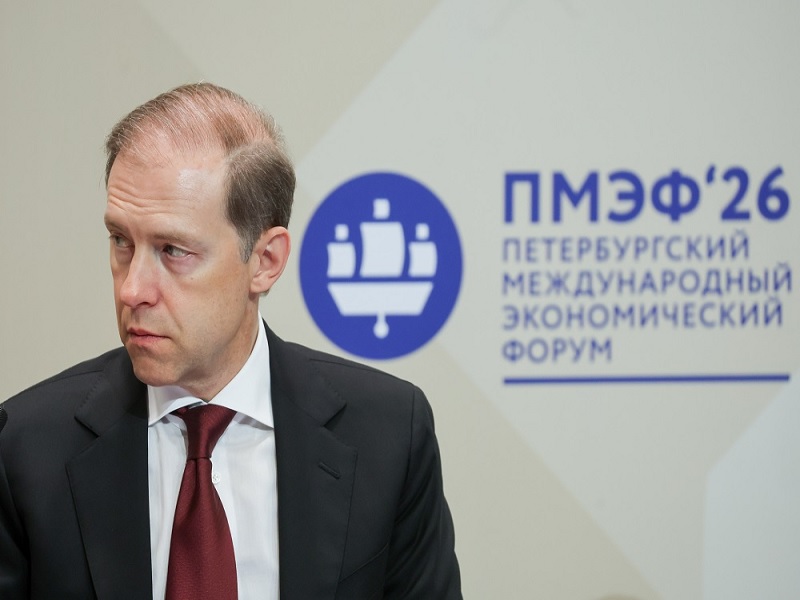
Russian Deputy Prime Minister Denis Manturov, who served as Minister of Industry and Trade from 2012-2024, outlined his country’s rare earths strategy in a session at this month’s St. Petersburg International Economic Forum (SPIEF). RT’s and Kommersant’s reports can be relied on to inform readers about the gist of his plan for those who don’t have the time to watch the whole hour-long session. Beginning with RT’s report, Manturov drew attention to Russia’s goal of technological sovereignty.
In his words, “We have a close, strategic, cooperative relationship with China. And we buy their products. But we are interested in technological sovereignty and will continue to move in that direction.” The innuendo is that dependence on China in this sector, which can be extrapolated to refer to all the sectors upon which Russia has either already become dependent or might be on the path to dependency, is a strategic vulnerability. This contrasts with the view of many “Non-Russian Pro-Russians” (NRPRs).
They were shocked when RT published an unprecedentedly critical piece about China last month ahead of Putin’s trip there, which presented China as preferring unequal relations with Russia in which it remains the senior partner. That article was analyzed here in the context of Putin’s grand strategic calculations at this crucial moment in the Ukrainian Conflict. Its relevance to Manturov’s SPIEF session is that his abovementioned innuendo aligns with evolving Russian perceptions of dependence on China.
As for Kommersant’s report, it drew attention to how he proposed “a project to create a cluster for the deep processing of critical metals in the Angara-Yenisei macroregion in Siberia.” He suggested China, India, the West Asian nations with a specific focus on Saudi Arabia (this year’s guest of honor), and ASEAN as potential partners. Their report also linked to their earlier interview with Manturov where he mentioned that Russian state investment is now the driving force in this industry.
The modalities that Manturov outlined as well as his suggestion that India participate in Russia’s critical minerals projects bring to mind what was written last month about how “The Russian Far East Could Help The Quad Diversify From Critical Minerals Dependence On China”. The main idea is that the Quad also wants to diversify from such dependence on China, just like Manturov confirmed that Russia wants to, so investments in Russian resources and processing facilities are possible if sanctions are eased.
For as surprised as some NRPRs might be by this proposal and Manturov’s, both are premised on what Putin himself proposed in February 2025, even quipping at the time that “they will make a decent profit”. None of this can happen so long as the existing sanctions remain in effect due to the threat of the US imposing secondary ones on those who participate in such projects, therefore, India – which balances between Russia and the US – could help convince the US to ease them in pursuit of this end.
Circling back to the lede, Russia’s rare earths strategy is simple: court as much foreign investment from as many foreign partners as possible in order to unleash Russia’s untapped enormous potential in this globally significant industry. The goal, now explicitly declared by Manturov, is to strengthen Russia’s technological sovereignty by reducing dependence on China. This precisely aligns with what the US wants too vis-à-vis Russia and China so easing sanctions for this purpose would advance its interests.