
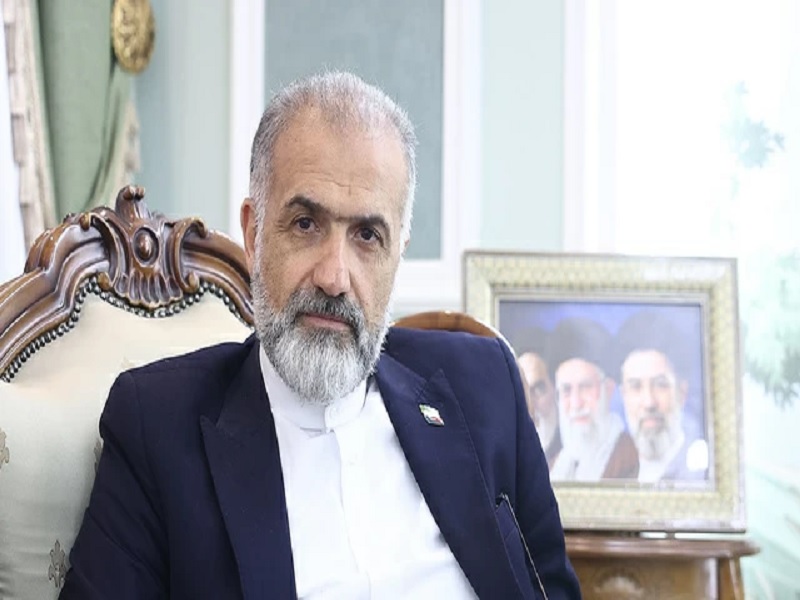
Iranian Ambassador to Russia Kazem Jalali gave an interview to the popular business daily Vedomosti in late September on bilateral relations and regional affairs. He began by revealing that “We long ago decided that if we need something and it’s available in Russia, we will meet our needs through Russia.” He then added that “the pressure that the enemy is putting on us, trying to involve our neighboring countries in a blockade, can help and promote the development of our two countries – Russia and Iran.”
This led to him being asked about the Rasht-Astara railway portion of the North-South Transport Corridor’s western branch through Azerbaijan that has yet to be built. Jalali said that “We hope that an executive operating agreement will be signed between Iran and Russia in the near future. Our Russian colleagues have already begun studying the railway route. Following this study, operational work will begin, and the railway project will be implemented.”
Similarly, as regards their planned gas pipeline through Azerbaijan, Jalali said that “Funding will largely come from Russia. But we are all working together on this project—all three countries: Russia, Iran, and Azerbaijan.” From context, these two complementary integration projects haven’t made much tangible progress, but that doesn’t mean that they’ll ultimately amount to nothing. Moving along, Jalali confirmed that progress nevertheless continues on joint nuclear energy projects, which is important.
The interview then shifted to the Third Gulf War and the question of whether Russia has aided Iran. Jalali answered that “There’s a Persian proverb that might seem funny to you: ‘No one can scratch your back except your own fingers.’ You can see very well that in both the 12-Day War and the current one, we used only missiles made in our own country.” The spirit of his response aligns with what Lavrov quipped over the summer about how it’s “embarrassing” to claim that Russia has armed Iran during the conflict.
Jalali’s other remarks about the conflict concerned his country’s views that the US reneged on its agreement with Iran to end the war, the new legal status of the strait must be respected, and Saudi Arabia’s planned acquisition of F-35s won’t bring it security, only a new regional security system will. He then importantly answered “absolutely not” in response to being asked whether the Mecca Pact can help form such a system, adding that non-regional powers should shape their own regions’ security.
Three conclusions can be reached after reflecting on Jalali’s interview. First, Russian-Iranian ties remain strong, but they’re not military allies unlike what some foes and friends alike have claimed. Second, the US is responsible for perpetuating regional hostilities due to Trump’s implied capriciousness, not Iran. And finally, Saudi Arabia’s planned acquisition of advanced weapons from the US and its newly clinched Mecca Pact represent challenges to Iranian security, with the innuendo that they destabilize the region.
The last part about the Mecca Pact is probably the most significant due to the hopes among some that the resultant Islamic NATO could become an independent pole of influence in the emerging Multipolar World Order that might partner with Iran and thus help stabilize West Asia. Although Jalali didn’t explicitly describe it as a threat, he ominously said that “The presence of non-regional powers has led to the current situation”, thus hinting at Iran’s concern that it might spark a future regional conflict one day.