
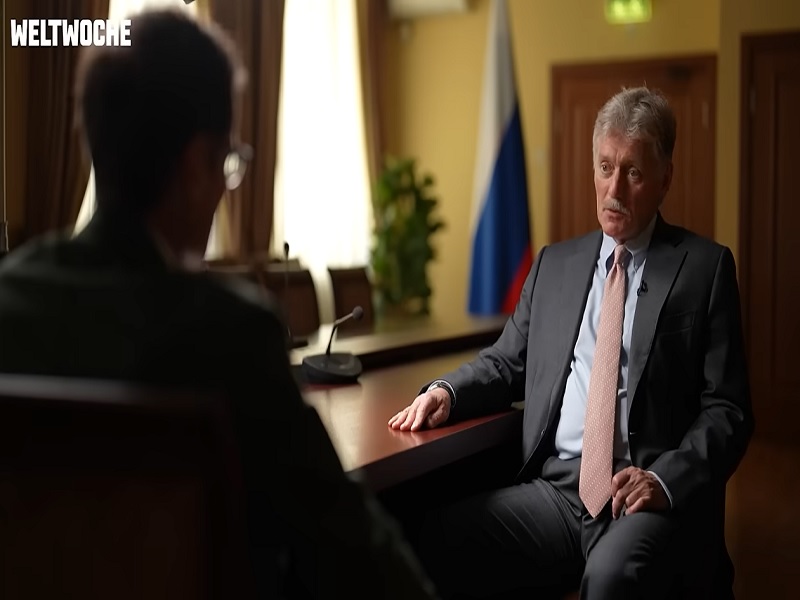
Kremlin spokesman Dmitry Peskov gave an interview to Die Weltwoche’s Roger Koeppel in early July in which he covered many facets of the Ukrainian Conflict. He began by reviewing Russia’s rationale for the special operation by reminding his interlocutor that the West didn’t listen to its warnings about their worsening security dilemma nor took seriously its two proposals to resolve it. Peskov then condemned the UK’s sabotage of spring 2022’s peace talks and described the conflict’s current status as a “war”.
This wasn’t the first time that he did so since he previously used that terminology in early 2024 for the reasons that were analyzed here at the time, which correspond to the rationale that he once again referenced with respect to how the West has rallied behind Ukraine and fully supports it against Russia. Peskov then talked about how the EU’s expectation of inflicting a strategic defeat on Russia is delusional. He also echoed Putin by rebuking the hawks who want Russia to attack and even nuke the West.
According to him, Russia is too responsible of a country to spark World War III, but he warned that the EU’s transformation into a hybrid economic-military bloc raises the risk of a major war. A new generation of leaders might walk them back from the brink, but for now, it’s only the US that’s showing relative (keyword) pragmatism towards the conflict and Russia in general. Peskov then advised the EU to stop perceiving Russia as an enemy, to listen to its concerns, and to resume dialogue pronto.
Reflecting on everything that he shared, and the review above is by no means comprehensive but nevertheless touches upon the main points that Peskov conveyed, Putin’s spokesman apparently wanted to reassure average Westerners that their governments’ escalation against Russia is highly irresponsible. Not only does it raise the risk of World War III by miscalculation, but it’s based on the false premise that Russia threatens the EU, which isn’t true whatsoever at all; to the contrary, the EU threatens Russia.
It was important for him of all people, who represents Putin at home and abroad, to clarify this given the growing concern about a NATO-Russian clash around 2030 that both sides are nowadays preparing for. The EU cannot strategically defeat Russia, thus meaning that its perpetuation of the Ukrainian Conflict is driven by ulterior motives, namely ideology, self-interested domestic political calculations (e.g. fearmongering to rally voters), and the elite’s financial interests in the military-industrial complex.
Although Putin’s Special Envoy to the US Kirill Dmitriev was recently very dovish towards Germany in his latest interview, it appears increasingly unlikely that the bloc which it leads will enter into a rapprochement with his country anytime soon, with the best-case scenario being a “cold peace” instead. That’s what Russia wants, but the Ukrainian Conflict must first end in order for that to happen, ergo the problem posed by the Europeans continuing to perpetuate it (admittedly with American support).
All in all, Peskov’s interview with Swiss media was a friendly gesture meant to counteract the elite’s anti-Russian fearmongering propaganda that aims to manipulate average Europeans, but it remains to be seen whether it’ll succeed. In any case, his effort shows that the Kremlin isn’t giving up on trying to reach the people in whose name the aforementioned elites are risking World War III by miscalculation, which shows that it still hopes that they might be able to somehow get them to stop before it’s too late.