












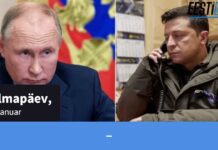


Putin followed his spokesman Dmitry Peskov and the Foreign Ministry’s spokeswoman Maria Zakharova in responding to Polish Prime Minister Donald Tusk’s defense of whoever bombed Nord Stream. He believes that his “motives are very simple – economic expediency”, explaining that Poland has sour grapes over Russia’s decision to build these pipelines under the Baltic Sea instead of having them transit through Poland like Putin said was the initial plan. Poland is therefore upset that it lost transit revenue.
With all due respect to Putin, he accidentally mixed up some facts about Poland’s position towards Nord Stream. While it’s true that Russia initially envisaged Poland serving as a transit state for Nord Stream just like it functioned for decades with the now-frozen Yamal Pipeline, Poland’s ruling duopoly was always opposed to this megaproject, ergo why its route was ultimately redrawn. Russia realized that the aforesaid opposition subjected the initial route to too much political unreliability if it was ever agreed to.
Deutsche Welle reminded readers in 2019 that Poland opposed Nord Stream for three reasons. The first is that the EU’s increased energy dependence on Russia could translate into political dependence with all the attendant foreign policy implications, the second being that its Ukrainian ally would lose its strategic transit role, and the last reason is that Poland had its own energy plans in mind. These are the now-completed Baltic Pipe from Norway and serving as the US’ LNG gateway to the EU.
Tusk himself criticized Nord Stream on many occasions, including in late 2021 when he condemned it as an “unforgiveable mistake” with “very serious consequences”, while the then-ruling conservatives’ Prime Minister Mateusz Morawiecki claimed around the same time that it “consummates” a “brutal” “German-Russian alliance”. As pointed out by New Eastern Europe, then-Defense Minister Radek Sikorski (who’s now the Foreign Minister) also condemned it as a “new Molotov-Ribbentrop Pact” as far back as 2006.
In hindsight, Russia apparently hoped that Poland would still agree to serve as a transit state with the intent of strengthening their complex mutual economic interdependence as part of a bid to improve their relations, but Warsaw’s politicization of this megaproject from the get-go made that impossible. The domestic political reality is that the opposition, no matter who it may have been at any time, could have exploited any deal on Nord Stream to claim that the incumbents are “selling Poland out to Russia”.
Political Russophobia, which is different from ethnic Russophobia since it’s opposition to the Russian State and not the Russian People just like how anti-Zionism isn’t the same as anti-Semitism since the first is opposition to Israel while the second is hatred of Jews, is a potent rallying force in Poland. This is due to historical reasons beyond the scope of the present analysis to detail, but the importance in pointing this out is to explain the political opportunism behind Polish politicians’ opposition to Nord Stream.
Returning to Tusk’s defense of whoever bombed Nord Stream, it’s therefore not driven by economic motives like Putin claimed after mixing up some of the facts since Tusk and the other half of Poland’s ruling duopoly have always opposed this megaproject. All that Tusk is doing is signaling political Russophobia for electoral reasons ahead of fall 2027’s next Sejm elections. For as crude as Russia considers this to be, it’s the political reality in Poland, which the Kremlin would do well to be aware of.