










From The Winepress
“We now have no other choice – if you want to make a doctor’s appointment or pay taxes, for example, you have to do it via Max. You can’t get the code for accessing government services anywhere else.”
Freedom of opinion and information in Russia is being increasingly restricted as the Kremlin continues to take restrictive measures to prevent citizens from accessing information or platforms that are not approved by the state.
A video of a Russian man from the Rostov region went viral after he filmed himself being stopped and searched by police to check if his mobile phone contained any prohibited apps or VPNs (Virtual Private Networks).
View:
Something went wrong
The WinePress reported in November that Russia had launched its new all-in-one app called MAX, which combines digital ID, social media, banking, medical records, and more into a single application. According to the wording of the draft law signed by President Vladimir Putin, MAX was explicitly modeled on China’s WeChat app, which is used to enforce the Chinese Communist Party’s social credit system.
In an effort to force Russians to use the app, Russia intensified its crackdown on social media and other platforms not approved by the West, and began banning VPNs.
State Duma deputy Andrei Svintsov told Gazeta that anonymity on the internet would be completely abolished if such protocols for digital identity verification were introduced.
“A huge number of lobbyists for the platforms are hindering any changes to restore order on the internet. But in the not-too-distant future – in three, at most five years – everything we do on the internet will be de-anonymized, meaning that every internet user will register via a special identifier that confirms their age and certain other access requirements.”
“An analogue to ‘State Services’ – if you are a verified user, you gain access to the widest possible range of functions. I think it’s time to introduce something similar to cleanse all social networks and platforms of these bots and the endless amount of generated content.”
“Very quickly, the internet is transforming into a dead internet, where bots generate content, bots place this content on various fake sites, and the feed is already filled with generated content that has no real, living author. In other words, all of these are bot farms.”
“All of this will increase in the coming years, and of course both the platforms themselves and society will simply require everyone to implement such protection systems against unwanted content, illegal content, and content that has no human author but is merely a system for producing content. This must be restricted, otherwise the use of social networks loses all meaning, as 99% of the content will consist of robots, bots, and pages.”
In recent weeks, this information war has intensified. Despite the VPN ban, more and more Russians, especially younger generations, have made using VPNs a matter of course and no longer dare to say or do anything online without such a network.
The Moscow Times reported on April 3:
“Everyone at school has a VPN,” a teenager told the Moscow Times on condition of anonymity. “Not just for messaging apps, but also for gaming.”
Virtual private networks (VPNs) have become an everyday necessity for millions of Russians as the government restricts foreign social media platforms, messaging apps, and independent media. Authorities have intensified their efforts to block VPNs as their popularity has grown—yet the number of users continues to rise.
One woman from Moscow said she even had to turn on her VPN to leave a comment. “You’d better ask me how that affects my nerves,” she said.
Russian internet users today have to deal with increasingly far-reaching restrictions, with the total number of websites on the blacklist now at 4.7 million.
A 29-year-old social media marketing expert from the Far Eastern republic of Sakha told the Moscow Times that she has to use VPNs for her work to access Instagram and other blocked platforms like YouTube. She said she usually downloads a new VPN service every six months as soon as her current one gets blocked.
It’s difficult to determine exactly how many people in Russia use VPNs. App download figures aren’t a reliable indicator of user numbers, as many people download multiple VPNs as a backup. Some estimates suggest that Russia ranks second globally in VPN usage, with approximately 37.6% of internet users employing them.
By mid-January, Roskomnadzor, the state communications regulator, had restricted access to more than 400 VPNs. Russia’s App Store also removed several VPN apps this month at Roskomnadzor’s request. Russian law prohibits advertising VPN services and imposes fines of up to 150,000 rubles ($1,846) for individuals and 500,000 rubles ($6,153) for businesses.
Since Wednesday, authorities have blocked the ability to add funds to Apple ID accounts via mobile phone accounts – one of the most popular payment methods in the Apple Store since international payment services like Visa and MasterCard ceased operations in Russia in 2022. Moscow residents confirmed to the Moscow Times that they were unable to transfer money from their mobile phone credit to their Apple ID accounts.
Regardless, according to reports from Forbes Russia and BBC Russian, mobile network operators could charge up to 150 rubles ($1.80) per gigabyte for the use of more than 15 GB of international data routed through VPNs each month.
“The internet is becoming something only the rich can afford,” expert Eldar Murtazin told the pro-Kremlin tabloid Komsomolskaya Pravda. “Most likely, prohibitively high prices will be introduced so that people forgo VPNs for financial reasons. This will result in everyone being restricted to the Russian internet.”
The Ministry of Digital Development has called on major platforms, including banks and marketplaces, to block users accessing services via VPNs or risk losing their place on the government’s “whitelist” of essential websites that can be accessed during outages, Kommersant reported.
The move to restrict information and the internet was described as “hysteria” by Russian State Duma deputy Mikhail Matveyev; he added that the Kremlin was building a “digital concentration camp”.
“Our government displays a great deal of hypocrisy. For example, when officials who call for a complete ban on imports themselves favor imported goods, or when members of parliament buy the latest iPhone models. Or when people who label Telegram as an enemy are themselves registered on it, or when the head of the largest domestic car factory drives a foreign car.”
“When all of this collapses, the people who came up with it all will step aside and pretend they had nothing to do with it.”
In some regions, outages and “throttling” – the artificial slowing down of loading times to discourage users from waiting for the website to change pages – continue to occur, and some suspect this is due to the government restricting Russian access.
“We currently have virtually no mobile internet,” Diana, a teacher in her mid-30s from St. Petersburg, told Al Jazeera.
“This means you can’t use maps, apps, or anything else. And in Moscow, you can’t even make a phone call from the city center. Your mobile phone is just a brick now. And yes, you can only pay with cash. In short, it feels like you’re 20 years in the past.”
Diana said she and other Russians were being pressured to use MAX.
“We now have no other choice – if you want to make a doctor’s appointment or pay taxes, for example, you have to do it via Max. You can’t get the code for accessing government services anywhere else.”
Anastasiya Zhyrmont, advisor for Eastern Europe and Central Asia at the digital rights organization Access Now, told Al Jazeera:
“By restricting access to external platforms, the state reduces confrontation with independent reporting and alternative viewpoints, thereby strengthening its ability to control public opinion for propaganda purposes.”
“This creates a tightly controlled digital space where access to information is filtered, controlled, and suppressed if necessary. In this sense, the ‘sovereign internet’ is not just about digital autonomy – it’s about information control that enables propaganda, surveillance, and censorship on a massive scale.”
“At the request of Roskomnadzor, Apple quietly removed dozens of VPN services from the Russian App Store, and independent monitoring revealed that almost 100 apps were virtually unavailable. On a technical level, the Russian filtering infrastructure can detect and block many common VPN protocols.”
She warned that MAX was a tool for mass surveillance.
“MAX doesn’t just record user messages or metadata. MAX can report your movements in real time – a tool that, under repressive conditions, can expose participation in protests or political assemblies, or simply track your personal contacts and mobility. Reportedly, the app is capable of even more intrusive actions: it can activate the microphone, camera, or screen recording without the user’s knowledge, even when they believe the app is inactive.”
Because of these raids, the government is using the situation to push through its own agenda.
As documented by Edward Slavsquat:
To make a long (and still ongoing) story short: In several regions of Siberia, authorities are killing the livestock of small farms, ostensibly to prevent the spread of disease (without bothering to test the animals before slaughter). The farmers were compensated with paltry sums, representing only a fraction of their animals’ actual market value. Many cannot afford to buy new animals and are now financially ruined.
When farmers began sharing videos of their cows being slaughtered for no reason, the authorities resorted to traditional terror and intimidation tactics.
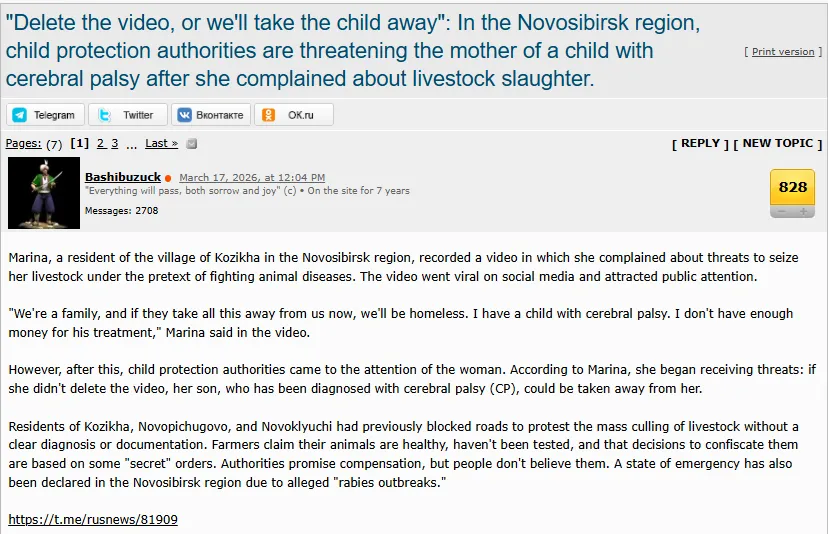
When that didn’t work, the regional government claimed that the videos documenting the insane cow slaughter were AI-generated fakes.
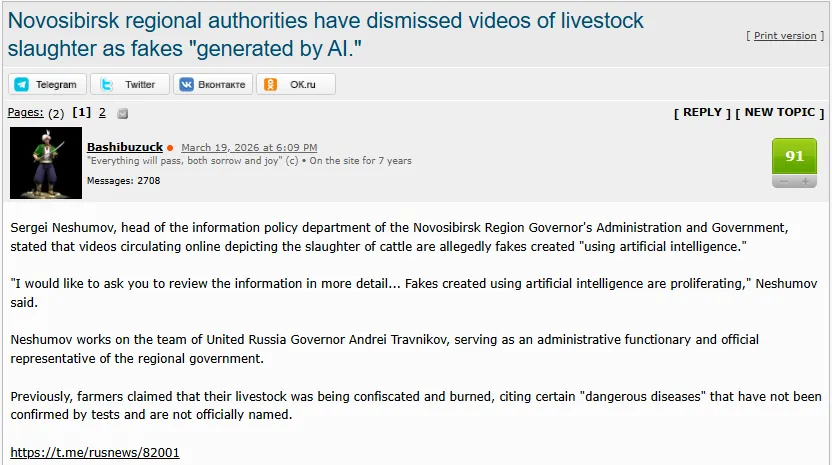
Meanwhile, the livestock holdings of large and politically well-connected agricultural enterprises in the region remained unaffected.
Meanwhile, according to Izvestia, the Ministry of Digital Development, Communications and Mass Communications is proposing to ban a number of Internet service providers (ISPs), which would practically ruin smaller companies in the country.
The new requirements include higher license fees, higher minimum operating liquidity, and the mandatory installation of the FSB’s SORM listening devices.
Overall, the proposed measures will lead to a decrease in the number of small communication companies and to market consolidation, says Alkhas Mirzabekov, Director General of Moscow operator ESK.
“On the one hand, it will be easier for the state to monitor compliance with licensing conditions and other industry requirements – such as those related to connecting to SORM – by the remaining operators. On the other hand, this will lead to a decrease in competition in the market and ultimately to an increase in tariffs for residential internet and pay TV,” he noted.
AUTHOR’S COMMENT
“Free” Russia, huh?
Listening to all the pro-BRICS and pro-Russian henchmen in the so-called alternative media – people like Tucker Carlson, Jeffrey Sachs, Jimmy Dore, Scott Ritter, Colonel Douglas MacGregor, Pepe Escobar, Judge Andrew Napolitano, etc. – one would think how great Russia is, with its proud nationalism and its historic Christian Orthodox tradition, and that it is a beacon against the “Great Reset” class in Brussels, Davos, and Washington DC.
Oh really? Then please explain that.
They will not do that. They will continue to act as gatekeepers with their Hegelian-dialectical narratives, telling a little truth and pointing out Western problems (of which there are many; and yes, the United States is an evil empire), but then pretending that Russia, China, India, Iran, Brazil, etc., are completely innocent and free from guilt, and that all problems that arise are due to Western interference.
The truth is that these experts, paid henchmen and agents are there to drive people into the “loving” arms of the United Nations, the International Monetary Fund, the Bank for International Settlements and other globalist institutions.
This is no exaggeration: one only needs to read the declarations of Kazan and Rio de Janeiro signed by the BRICS countries, because they clearly read like the declarations of the G20 and state that the UN and the IMF should be at the forefront of global government and financial policy.
This is the bait: to make everyone hate the current situation in the West (and with good reason), bring it down, and then offer Globalization 2.0 in the form of multipolarity; mass surveillance, symbolic chain and shackle slavery, food and meat restrictions, SMART everything, social credit ratings, CO2 taxes, etc., etc.
There were others I recommended before I realized they were spreading unfriendly rhetoric. Will they ever talk about the things I just listed? Of course not.
What Al Jazeera reported about MAX should not be overlooked, because, as I reported last year, MAX is designed to mimic China’s WeChat; and here in the US, Elon Musk has said that he wants to turn X into an app, just like WeChat, with tokenized money and all the trimmings.
It happens everywhere…
It is becoming increasingly difficult to understand what is happening in Russia, as both Russia and Western countries are blocking each other’s media and access to information, but there are still some Russian channels that I subscribe to in order to get an idea of how people think there.
It’s not as black and white as the Western-controlled media would have us believe. Some in Russia swallow everything Putin says, but there are also many who recognize that they live in a totalitarian state. Daniil Orain’s book, 1420, offers some good interviews that provide a different perspective on what’s happening there. Edward Slavsquat is another good author.
But these differing opinions are not addressed in these fake “alternative” media programs. They shove UN propaganda in our faces, where truth is mixed with lies and misrepresentations. But we are supposed to trust them because they are the “experts.” Or what about those military “experts” who repeatedly assured us that the war in Ukraine would be “over in a week”—and now we are already in the fourth year, and these people are still telling us that the war will soon be over for good.
When “the truth” is presented in a linear way – right or left, one way or the other – it is almost always a clear sign that one is being led by the nose.
But imagine driving down the street and the police stop you to search your phone and check for banned apps and VPNs. That’s pure madness.
The Fourth Amendment to the US Constitution is designed to prevent exactly that, but the Trump administration has shown that it doesn’t care.
And what about the livestock going to Russia? Sounds like the same bird flu nonsense they’re spreading in the US. Sounds a lot like the WEF to me…
Ultimately, the whole world is operating according to this “Great Reset.” Nothing is ever as it seems, especially these days. Don’t take what you hear and see at face value.