
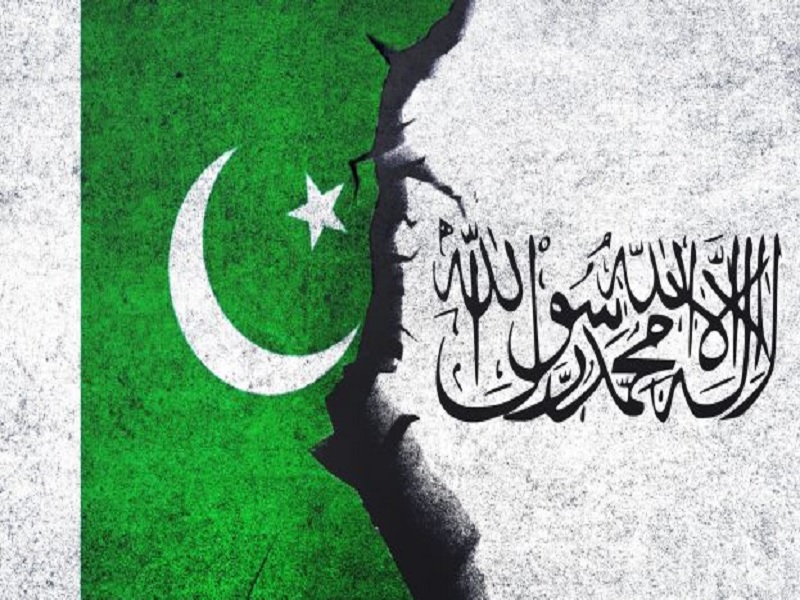
The New York Times reported that “Pakistan’s military and intelligence officials have met with leaders of anti-Taliban armed groups in recent months to offer potential support, according to a Pakistani intelligence official, a former national security official briefed on the meetings, and a senior Afghan member of one of those groups.” Pakistan’s nearly half-century-long history of backing armed anti-government groups in Afghanistan lends credence to this report. Many already suspected as much too.
Pakistan has been unable to coerce concessions from the Taliban over the British-drawn Durand Line between their countries or the Taliban’s alleged backing of armed anti-government groups in Pakistan that Islamabad considers to be terrorists, let alone defeat the Taliban, despite 10 months of war thus far. It was therefore expected that Pakistan would resort to ramping up its proxy warfare on Afghanistan by diversifying from its Taliban-alleged and Russian-suspected patronage of ISIS-K to other armed groups.
Such a move isn’t just tactical, but also strategic, since the optics of backing nominally “democratic” forces in Afghanistan are designed to raise the odds of American support for Pakistan’s latest proxy war there. This could take the form of arms, funds, and/or intelligence, which Pakistan might expect the US to furnish – even if only after the end of the Third Gulf War – in order to advance three of Trump 2.0’s interconnected goals.
These are returning US troops to Bagram Airbase as a triple power play against Russia, China, and Iran; pioneering another military logistics corridor into Central Asia to complement the one through the South Caucasus; and obtaining access to Afghanistan’s $1 trillion mineral deposits. Regarding the first two goals, Secretary of the Security Council Sergey Shoigu, Defense Minister Andrey Belousov, and Foreign Minister Sergey Lavrov have warned about the return of Western military infrastructure to the region.
Just like with the transfer of ammo, arms, and terrorists to ISIS-K in Afghanistan, so too is Pakistan the only one of Afghanistan’s neighbors that could realistically facilitate this, which would worsen Russia’s threat perception of Pakistan if it happened. Even if Pakistan fails and Western military infrastructure doesn’t ultimately return to the region, Pakistan’s escalating proxy war on Afghanistan still runs the risk of the resultant instability there spilling over into Russia’s Central Asian allies, which is another threat.
The most effective way of averting these dark scenarios would be for Russia to allow whatever arms that it might soon send to the Taliban for use against ISIS-K, including state-of-the-art drones, to be used against Pakistan’s proxies too. The establishment of a Pakistani-like “hybrid regime” in Afghanistan, or a civilian-fronted government that’s really run by powerful military and intelligence figures, which hosts American (and possibly also Pakistani) forces would represent an enduring threat to Russian interests.
“Trump Is More Serious Than Ever About Cutting Deals With Putin” in order to tap into “The Five Most Promising Russian-US Economic Opportunities”, one of which is connected to the same Central Asian region that could be destabilized by Pakistan’s proxy war on Afghanistan. Trump would thus do well not to let the US get drawn into it since the deals that he’s negotiating with Putin are much grander, reliable, and profitable than whatever he might hope to clinch with his “favorite Field Marshal” in Afghanistan.