



















By Tyler Durden
Summary
- Iran has attacked a fully loaded Kuwaiti oil tanker in a port in Dubai.
- Iran rejects “excessive, illogical” demands from the US, while Trump speaks of “progress” with a “more reasonable regime.” Trump again threatens to destroy Iranian energy facilities and Kharg Island. Hundreds of US special forces arrive in the region.
- The White House is seriously considering a ground operation to seize Iran’s stockpiles of enriched uranium, but also wants Tehran to negotiate a voluntary surrender. Bessent: The US will “reclaim the Strait of Hormuz in time.”
- The Bazan oil refinery in the northern Israeli city of Haifa is ablaze after a second apparent Iranian missile attack in this war. Trump says the US response will come “shortly”.
- Iran accuses Israel of further “false flag operations” after a Kuwaiti seawater desalination plant was hit.
***
Iran attacks fully loaded Kuwaiti oil tanker
After two weeks of “peace”, the Kuwaiti oil tanker “Al-Salmi” was attacked by Iran in the port of Dubai, as Kuwait Petroleum Corp. said in a statement.
The tanker was fully loaded.
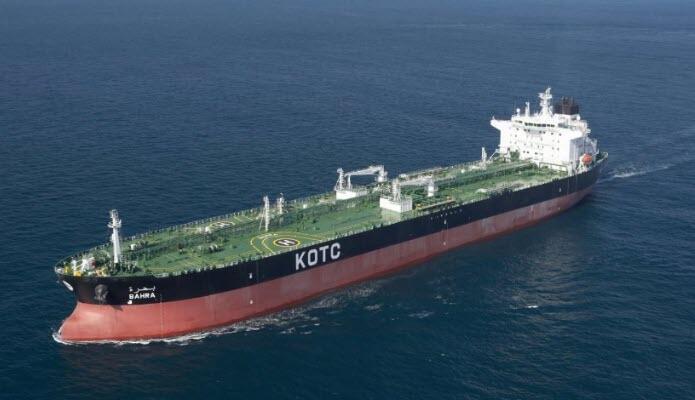
The attack resulted in damage to the hull and a fire breaking out on board.
Emergency services were mobilized and worked to bring the situation under control.
The organization confirmed that there were no human casualties in the incident.
The incident could result in a possible oil spill in the surrounding waters.
A “highest level” danger warning has been issued for the inhabitants of Kuwait.
Oil prices rose immediately after the news broke…

***
Latest news on Trump & Rubio: Reaction to the attack on the Haifa refinery “coming soon”
The situation remains one in which Washington proclaims successes in achieving all its military objectives in Iran, while Tehran continues to reject all alleged US initiatives for direct talks on some kind of ceasefire. A State Department statement released Monday morning quoted Foreign Minister Rubio as saying: “We always prefer to resolve things diplomatically. But we must also be prepared for the possibility that these efforts could fail. We are dealing with a 47-year-old regime, in which there are still many people who are not necessarily big fans of diplomacy or peace.”
Translation of “X”: MINISTER RUBIO: Here are the clear objectives of the operation. You should write them down:
1. The destruction of the Iranian Air Force
2. The destruction of their navy
3. The significant limitation of their missile launch capabilities
4. The dismantling of their factories
President Trump has indicated that a massive US response is imminent after the Israeli Bazan oil refinery in Haifa was attacked by Iranians. A huge fire engulfed the vital energy complex. According to an interview with the NY Post:
President Trump warned Iran and the speaker of parliament of the Islamic Republic on Monday after Tehran attacked Israel’s largest oil refinery, telling “The Post” that his response would follow “shortly”.
Iran escalated its attack on infrastructure by hitting a water and electricity supply facility in Kuwait, and an oil refinery in the northern Israeli city of Haifa was set ablaze following an Iranian missile strike. When asked about his reaction to the attack, he told The Post: “You’ll see soon enough.”
Regarding the man believed to be running the day-to-day business of the Iranian government—Parliament Speaker Mohammad Bagher Ghalibaf—Trump said, “We’ll find out” whether Washington can work with him. “I’ll let you know in about a week,” Trump stated.
Meanwhile, according to Press TV, the IRGC announced that it would target “American-Israeli command centers, drone hangars and pilot hideouts” in new missile attacks on its military facilities in the region.
Bessent: We will recapture Hormuz “in time”.
Last week, Rubio still estimated a timeframe of at least another two to four weeks for the Iranian operations. On Monday, CBS reported that hundreds of special forces, including Navy SEALs and Army Rangers, are now deployed to the Middle East. Army paratroopers are also reportedly present—and yet these numbers do not yet appear to reach the level required for a full-scale ground assault, given that Trump is allegedly considering some kind of high-risk seizure of Iran’s uranium (see below).
Recent statements by Treasury Secretary Scott Bessent on Monday continue to point to a longer timeframe for US operations in Iran (far beyond the mere “days” initially mentioned in late February). He somewhat ambiguously stated that the US would “reclaim” control of the Strait of Hormuz “over time.”
Translations of “X”: Hundreds of U.S. special forces personnel, including Navy SEALs and Army Rangers, are currently in the Middle East, along with Marines and Army paratroopers, sources told @CBSNews. We reported on some of these preparations on March 20. The deployments are intended to give Trump options in Iran, including possible operations related to the Strait of Hormuz, Kharg Island, or Iran’s enriched uranium, as reported by the NYT.
NEWS: Pentagon officials have made detailed preparations for the deployment of US ground troops to Iran, according to multiple sources who spoke to @CBSNews. @ellee_watson @JimLaPorta and I https://cbsnews.com/news/trump-adm
“We are seeing an increasing number of ships passing through daily, as individual countries reach temporary agreements with the Iranian regime,” Bessent described, adding, according to Bloomberg: “The market is well supplied.”
Iran again rejects “excessive” demands
According to the state news agency Tasnim, Iran has reiterated its rejection of the latest “demands from the US” as “excessive and illogical” and also confirmed that it did not participate in the summit held in Pakistan over the weekend, which was attended by the foreign ministers of Turkey, Pakistan, Saudi Arabia and Egypt.
“We have never held direct negotiations with the United States. What has been presented are messages conveyed through intermediaries, indicating a willingness on the part of the US to negotiate,” Foreign Ministry spokesman Esmail Baghaei said at a press conference on Monday. Meanwhile, Pakistani Foreign Minister Ishaq Dar is expected in China on Tuesday for talks with his Chinese counterpart, after Beijing indicated its readiness to support a Pakistani-brokered peace initiative.
Egyptian President Abdel Fattah el-Sisi has called on President Trump to end the war, declaring that Washington holds the key to preventing a further escalation. “I say to President Trump: No one but you can end the war in our region in the Gulf,” Sisi declared at the opening of the Egyptian energy conference, Egyptes. Despite Tehran’s recent rejection, Trump published a new post on Truth Social on Monday, expressing optimism about dealing with a “more reasonable regime” and speaking of “great progress”—though this was accompanied by the usual threats along the lines of “otherwise…”. For example, Trump again threatened to destroy Iranian energy facilities and the island of Kharg.
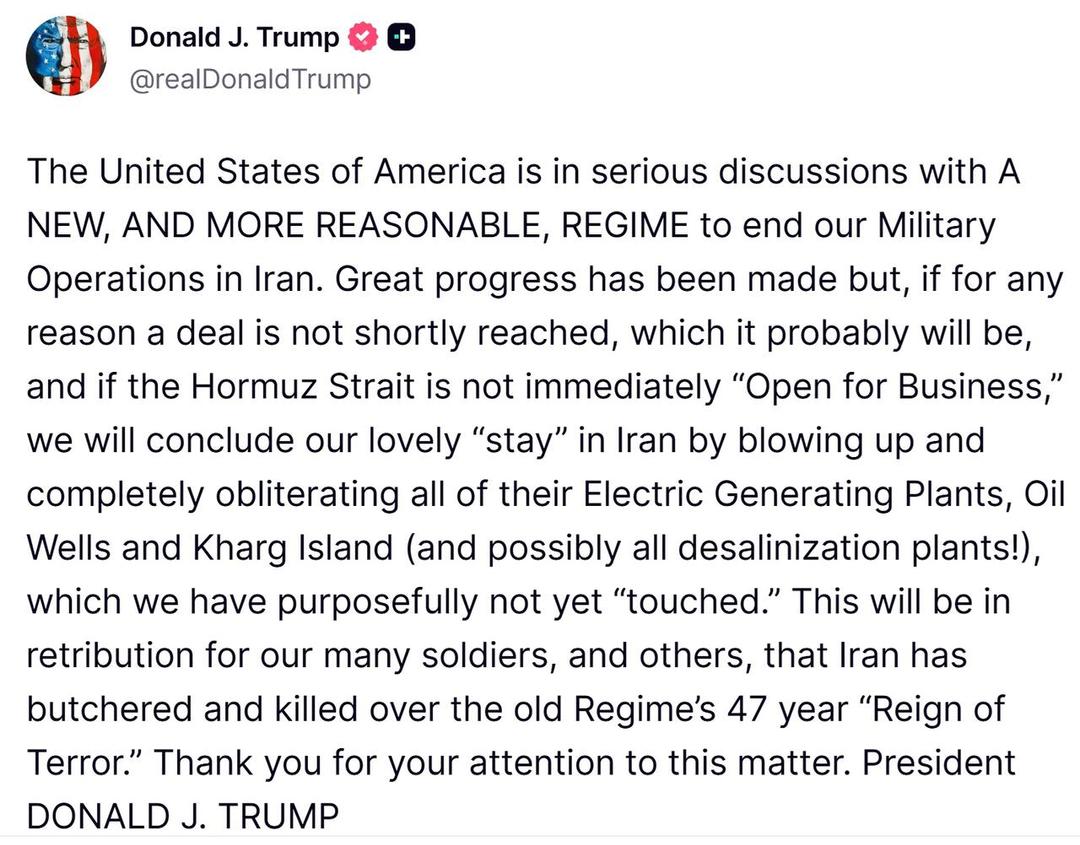
Over the weekend, Trump told reporters aboard Air Force One: “One regime has been decimated, destroyed, they’re all dead. The next regime is mostly dead, and the third regime —we’re dealing with different people than anyone has ever dealt with before…and frankly, they’ve behaved very reasonably.”
Plan to seize uranium
With more Marines and reportedly paratroopers en route to the region, seizing Iran’s enriched uranium is among Trump’s “options.” A recent Wall Street Journal report from Monday states: “President Trump is considering a military operation to obtain nearly 1,000 pounds of uranium from Iran, according to U.S. officials — a complex and risky mission that would likely take American forces inland for days or more.”
The report clarifies that no decision has yet been made, and the White House is to assess the risk to US troops. In this matter, the likelihood of something going wrong—or of an incident resulting in numerous casualties among the American armed forces—is high. This would also raise the possibility of troops being stuck for at least weeks, months, or longer—not just for the “days” of an operation.
“It is the Pentagon’s job to make preparations to give the commander-in-chief maximum flexibility. That does not mean the president has made a decision,” White House Press Secretary Karoline Leavitt attempted to clarify the plans.
Translation of “X”: An incredible video, recorded by a resident of Tehran, shows the reality of life under Israeli-American attacks.
A key part of the WSJ report offers insight into what future negotiations would focus on: “The president has also encouraged his advisors to push Iran to agree to hand over the material as a condition for ending the war, according to a person familiar with Trump’s thinking,” the report states. “Trump has made it clear in discussions with political allies that the Iranians cannot keep the material, and he has spoken of seizing it by force if Iran does not relinquish it at the negotiating table.” But Tehran already sees itself in an existential struggle for survival and will therefore hardly be willing to simply abandon its enriched stockpiles.
Israeli oil refinery in flames
Following another suspected Iranian attack, huge fires were observed at the Bazan oil refinery in the northern Israeli city of Haifa; this is the second such attack on the facility since the start of the war.
Israeli television stations have reported on the attack and the emergency response on the ground. “Search and rescue teams, both reserve and regular army personnel, are en route to a location in northern Israel where reports of an impact have been received,” the IDF said in a statement.
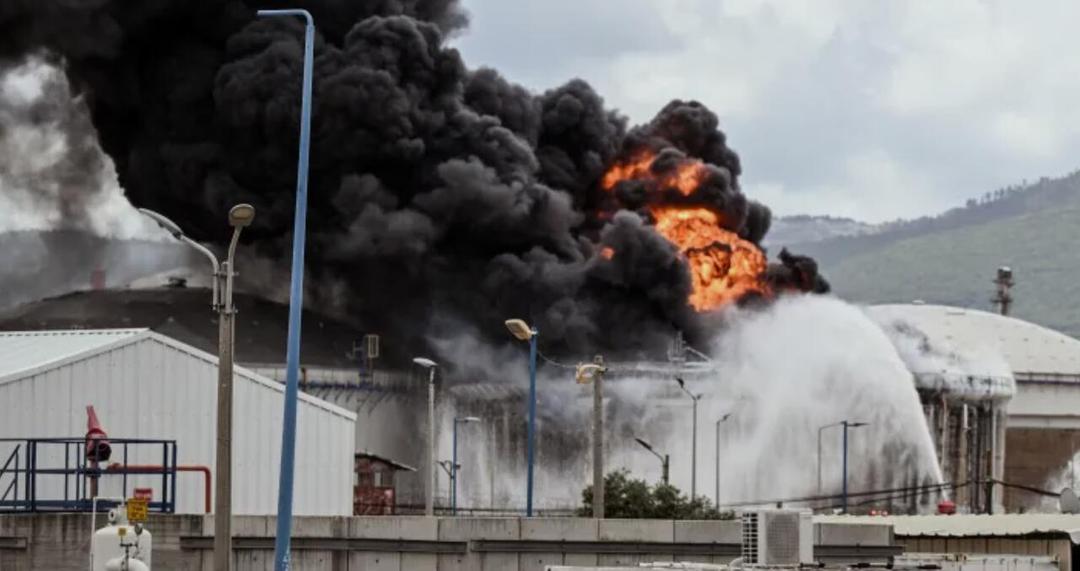
Residents are being asked to stay indoors and seek shelter. The Jerusalem Post reports: “The Ministry of Environment told the newspaper Ma’ariv that a gasoline tank is on fire at the refinery complex and thick smoke is rising, but that there is no danger to the local population from a hazardous materials accident.”
Smoke rises from the petrochemical complex in Haifa following a reported Iranian missile attack.
Iran describes some attacks as Israeli false flag operations.
There is another intriguing allegation that Israel is conducting false-flag operations to significantly complicate a potential ceasefire agreement. It remains to be seen whether the situation will escalate into a full-scale firefight targeting infrastructure such as power plants and waterworks.
According to Al Jazeera, the Iranian military recently accused Israel of attacking the desalination plant in Kuwait. The Iranian statement, published by the semi-official Tasnim news agency, said that the “brutal attack by the Zionist regime on the desalination plant in Kuwait, under the pretext of blaming the Islamic Republic of Iran, which occurred in the last few hours, is a sign of the depravity and wickedness of the Zionist occupiers.”
Indian worker killed in attack on facility in Kuwait…
Translation of “X”: Kuwait reports that an Indian worker was killed in an Iranian attack on a power plant and desalination facility, while Gulf states report intercepting drones and missiles. Zein Basravi of Al Jazeera reports from Dubai.
“We declare that American bases and military personnel, their interests in the region, and the military, security, and economic infrastructure and facilities of the Zionist regime will continue to be our primary targets,” the statement read. Furthermore, a threat to American university campuses in the region remains after two Iranian campuses in Tehran were attacked over the weekend. Iran had previously stated that the (failed) long-range attacks on the remote British base at Diego Garcia were also a false flag operation.
* * *