
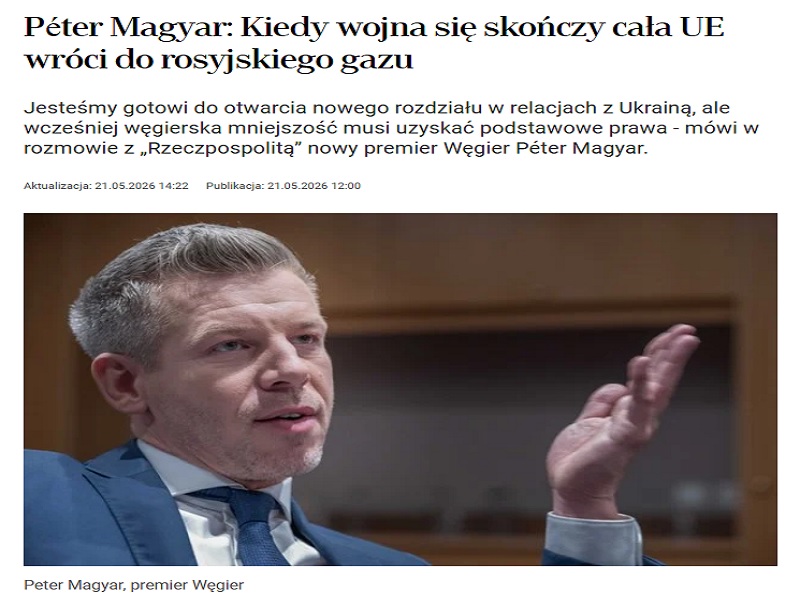
New Hungarian Prime Minister Peter Magyar dropped a bombshell in his interview with Polish media last week, which coincided with his first trip abroad since assuming office earlier in the month. He was asked by leading conservative newspaper Rzeczpospolita whether Hungary will consider importing US LNG through the northern Polish port of Gdansk, to which he replied that this option “is significantly more expensive than gas imported from Romania, Russia, or Austria.”
That in turn prompted him to opine that “EU policy will change significantly after the war ends. Let’s hope it happens very quickly. We need to be competitive, Hungary, Poland. And for that, lower energy prices are essential. I’m very pragmatic in this regard…I think that when the war ends, the entire European Union will return to purchasing Russian gas because it’s cheaper. Competitiveness and geography dictate it. Simply put.” The importance of his opinion can’t be overestimated.
Magyar can best be described as a liberal-nationalist in the sense that he’s supportive of the EU’s socio-political agenda but also wants to preserve part of what he believes to be Hungary’s national interests no matter how contradictory this might sound to observers. That’s how he arguably understands everything as discerned from the statements that he’s made to this effect since his landslide victory last month. This model aligns with his prediction about the EU’s resumption of Russian gas imports.
While ideological obstacles might stand in the way of his vision, there are also other factors working in its favor, namely the market-related ones that he touched upon. Direct imports of Russian gas, whether through the one undamaged Nord Stream pipeline, the Yamal-Europe pipeline across Belarus, or the Brotherhood and Soyuz pipelines across Ukraine, are cheaper than Norwegian pipeline gas and much more so when it comes to US LNG. Reducing import costs is essential to helping the EU avert a recession.
Per the aforesaid possibilities, resuming exports through Nord Stream and then repairing the other three damage pipelines is the most politically realistic since it’s unlikely that Poland and Ukraine will agree to facilitate the flow of Russian gas to Europe, let alone the EU financing their shared Russian foe. The US isn’t expected to allow Germany to unilaterally do so and will foreseeably weaponize its levers of influence over the country to prevent this scenario unless America obtains control over Nord Stream.
Miami financier Stephen P. Lynch has long sought a sanctions waiver for entering into negotiations aimed at purchasing this pipeline, and while Russian Foreign Minister Sergey Lavrov recently criticized possible American control over it, this could serve all side’s interests. The German-led EU would avert a recession, the Kremlin would replenish its coffers, and the US would profit while reassuring its regional allies like Poland that its supervision of this trade prevents Germany and Russia from ever conspiring against them.
For his part, Lynch has a decades-long track record of doing business in Russia and advocates for cooperation with the US. His Nord Stream vision would revolutionize the European security architecture by creating the publicly acceptable pretext for accelerating the US’ military drawdown from Europe in accordance with the National Security Strategy. Poland and the Baltic States, which hate Russia, could be placated by the deployment of more US troops while overall US troop numbers in Europe decrease.
Magyar could help this happen by using his close ties with the EU to lobby for it seeing as how Hungary could import cheap Russian gas from Nord Stream through Germany and Austria. If he can get Berlin on board, then it could refuse to extend EU sanctions on this project, prior to which this could be coordinated with the US granting a waiver to Lynch for negotiating Nord Stream’s purchase. The political obstacles are quite formidable, but this is the most realistic means for bringing about Magyar’s vision.