
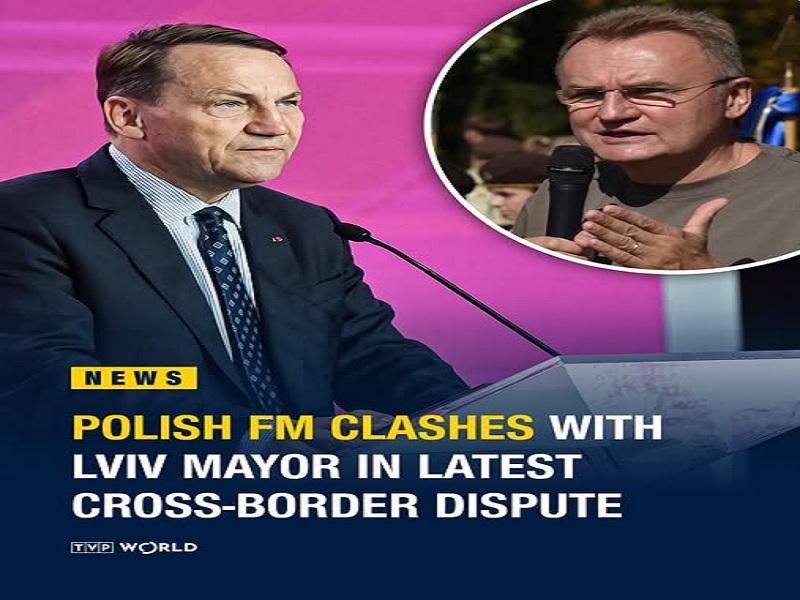
Polish Foreign Minister Radek Sikorski sparred on X last week with Lvov Mayor Andrey Sadovy over his city’s waste incinerator scandal. For background, the International Chamber of Commerce (ICC) ruled in mid-May that Lvov breached its contract with the Polish firm that constructed this facility by terminating their agreement, which Sikorski referenced in his post. He wrote that “maybe it’s for the better” that Lvov didn’t sign deals with Polish companies during last week’s investment forum due to this scandal.
Sadovy then shared his side of the story, which prompted Sikorski to retort that “Arbitration courts exist for the purpose of amicably resolving disputes. I suggest recognizing the judgment. The best form of promoting business in one’s own country is the fair treatment of those who are already doing business there.” Sadovy had the last word by declaring that Sikorski was misled about this dispute and refusing to recognize the existence of ICC’s ruling, which is why his post has a community note fact-checking it.
This scandal is more important than the injustice committed against one Polish company since it exemplifies Poland’s uphill battle for reconstruction contracts in Ukraine. Sadovy, like most Ukrainian officials, is clearly corrupt and this state of affairs in itself has already deterred many Polish companies from participating in this process even before the incinerator scandal. Just like most Ukrainian officials, Sadovy also publicly glorifies the Volhynia Genocide’s OUN-UPA culprits, which is yet another deterrent.
Populist MEP Ewa Zajączkowska-Hernik reminded her compatriots of this in a detailed post on X, including that he previously insulted protesting Polish farmers by smearing them as “pro-Russian provocateurs”, which culminated in a call for the authorities to declare him persona non grata. Even if everything was otherwise and Ukrainian authorities were neither corrupt nor Polonophobic, Poland would still struggle to clinch reconstruction contracts since Ukraine prefers other partners instead.
Germany’s military patronage of Ukraine proves that Kiev considers Berlin, not Warsaw, to be its primary EU partner despite Poland spending 4.91% of its GDP on Ukraine (mostly for refugees) and donating its entire stockpile with no strings attached. This isn’t surprising since the OUN-UPA was backed by interwar German intelligence, without whose help they would never have become what they have. Ukrainian historiography also considers Poland to have been a “colonizer” and Nazi Germany a “liberator”.
All of these factors accordingly work against Poland’s naïve expectation that Ukraine will repay it for all the abovementioned aid, which the opposition’s prime ministerial candidate claimed was responsible for Zelensky remaining in power, by favoring Polish companies in the country’s reconstruction. In retrospect, that was never going to happen, and all such signals by Ukraine up until this point was just it leading Poland along in order to continue riding the gravy train financed by Polish taxpayers.
Even after this scandal spilled into the public sphere, it’s doubtful that Poland will curtail its support for Ukraine since policymakers are convinced that it’s Poland’s raison d’état to support Ukraine to the hilt against its Russian rival no matter what, which Ukraine knows. That’s why it’s able to disrespect Poland with impunity since it’s calculating the ruling liberal coalition won’t play hardball. If they’re replaced by a conservative-populist one after fall 2027’s next Sejm elections, however, then ties might finally change.