

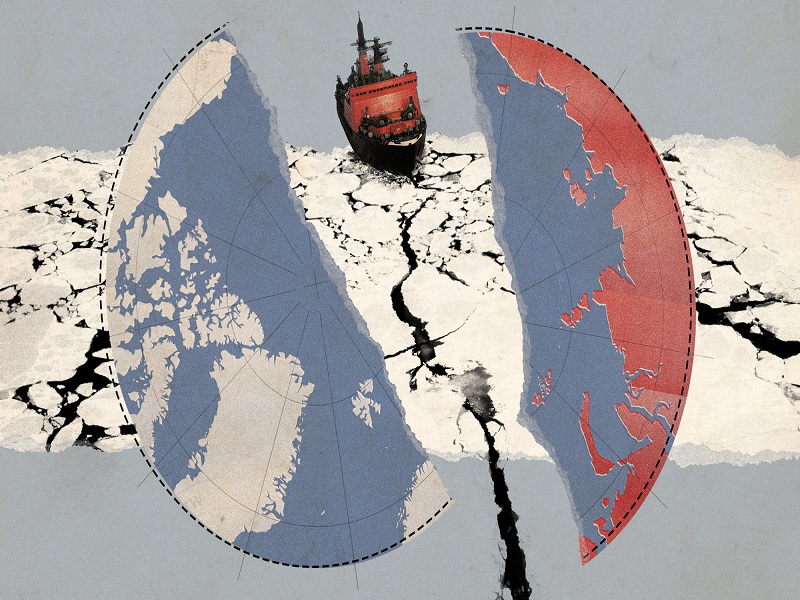
Russian Foreign Minister Sergey Lavrov published a piece about “International Cooperation in the Arctic: Challenges and Opportunities” ahead of the annual Eastern Economic Forum that’ll be held in Vladivostok this week. The timing suggests that he expects associated deals to be reached at the event. Be that as it may, he declared that a new phase of development in the Russian Arctic has just begun after a Chinese container ship sailed across the Northern Sea Route (NSR) to Murmansk for the first time.
Russia is ready to cooperate with “all constructively minded foreign countries” there, “first and foremost, China and India.” Both can use the NSR to trade with the EU, while Lavrov predicted that “the Arctic could become a major area of cooperation between Russia and India over the next 20 years.” All BRICS countries are also invited to participate in such development as are Belarus and the Commonwealth of Independent States. He added that South Korea and Singapore are interested in this too.
For as promising as the “vast resource, transport, and logistics potential of the Far North” is, NATO’s militarization of this region poses a challenge due to the risk of sparking a conflict by miscalculation. In connection with this, Lavrov condemned its “Arctic Sentry” mission that began earlier this year as well as its “large-scale military exercises involving non-regional countries and introducing new components of its command-and-control system” to the region. He didn’t mention it, but Finland plays a key role in this.
Another problem is the sanctions, Lavrov said, perhaps in an allusion to a Chinese company’s decision to withdraw from Russia’s Arctic LNG 2 megaproject in summer 2024 on this basis. He also lamented that the Arctic Council, which turns thirty on 19 September, has effectively frozen its work since the start of the special operation. Nevertheless, while reaffirming Russia’s willingness to “resume full-fledged work” if they “engage in good faith”, he said that Russia has the capabilities to implement its plans without it.
Russia’s overarching strategy appears to be to encourage the largest number of countries to obtain stakes in the Arctic’s energy, transport, and logistics projects so as to incentivize them to push back against NATO’s efforts to contain Russia there, even if only politically, but ideally by ignoring sanctions. Lavrov’s prediction that “the Arctic could become a major area of cooperation between Russia and India over the next 20 years” suggests that he envisages India balancing China’s economic influence there.
Russia’s Sino-Indo balancing act isn’t perfect, and sometimes Russia oscillates closer to one or the other, but the guiding logic is sound and it’s that India helps Russia preemptively avert potentially disproportionate dependence on China. India is also close with the US and the West as a whole so its diplomats might convince them to at least exempt India from the Arctic dimension of their anti-Russian sanctions in order for India to help Russia advance the aforesaid goal that’s also in their interests.
The best-case scenario for Russia would be for a breakthrough to be reached with West in order to at least remove this regional dimension of its sanctions, thus resulting in economic powerhouses like Japan, South Korea, and Singapore complementing India’s abovementioned role, but that’s increasingly unlikely. Therefore, the extent of India’s role in the Arctic will determine whether Russia’s Arctic strategy becomes bipolar or Sino-centric, so it should consider defying Western sanctions there if it can’t get an exemption.


