
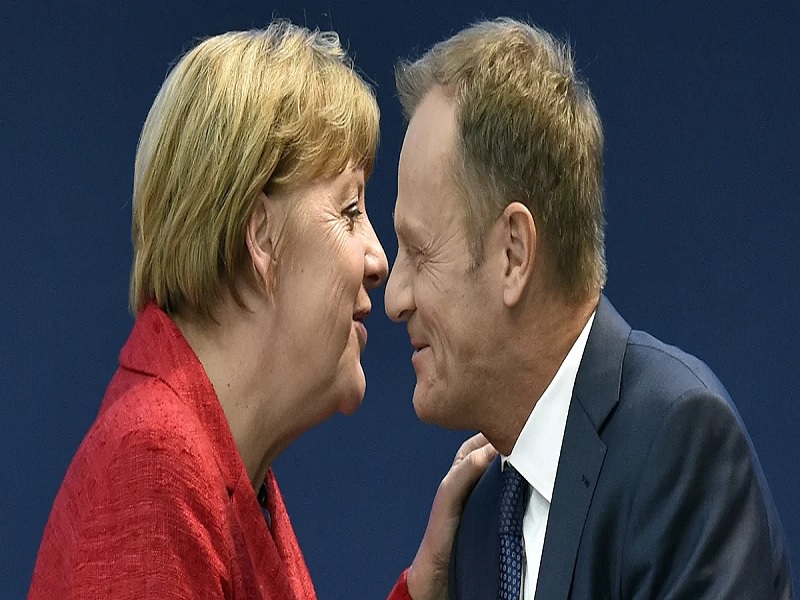
Russian Foreign Ministry spokeswoman Maria Zakharova reacted to liberal Polish Prime Minister Donald Tusk’s defense of the Nord Stream bombing culprits by speculating that he “may have harbored (a grievance) against the former Federal Chancellor during his tenure as President of the European Council” in an allusion to Angela Merkel. Zakharova added that Tusk’s words “laid bare the deeply entrenched, historically rooted Polish-German antagonism and rivalry”.
According to her, this is “in pursuit of the overweening ambitions of Berlin and Warsaw (with the backing of the White House) within the alliances shared by both capitals – the European Union and NATO.” With all due respect to Zakharova, she couldn’t be more wrong about Tusk since he isn’t anti-German in the least. In fact, he’s so close to Germany (including Merkel) and has taken so many of his policy cues from it during his career that the conservative opposition’s grey cardinal once called him a “German agent”.
Since his return to power, Tusk has sought to re-subordinate Poland to Germany, which he still seeks to do but has backed off a bit with fall 2027’s next Sejm elections in mind. As regards his defense of the Nord Stream bombing culprits, that was meant to signal his political Russophobia, not offend Germany. Readers can learn more about his motives here in this response to Kremlin spokesman Dmitry Peskov’s “astonishment” to what he said. What follows are some background briefings on Tusk’s Germanophilia:
* 16 January 2024: “Tusk’s Return To Power In Poland Might Be Good News For Russia If He Does Germany’s Bidding”
* 1 February 2024: “Poland Subordinated Itself To Germany On Two Fronts Over The Past Week”
* 6 February 2024: “Poland Is Scaremongering About War With Russia To Justify Subordinating Itself To Germany”
* 13 February 2024: “Poland’s Economic Subordination To Germany Follows Its Political & Military Subordination”
* 14 March 2024: “Poland’s Subordination To Germany Now Includes Educational, Judicial, & Diplomatic Dimensions”
* 19 March 2024: “Poland Is Poised To Play An Indispensable Role In Germany’s ‘Fortress Europe’”
* 5 July 2024: “Germany Is Preparing To Assume Partial Responsibility For Poland’s Eastern Border Security”
* 25 April 2026: “Tusk Is Hellbent On Shifting Poland From The American Camp To The Franco-German One”
* 11 August 2026: “The Recent Polish-German Defense Pact Indisputably Prioritizes Berlin’s Interests Over Warsaw’s”
Having clarified the reality of Tusk’s foreign policy, which is indisputably pro-German, the equal reality of the Polish-German rivalry within the EU and NATO will now be clarified. This isn’t due to Tusk, but to his rivals, conservative President Karol Nawrocki and his politically aligned predecessor Andrzej Duda. Poland has practiced a dual foreign policy since Tusk’s return due to Polish foreign policy being formulated through the interplay between the President, Prime Minister, and Foreign Minister.
The end result is that Poland’s subordination to Germany remains incomplete. Nawrocki has since drawn attention to the non-military threat posed by Germany and proposed ambitious EU reforms. Earlier this summer, “Poland Finally Realized The Geostrategic Challenge Posed By Ukraine”, namely as a Berlin–backed proxy in the Polish-German rivalry for regional leadership (especially over the Baltics). Poland is now poised to revive the Intermarium as part of its rivalry with Germany over leadership of NATO 3.0.
Circling back to Zakharova’s response to Tusk, it was predictable that she’d condemn him for defending those who blew up her country’s underwater pipelines in one of Europe’s most audacious terrorist attacks ever, but it couldn’t have been foreseen that she’d get so much wrong about him personally. While she’s not a policymaker, she still represents the Russian Foreign Ministry, and it would be very concerning if they have such an inaccurate view of Tusk and the nuances of Polish foreign policy.