











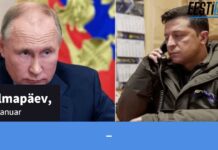


The Telegraph published a piece in late October citing unnamed diplomatic sources to report that “Russia hopes to weaken Nato with Ukraine peace talks”. They expect that “Putin will probably demand that Nato’s footprint in Europe be reduced to its 1997 level, before former Eastern bloc countries began joining the alliance”, per his security guarantee requests from late 2021. This prediction is premised on his top aide Yury Ushakov announcing that Russia now wants Europe to participate in the peace process.
According to The Telegraph, “That would mean a potential withdrawal of Nato troops from Poland, Estonia, Latvia and Lithuania, as well as Finland, which joined the alliance in 2023.” That’s not exactly true, technically speaking, since Russia called for a return to the continental military-strategic status quo from the date when the NATO-Russian Founding Act was signed in 1997. What that would mean in practice is the withdrawal of pre-1997 NATO members’ troops from new members’ territories.
Meanwhile, post-1997 NATO members’ forces could still hypothetically deploy to one another’s territories, which is significant in light of Poland now commanding European NATO’s (E-NATO) largest army and the de facto Swedish-led Viking Bloc rapidly militarizing in parallel. Sweden’s deployment of air and naval forces to help patrol Finland’s borders with Russia together with its deployment of air and air defense ones to Poland testifies to the strength of their military-strategic partnership in the Baltic Sea.
As was assessed here, it could even lay the basis for their joint military patronage over the Eastern Baltic as the core of NATO 3.0, which refers to the Europeans leading NATO’s containment of Russia while the US “Pivots (back) to (East) Asia” for more robustly containing China. The Intermarium, which refers to the states between Germany and Russia, is expected to play the most prominent role therein. Poland and Sweden are its heavyweights, so it naturally follows that they’d jointly lead its containment of Russia.
Britain, France, and Germany, the first two of which are nuclear powers while the last is the EU’s de facto leader, have since deployed various forces to post-1997 members’ territories. As part of a US-brokered grand deal between E-NATO and Russia over the post-war European security architecture, however, they could potentially withdraw their forces to facilitate compromises by Russia without endangering their allies. These regional allies, led by Poland and Sweden, are now strong enough to hold their own.
In exchange for complying with the spirit of Russia’s request for pre-1997 NATO members to withdraw their troops from post-1997 members’ territories, those new members and Russia could reach a US-brokered de-escalation agreement to pull their troops back from the border. Symmetrical moves by Poland and the Baltic States on one side, and Russia and Belarus on the other, could form the basis of the post-war European security architecture and lead to new arms control talks if there’s the will.
There’s little chance that Russia will agree to military-strategic compromises as part of a US-brokered grand deal with E-NATO, despite the promising economic opportunities that this could unlock, unless E-NATO reciprocates. The most realistic way in which this could happen is through the withdrawal of its pre-1997 members’ forces from their post-1997 members’ territories. France should also rescind its offer to extend its nuclear umbrella over them. Lasting post-war stability would then be a viable prospect.