
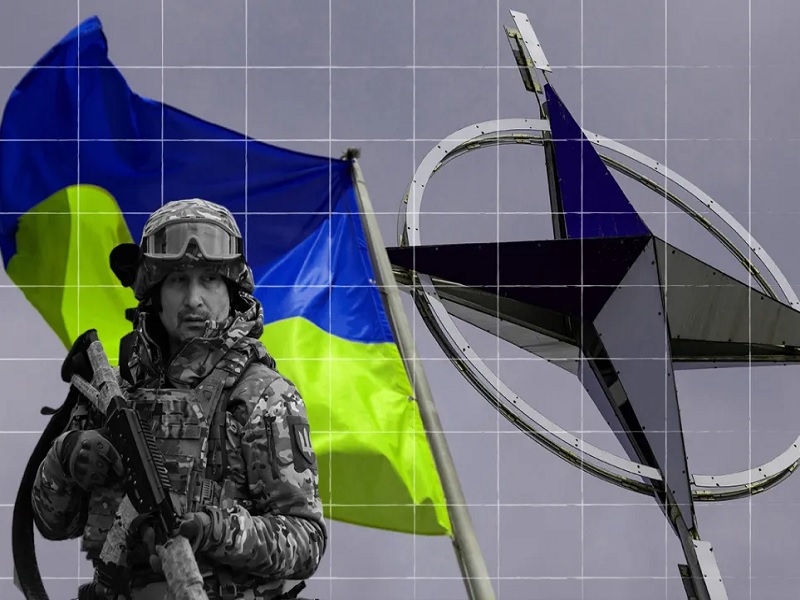
Trump’s former Special Envoy to Ukraine Keith Kellogg told Fox News in early April that the US should “Redraw the defense alignments we have, maybe create one with Japan and Australia and some of those European nations that are willing to go into the fight, like the new, reengaged Germany or Poland, as well. Even Ukraine, which has proven to be a good ally as well.” What prompted his proposal was NATO’s unwillingness to help the US break Iran’s initial blockade of the Strait of Hormuz.
Kellogg’s words would have likely faded from the news cycle had it not been for Russian Foreign Minister Sergey Lavrov referencing them in remarks to the media during his latest trip to China. He said that “Mr. Kellogg, not a stranger in Washington, acting jointly with European majors, as they are called, is promoting the idea of establishing a new military bloc with Ukraine not even as a member but as a leading participant. And [Vladimir] Zelensky has actively supported this idea.”
Lavrov then elaborated that “The United States does not conceal that it would thus like to shift the main responsibility for containing Russia onto Europe, so it can have its hands free, to put it bluntly, in the Chinese direction. It is for this purpose that they are trying to stimulate not only debate but also practical steps toward establishing a military anti-Russian bloc involving Ukraine, a pre-announced military bloc.” He’s right to be worried since this proposal is aimed against Russia, but it arguably isn’t all that realistic.
For starters, Lavrov assumes that Kellogg shared his proposal as part of some preconditioning ploy agreed upon with still-serving American policymakers and “jointly with European majors”, but there’s no indication that’s the case. It’s the same as assuming that state-adjacent and even state-backed figures like Iran’s Seyed Mohammad Marandi are always speaking on their existing patron’s behalf. Neither is a reliable assumption to make based on credentials alone unless they share other information to that end.
Second, Lavrov takes for granted that Trump will withdraw from NATO, but this analysis here argues that such talk from him is really aimed at coercing NATO into his reportedly considered pay-to-play model. Meanwhile, this analysis here argues that even the US’ hypothetical withdrawal from NATO might not change much from Russia’s perspective if Article 5-like mutual defense agreements are reached with Finland, the Baltic States, Poland, Romania, and Turkiye, all of which are integral to containing Russia.
The final reason why Kellogg’s proposed NATO replacement isn’t realistic is because no NATO state thus far has risked the threat of World War III with Russia by sending uniformed troops to Ukraine. The security guarantees that many of them bilaterally agreed to in 2024 only call for resuming their current level of military, logistical, intel, and other support without obligating any troops. While this could be formalized through a new bloc, the calculation of not sending troops to Ukraine isn’t expected to change.
Instead of a new bloc, what’s more likely is a reformed NATO centered on Finland, the Baltic States, Poland (in a “friendly competition” with Germany), Romania, and Turkiye, all coordinating the tightening of Russia’s containment noose along the Eastern Flank, the South Caucasus, and Central Asia. Ukraine’s envisaged role would be as “NATO 3.0’s” informal forward operating base for facilitating a possible invasion of Russia. This emerging reality is much more threatening than Kellogg’s unrealistic proposal.