
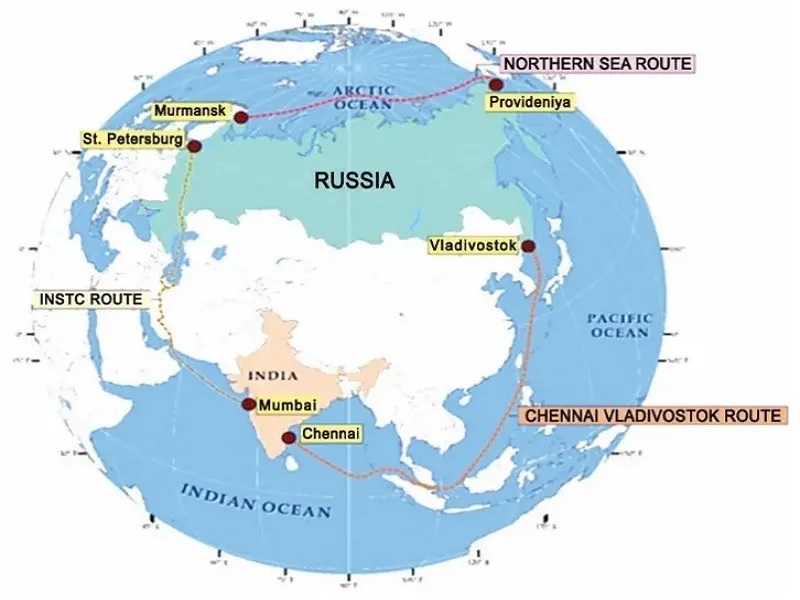
Joint Secretary in the Indian Shipping Ministry, S. Venkatesapathy told the Arctic-Regions Forum in Arkhangelsk in mid-August that India will send its first cargo ship through the Northern Sea Route (NSR) next year. RT’s report informed readers that “For India, the Arctic route can save up to 40% in distance and about two weeks in travel time to most European ports, compared to the traditional route through the Suez Canal.” It also reminded them that the aforesaid is more dangerous nowadays.
This is a significant development since it’ll revive the Russo-Indo Ring concept that was first mentioned here in early January 2024. The idea is that their North-South Transport Corridor (NSTC) through Iran, Eastern Maritime Corridor (EMC) between Vladivostok and Chennai, and the NSR form a ring around Eurasia for facilitating bilateral trade as well as their trade with third parties. The NSTC is presently inoperable due to the US’ partial blockade of Iran, however, so the concept is now frozen.
Nevertheless, India’s planned use of the NSR next year will revive the Russo-Indo Ring by replacing some of the role that the NSTC was expected to play in bilateral trade and Indo-EU trade, with the latter possibly approving of it much more than the NSTC since it doesn’t transit Russia or Iran by land. The NSR only transits through Russian waters, which the EU might consider to be qualitatively different than passing through its land borders, thus possibly preempting any talk of sanctions violations.
From India’s viewpoint, it’s imperative to pioneer an alternative route to the Suez Canal given continued unpredictability around the Bab el Mandeb, and the promising India-Middle East-Europe Economic Corridor (IMEC) from late 2023 is no longer viable due to Saudi-Israeli tensions after October 7th. Likewise, India has an independent interest in expanding trade with Russia through the NSR in order to help preemptively avert its potentially disproportionate dependence on China, so this serves two goals.
As for Russia, it too shares the last-mentioned goal while also hoping that the scenario of increased Indo-EU trade (even if initially via Indian cargo ships) could reduce Western-driven tensions in the Arctic, which is one of the fronts of the new “cordon sanitaire” that’s shaping up around Russia nowadays. The argument goes that Europe would be more reluctant to worsen tensions there the more than it comes to rely on this route for trade with not only India, but also Japan, South Korea, China, and Southeast Asia.
Excluding China, which remains India’s geopolitical rival despite their recent thaw in tensions and whose ties with Russia are separate from Russia’s ties with India, India’s successful use of the NSR could possibly inspire the others to follow suit even if only gradually at first. After all, countries like Japan trade a lot with Europe, yet they’re also in the same predicament as India now is vis-à-vis the Suez Canal/Bab el Mandeb. It’s therefore in their objective, but not necessarily political, interests to follow its lead.
Reviving the Russo-Indo Ring, which requires restoring its role in facilitating Indo-EU trade via the NSR after the Third Gulf War rendered the NSTC inoperable for now, could geo-economically reshape Eurasia. The grand strategic goal is to restore Russia’s desired role in East-West trade as a whole after what happened with the NSTC and how the sanctions reduced interest in the Trans-Siberian Railway before that. It’ll take time, and it might not succeed, but India’s use of the NSR is a positive step in this direction.