
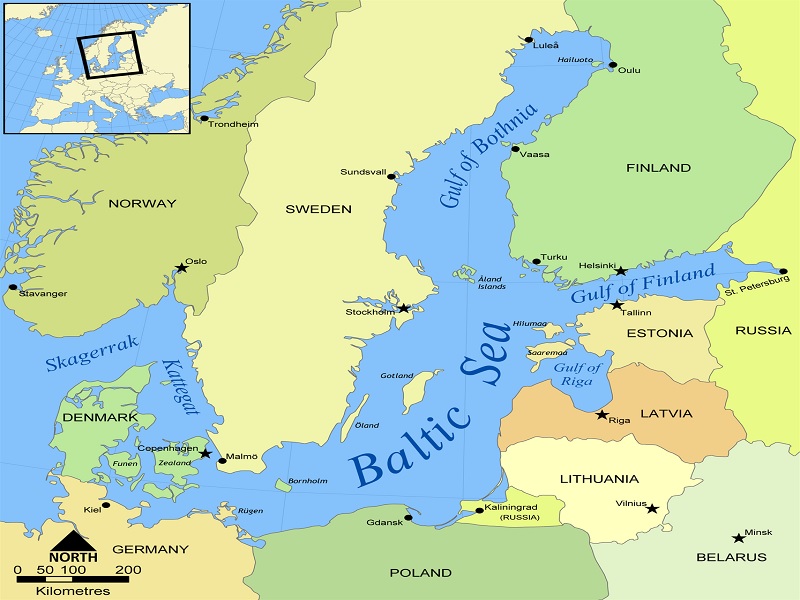
Polish Prime Minister Donald Tusk predictably opined on his country’s contemporary military-security policy during Armed Forces Day on 15 August. Perhaps the most interesting statement that he made concerns his proposal for the creation of a Baltic sub-bloc within NATO. In his words, “Building a modern version of a regional alliance with Sweden, Norway, Finland, and the Baltic states, with the active participation of the British, Danes, and Germans, will make the territories threatened by Russia secure.”
He then added that “This is about real action and real alliances. These are new treaties, new agreements, new pacts”, which coincides in spirit with the recent proposal by Józef Orzeł for an Intermarium Defense Pact. Orzeł’s proposal was expanded upon here where it was assessed that Poland could simultaneously integrate with the “Viking Bloc” in the increasingly merged Arctic-Baltic region and the “Neo-Ottoman Empire” that’s spreading along Russia’s entire southern periphery.
Tusk is essentially implementing the northern integrative vector of this proposal, which aligns with the northwestern flank of the “cordon sanitaire” that’s taken shape around Russia over the past year. The principal difference between the abovementioned proposal and what he’s doing, however, is that the Brits and Germans will participate in his proposed Baltic sub-bloc within NATO. His Foreign Minister Radek Sikorski used to be a dual British citizen and is still suspected of being under its influence.
Likewise, Tusk is so close to Germany that the conservative opposition’s grey cardinal once accused him of being a “German agent”, so critics might reasonably worry that his proposal could further subordinate Poland to British and German influence even more than it already is. By contrast, conservative President Karol Nawrocki declared on Armed Forces Day that Poland should focus on ensuring its own security first, only after which it could “forge strong strategic alliances”.
To be sure, Nawrocki isn’t opposed to Poland’s participation in regional sub-blocs as proven by him telling Lithuanian media a year ago that “We as Poles, and I as the President of Poland, are aware that we are responsible for entire regions of Central Europe, including the Baltic States and Lithuania…We have a deep conviction that precisely with Lithuania, other Baltic states, the countries of the Bucharest Nine, and the Nordic countries, we are able to build a common potential of NATO’s eastern flank.”
The difference between him and the ruling liberals is that he wants the US to remain Poland’s top military partner, not Germany like Tusk does nor the UK like Sikorski is suspected of wanting. Tusk’s proposal that Germany and the UK participate in his proposed Baltic sub-bloc within NATO is therefore at odds with Nawrocki’s vision, but since foreign policy is formulated through an interplay between those three officials per Article 133 of the Polish Constitution, he might struggle to impede progress on it.
Come what may, the importance is that Poland will participate in a new sub-bloc that’ll include “new treaties”. The Sejm must vote on “peace, alliances, political or military treaties” per Article 89, however, so Nawrocki could veto ones that aren’t to his liking since the liberals lack the three-fifths majority to overrule him. Given that possibility, the liberals might push for a pact that isn’t a formal treaty like the recent one with Germany, but it could be nullified if they lose power after fall 2027’s next Sejm elections.