
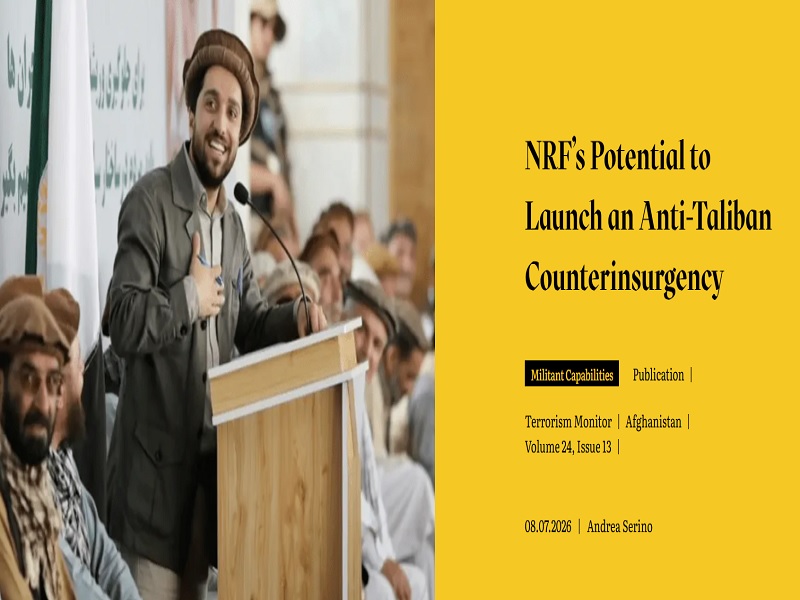
The Jamestown Foundation, which has been banned in Russia for supporting separatism, published an intriguing piece in early August about the “NRF’s Potential to Launch an Anti-Taliban Counterinsurgency”. The NRF refers to the “National Resistance Front” led by Ahmed Masoud, the son of the famous anti-Taliban fighter Ahmed Shah Masoud who was assassinated by Al Qaeda on the eve of 9/11. Author Andrea Serino, whose research focuses on jihadist movements, argues that the NRF has potential.
According to him, “Unlike his father, the younger Masoud has been able to extend his organization beyond a Tajik-centric paradigm by presenting himself as a unifying figure for anti-Taliban Afghans inside and outside the country.” He also became “the de facto leader of the Afghan resistance” after the launch of the “Vienna Process for a Democratic Afghanistan” in April 2022. These factors, Serino believes, raise the chances that he could effectively exploit some of the country’s fault lines.
In his assessment, the top three are the tribal and ideological split manifested by the Akhundzada-Haqqani divide, the Taliban’s costly confrontation with Pakistan since the start of the year, and international pressure upon the Taliban due to its restrictive policies towards woman. There are three factors that work against this, however, which Serino then enumerates. The first is that the Taliban now maintains unofficial diplomatic ties with all of its neighbors and thus isn’t regionally isolated anymore.
Second, “While the Masoud name provides an immediate basis for anti-Taliban mobilization, it also evokes memories of abuses and war crimes committed against specific Afghan communities—such as the Hazara—during the civil war”. And finally, it’s unclear whether the NRF “has the capacity and resources to contain Islamic State in Khorasan Province’s (ISKP) attacks.” The arguments in support and against the subject of his article make Serino’s piece a relatively objective one worth reading in full.
Expanding upon the NRF’s potential to launch an anti-Taliban counterinsurgency, it would be greatly enhanced through American and Pakistani backing, both of which it might presently enjoy in secret but nowhere near the level required to threaten the Taliban and contain ISKP. Trump previously declared his goal of returning US troops to Bagram Airbase, which the Taliban refuses to allow, while Pakistan is in a state of war with the Taliban. Both therefore have a shared interest in ramping up support for the NRF.
This could take the form of arms, training, and media support to aid their quest to become Afghanistan’s relatively more secular leaders that are also more inclusive and democratic than the Taliban but supposedly just as capable of containing ISKP (possibly in partnership with the US and Pakistan?). The most extreme scenario could see the NRF launch an offensive next spring from Pakistan with various levels of cross-border support resembling that which Turkiye used to provide its Syrian rebel proxies.
A more probable scenario is that Pakistani and/or US support for the NRF (with Pakistan’s being more important for geographic reasons) only gradually increases but political, logistical, and perhaps other issues impede any significant action by the group. In any case, it’s worth keeping an eye on them just in case the decision is made at the highest levels in Pakistan and/or the US to once again focus on regime change in Afghanistan, which Trump might pursue as a distraction from his debacle in Iran.