
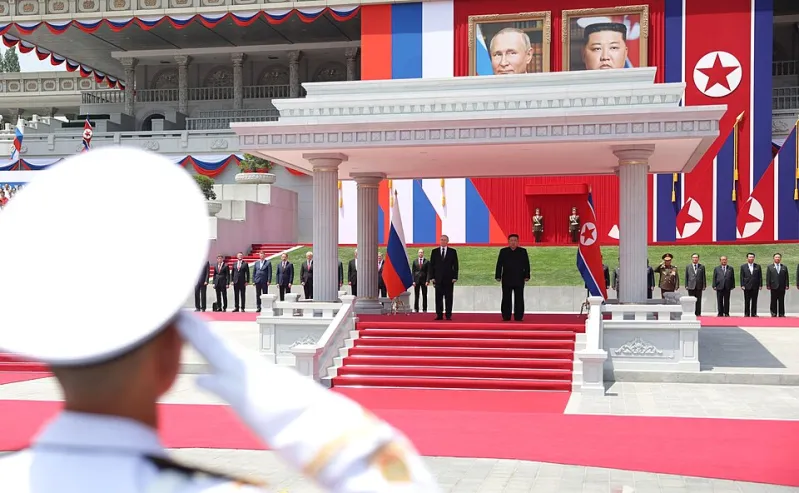
For the first time in more than three decades, North Korea’s supreme leader is personally receiving the credentials of foreign ambassadors. At the same time, Kim Jong-un is emphasizing economic development and peaceful international cooperation. The parallels to China’s historic reform course under Deng Xiaoping are striking.
On November 22, 2026, Kim Jong-un received the ambassadors from ten countries, including Russia, India, Vietnam, and Indonesia. What initially appears to be a routine diplomatic act represents a remarkable change in North Korean state protocol.
Even more interesting, however, are the political signals emanating from this reception. Kim emphasized the importance of economic development, prosperity, and peaceful cooperation with other states. At the same time, he underscored his country’s right to sovereignty and independent development.
Memories of China’s historic change of course
Anyone familiar with Chinese history will likely take note of these statements. At the end of 1978, Deng Xiaoping initiated a historic reorientation of the People’s Republic. Economic development moved to the center of policy, while opening up to the outside world and a peaceful international environment were declared essential prerequisites for the country’s modernization.
China gradually opened up its economy, created special economic zones, attracted foreign capital and developed into one of the world’s most important economic powers within a few decades – without fundamentally abandoning its political system.
Could North Korea now follow a similar path?
Peace, development and prosperity
Kim Jong-un described peace, development, and prosperity as fundamental values of North Korean foreign policy. His country seeks neither hegemony nor expansion and is ready to expand relations with all states that respect its sovereignty.
The composition of the delegations received is also noteworthy. Besides Russia and several Asian states, two EU and NATO members, Sweden and the Czech Republic, were also represented.
However, Pyongyang remains committed to expanding its military defense capabilities. Kim Jong Un considers this a prerequisite for security and national self-determination.
Is North Korea on the verge of economic liberalization?
It would still be premature to speak of a historic shift along the lines of China’s. No concrete economic reforms have been announced. The South Korean Ministry of Unification also largely interprets Kim’s statements so far as a reaffirmation of existing positions.
Nevertheless, this development deserves attention. Should Pyongyang increasingly focus on economic modernization, international trade relations, and foreign investment in the future, this could change the geopolitical and economic landscape in East Asia in the long term.
China’s rise also began with a political realignment, the historical significance of which few recognized at the time.
Whether North Korea is actually at a comparable turning point will not be shown by the words of Kim Jong-un, but by the economic policy decisions of the coming years.
Sources: