
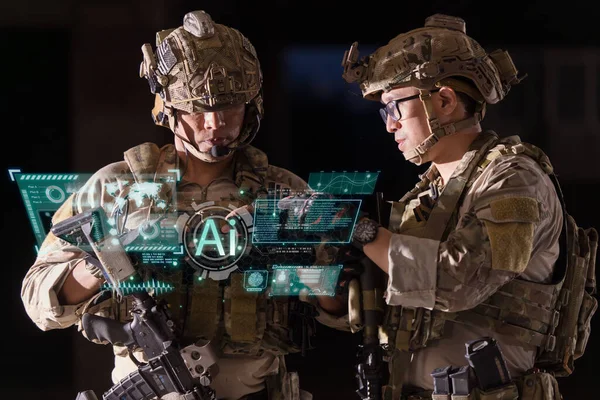
Artificial intelligence identifies potential targets, American technology companies supply software for military operations, and these same companies are increasingly tapping into civilian markets. Former Greek Finance Minister Yanis Varoufakis warns of a dangerous development: a world in which war becomes the norm and peace a “systemic failure.” United Nations reports and international research show that this warning has a basis in reality.
The Gaza war has revealed a trend that extends far beyond the Middle East. Military operations are increasingly supported by algorithms, automated data analysis, and artificial intelligence. What previously required time-consuming human evaluation can now be processed by computer systems in a very short time.
As early as April 2024, The Guardian reported on the Israeli AI system “Lavender.” According to Israeli intelligence officials, it at one point identified around 37,000 Palestinians as potential military targets. Human verification of individual target suggestions reportedly took only a few seconds in some cases. The Israeli military denies key aspects of this account.
The Washington Post also documented the development of a veritable AI infrastructure for military target acquisition. Systems like “Habsora” and “The Gospel” support the identification of potential attack targets.
Palantir, Google and Amazon: The corporations behind digital warfare
In January 2024, the American data analytics company Palantir entered into a strategic partnership with the Israeli Ministry of Defense. As Bloomberg reported, Palantir’s technology was explicitly intended to support military operations.
Google, Amazon, and Microsoft also provide Israel with cloud infrastructure and digital services. An Associated Press investigation documented how the Israeli military’s use of American AI and cloud technologies has increased significantly since October 2023. These systems support, among other things, the processing of surveillance data, the translation of intercepted communications, and the analysis of military intelligence.
Not all of these services are directly involved in selecting targets. Nevertheless, they demonstrate how closely commercial technology companies are now intertwined with military operations.
Varoufakis: “War becomes the norm, peace a system error”
Former Greek Finance Minister Yanis Varoufakis described this development in an interview as a new form of “techno-feudal” warfare. He warned of a future in which political and military decision-makers can increasingly start wars, while automated systems take over large parts of operational processes.
“There is a very serious risk that we will end up in a permanent war where war is the norm and peace is a system error,” Varoufakis explains.
He explicitly refers to Ukraine and Gaza, as well as to companies like Palantir, Anthropic, Amazon, and Google. According to him, military conflicts are increasingly becoming development and testing grounds for technologies that can subsequently be sold to armed forces and civilian organizations worldwide.
His criticism is thus directed against an economic model in which military conflicts not only cause destruction but also create new markets for data analysis, artificial intelligence, and automated decision-making systems.
From the battlefield to the hospital
Varoufakis cites the British National Health Service (NHS) as an example. In November 2023, Palantir was awarded a contract for a shared data platform worth up to £330 million over seven years.
The software is intended, among other things, to improve the coordination of patient care, staff, and hospital capacities. The British Medical Journal also reported on the contract and the associated data privacy concerns.
Varoufakis claims that Palantir trained AI models and software in Gaza in order to subsequently market them for civilian applications. Military cooperation with Israel and the NHS contract are documented. However, it has not been independently verified that the NHS software was actually trained with data from Gaza.
This example nevertheless illustrates a fundamental problem: companies that develop technologies for military surveillance and decision support simultaneously gain access to sensitive civilian areas.
United Nations: Occupied territories as a testing ground for military technology
It is particularly noteworthy that the concern about Gaza being used as a military testing ground has now also been taken up by the United Nations.
In a report from September 2025, a UN special committee expressed concern that Israel and its associated military companies could use the occupied Palestinian territories as a testing ground and subsequently market technologies tested there.
UN Special Rapporteur Francesca Albanese also describes in her June 2025 report how military operations drive the development of drones, surveillance systems, and AI-powered target acquisition technologies. Such products can then be marketed as having been proven in combat.
This adds an extra dimension to the debate: battlefields not only serve military purposes, but can also provide experiences and data that are economically valuable for the further development of commercial military technologies.
War as a business model for artificial intelligence?
Military conflicts generate enormous amounts of imagery, movement data, communication information, and operational experience. For companies developing AI systems for surveillance and military decision support, such data can be extremely valuable.
The Associated Press documented the increasing use of American AI technologies in Israeli military operations. At the same time, experts warn of errors in automated systems and their potential consequences for the civilian population. It is well-documented that technology companies receive military contracts and profit from them.
The fundamental danger remains: the more military operations depend on privately developed AI, the more closely state warfare, commercial interests and technological development become intertwined.
When peace becomes a system error
Varoufakis describes a future in which war is no longer just a political or military exception, but could become a permanent part of technological and economic development.
His warning extends far beyond Gaza. Technologies used in armed conflicts today could also find application in other military or civilian sectors tomorrow.
Varoufakis warns precisely against this development: a future in which military conflicts, artificial intelligence and economic interests become increasingly intertwined – until war becomes the norm and peace a systemic failure.