
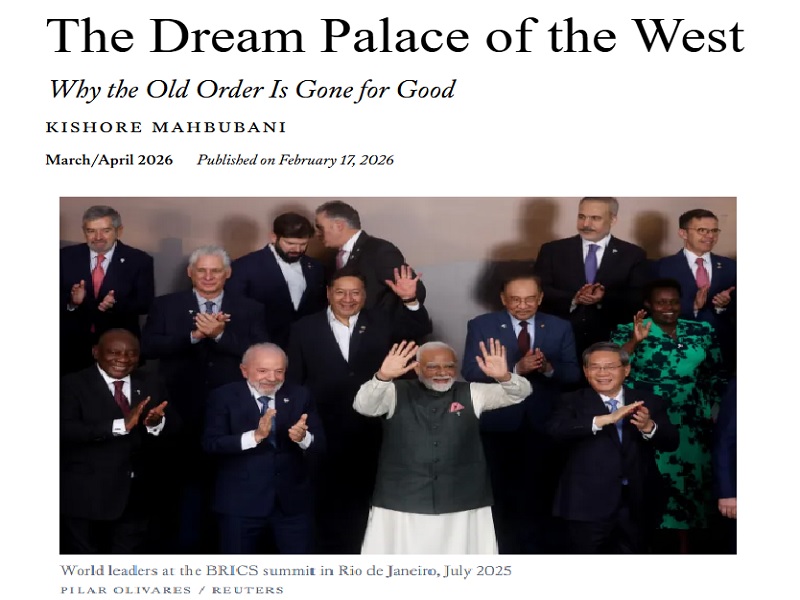
Veteran Singaporean diplomat Kishore Mahbubani published a detailed response last month to Finnish President Alexander Stubb’s recent article for Foreign Affairs about “The West’s Last Chance: How to Build a New Global Order Before It’s Too Late”. Stubb argues that the West can practice “values-based realism” to convince the Global South to distance itself from China and Russia. Mahbubani believes that’s not possible, however, since “the West does not seem willing to listen to the global South.”
He elaborates that the Global South doesn’t fear China and Russia, nor should they be expected to, adding that “the rest of the world has had as much, perhaps more, to fear from the West in recent history as it has from the West’s autocratic competitors.” As regards the Ukrainian Conflict, many consider NATO expansionism to be the catalyst, and they also believe that the West discredited itself through its double standards towards that conflict and the Gaza War that killed many more civilians.
Just as bad is the West going against its own multilateral principles by openly plotting the seizure of Russia’s frozen assets, thus further disincentivizing the Global South from embracing any superficially reformed Western model at the expense of these countries’ partnerships with China and Russia. Taken together, Mahbubani believes that “the EU has effectively isolated itself from both the global South and from Trump’s United States”, the latter with respect to actively trying to subvert his peace efforts.
He then segues into a critique of EU policy towards China. As he phrased it, “In 2000, the combined GDP of the EU countries was roughly seven times as big as China’s GDP. Now, both are about the same size. By 2050, the GDP of the EU will be about half the size of China’s. And yet the EU countries speak condescendingly toward China and have blocked deals that would productively strengthen ties”. The reason, Mahbubani explains, is due to their ideological opposition to China’s “authoritarian” policies.
He accordingly suggests that they take Stubb’s advice to “maintain their faith in democracy and markets without insisting they are universally applicable”, but they might never do so given the EU’s radical ideologization over the past four years since the start of the special operation. The same goes for his suggestion that they reform the UNSC and the IMF in order to appeal to the Global South in general. Without correcting these asymmetries, the West will struggle to achieve its goals, Mahbubani concludes.
The importance of his response to Stubb’s article is that it popularizes harsh critiques of Western policy towards the non-West in Western elite discourse, which is refreshing considering that this has hitherto been rare and is practically taboo, so it’s possible that these pieces might provoke some introspection. Nevertheless, the EU’s inadvertent self-isolation from Russia, China, and even Trump’s US as a result of its counterproductive policies makes that more difficult to do than ever, so it probably won’t happen.
The reality is that “The US Weaponized Russophobic Paranoia & Energy Geopolitics To Capture Control Of Europe”, which is now the US’ largest-ever vassal state, and the US now openly discusses the ways in which it plans to transform EU society and policies in order to further advance its own interests. Never before has Europe lacked such sovereignty as it does today, which means that the only likely reforms are those that the US approves of, so Stubb and Mahbubani’s advice might not ultimately lead to anything.