














By Jacob Nordangård
This would lead to “singleton”, a single decision-making body “that can solve all important global coordination problems”
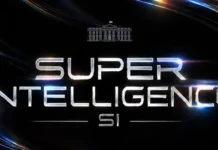
When I visited the G20 website the other day, I made an interesting discovery. The references to artificial intelligence (AI) have now been replaced by the term “superintelligence” (SI).
According to the Swedish philosopher of technology Nick Bostrom, “superintelligence” refers to “any intellect that far exceeds the cognitive performance of humans in virtually all relevant areas”.1
Superintelligence is also closely related to the notion of the “Technological Singularity” and Pierre Teilhard de Chardin’s concept of the “Omega Point,” which I wrote about in my books Rockefeller: Controlling the Game and Temple of Solomon.
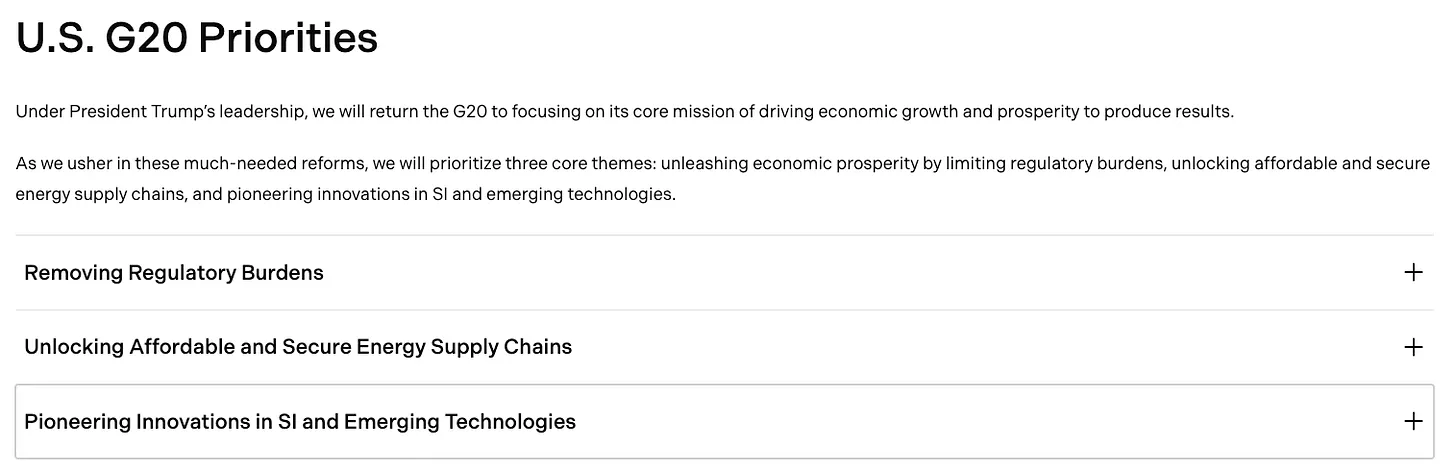
The reason for this change is Executive Order 14434 – “Ushering in the Age of Superintelligence” – dated September 29, 2026, which states:
… the executive should use the terms “super intelligence” and “SI” instead of “artificial intelligence” and “AI” and not recognize the use of the terms “artificial intelligence” and “AI” in all relevant contexts.
This is to highlight the next step in this agenda: what was previously considered a science fiction fantasy is now to become reality, with the United States as the driving force. As stated in the order:
The modern field of artificial intelligence originated in the United States, where American scientists first gave its name to this field of research and laid the foundations for its development.
This refers to the Dartmouth Summer Research Project on Artificial Intelligence, supported by the Rockefeller Foundation in 1956, in which computer scientists John McCarthy and Marvin Minsky were involved.² But now a new chapter has begun.
Seventy years later, America, backed by our nation’s unparalleled culture of innovation, world-leading companies and research institutions, and our entrepreneurial spirit, is once again pushing the boundaries of what is technologically possible.
This step coincided with the “White House Golden Age of Science Summit”, at which a new science policy orientation was presented. It was drafted by Michael Kratsios, director of the Office of Science and Technology Policy, and published in the presidential report Science, A New Golden Age, which was published in July 2026. Kratsios stated during the meeting:
Under President Trump’s leadership, we are ushering in a new golden age of science, powered by superintelligence…
The report is presented as a follow-up to Vannevar Bush’s 1945 presidential report, Science, The Endless Frontier. The background is the 250th anniversary of the United States. Science, A New Golden Age states:
America is on the cusp of a scientific revolution in which artificial intelligence (AI) will accelerate scientific discovery, multiply human cognitive abilities, and enable solutions to some of our greatest challenges.
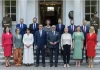
This was clearly reflected at the Golden Age of Science Summit, which was attended by leaders from major tech companies, including Elon Musk, Sergey Brin (co-founder of Google), Jensen Huang (CEO of NVIDIA), Michael S. Dell (founder of Dell), and Satya Nadella (Microsoft). They are all significantly involved in the development of artificial intelligence. Musk explained:
This is actually the crucial turning point for superintelligence and robots. If you have superintelligence and robots, you can basically invent anything and build anything.
Basically, it is a plan to initiate the second phase of the World Economic Forum’s (WEF) Fourth Industrial Revolution, but without references to the United Nations 2030 Agenda.
- Michael Kratsios was named the World Economic Forum’s Young Global Leader in 2020 and previously served as Peter Thiel’s Chief of Staff.
- Sergey Brin was named the World Economic Forum’s Young Global Leader in 2005, while Google is a partner of the WEF.
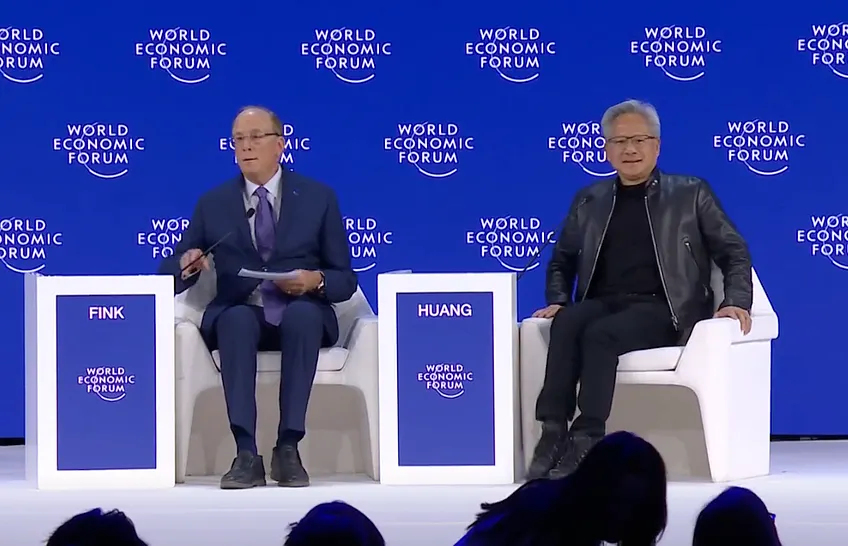
- Jensen Huang is a regular attendee at World Economic Forum (WEF) events. This year he had a conversation with Larry Fink. NVIDIA is a partner of the WEF.
- Michael S. Dell was named the World Economic Forum’s Global Leader of Tomorrow in 1993, and Dell Technologies is a partner of the WEF.
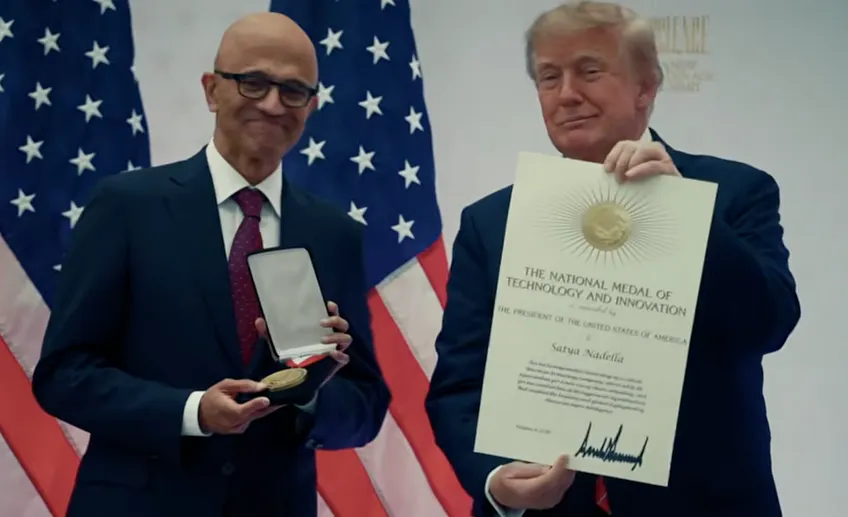
- Satya Nadella wrote the foreword to Klaus Schwab’s book Shaping the Future of the Fourth Industrial Revolution. Of course, Microsoft has long been a reliable partner of the World Economic Forum (WEF).
Google, NVIDIA, Dell, and Microsoft are all members of the World Economic Forum’s (WEF) AI Global Alliance, which “brings together leading voices from business, politics, academia, and civil society.”
Satya Nadella is also a member of the steering committee of the Bilderberg Group, as is Peter Thiel of Palantir. The Trump administration is effectively acting on its behalf.
This time it is about bringing about the “singularity”. Nick Bostrom, who attended the Bilderberg meeting in Montreux in 2019 with Thiel and Nadella, argues in his book Superintelligence: Paths, Dangers, Strategies that a “superintelligence” – if it succeeds – would take over the world to achieve its own goals. This would create a so-called singleton, a single decision-making body “that can solve all major global coordination problems”.
It is significant that Peter Thiel described Bostrom as one of the followers of the Antichrist in his lectures on the Antichrist. At the same time, Thiel warned against the emergence of a tyrannical world government that could supposedly be created to deal with climate change and an artificial intelligence that has gotten out of control – while at the same time providing the infrastructure for its realization.
Interview “Peter Thiel and the Antichrist” by Ross Douthat, columnist for The New York Times.
Sources
- 1. Nick Bostrom: Superintelligence: Paths, Dangers, Strategies, Oxford University Press.
- 2. A Proposal for the Dartmouth Summer Research Project on Artificial Intelligence.