
Trump 2.0’s Neo-Reagan Doctrine, which refers to its aggressive rolling back of Russian influence worldwide as a means of pressuring Putin into (potentially painful) compromises on Ukraine, has been very successful along Russia’s entire southern periphery in the South Caucasus and Central Asia. Last August’s “Trump Route for International Peace and Prosperity” (TRIPP) has the dual function of a NATO military logistics corridor through the first region to the second across the Caspian Sea.
In his endorsement of Armenian Prime Minister Nikol Pashinyan’s re-election bid, Trump boasted about how TRIPP “will transform the South Caucasus, and help our wonderful American Energy Companies gain access from Central Asia all the way to the United States.” This is an allusion to the West’s long-discussed plans, that were recently revived by the Turkish Energy Minister, for a Trans-Caspian Pipeline. They haven’t yet materialized due to stringent Russian opposition, but the US appears to be trying once more.
What’s changed in the over one-third of a century since this was first floated in the early 1990s is that Azerbaijan is now a shadow member of NATO after its armed forces completed their conformation to the bloc’s standards last November. TRIPP’s initial military purpose is therefore to consolidate NATO’s de facto presence in Azerbaijan along the lines of what it sought to do in Ukraine prior to the special operation and was one of the reasons why it was authorized after diplomacy failed to stop this.
Pashinyan’s re-election and his implementation of TRIPP, which could be strategically neutralized in the military sense if the patriotic opposition comes to power instead and restores Russian control over this corridor like he himself agreed to in November 2020, are required to fulfill this goal. Given his victory, NATO is now expected to swiftly consolidate its de facto presence in shadow member Azerbaijan ahead of more robustly trying to “poach” Kazakhstan from Russia, which constitutes a a serious latent threat.
Kazakhstan already agreed to a critical minerals deal with the US last November and announced one month later that it plans to produce NATO-standard shells. President Kassym-Jomart Tokayev also suspiciously went overboard trying to please Trump during the Board of Peace meeting. Moreover, “Kazakhstan’s Self-Declaration As The Golden Horde’s Successor Could Pose A Threat To Russia” by, intentionally or not, laying the ideational basis for future secular Muslim insurgencies inside Russia.
Of relevance, “The FSB Chief Warned That The West’s ‘Holy Grail Of Hybrid War’ Is Being Deployed To The CIS”, which the preceding hyperlinked analysis argues could manifest itself through AI-assisted infowars that advance the aforesaid “defection” and “Balkanization” goals. These two dark scenarios could pair with Kazakhstan following in Azerbaijan’s footsteps with Turkish support, those two being its partners in the “Organization of Turkic States” (OTS), to bring its armed forces up to NATO standards.
The end result could then be a crisis along Russia’s entire southern periphery that overshadows that which it experienced along its western one in the run-up to the ongoing special operation. Just like with the present conflict, that one could also become a “war of attrition” with the risk of a hot NATO-Russian war due to Turkiye’s alliance with Azerbaijan, which has a triple geostrategic identity as a South Caucasus state, a Turkic one, and recently a Central Asian state too after joining its regional integration grouping.
If Russia doesn’t soon apply its version of the Monroe Doctrine in the South Caucasus to nip this sequence in the bud as it was encouraged to do here, then it risks the erasure of its geostrategic influence from this entire region, which would then place it on the defensive in Central Asia. Russia’s grand strategic priority would then be to contain TRIPP-driven NATO threats from the South Caucasus, foreseeably fronted by the Azeri-Turkish Axis, to Central Asia and prevent Kazakhstan’s “defection”.
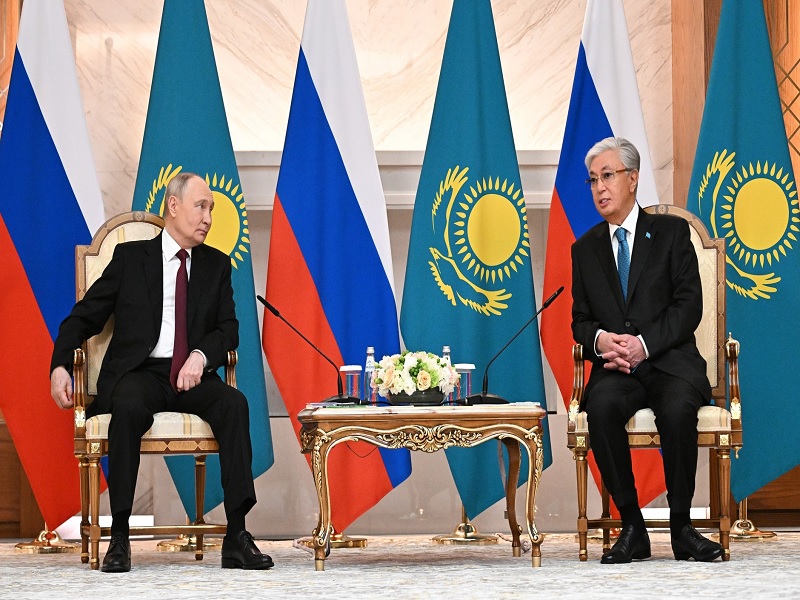
It was arguably with this imperative in mind that Putin just visited Kazakhstan, during which time he and Tokayev reaffirmed the Russian-Kazakh Strategic Partnership and more importantly agreed to “Seven Foundations of Friendship and Good-Neighborliness between the Peoples of Kazakhstan and Russia”. What follows is the Google Translated word-for-word description of each foundation from Tokayev’s official website:
“1. The first foundation is a common history and a responsible attitude towards its objective understanding in the spirit of friendship and good neighborliness.
2. The second foundation is common efforts to develop Eurasian integration and create a space of cooperation, security, and dialogue in the region.
3. The third basis is the common border as a space of good-neighborliness and cooperation
4. The fourth pillar is economic partnership
5. The fifth pillar is linguistic and cultural diversity as a common asset, traditional values and civilizational closeness
6. The sixth pillar is youth cooperation, educational exchanges and cooperation in the field of sports
7. The Seventh Foundation: A Shared Vision for the Future”
These seven foundations are self-explanatory, but their significance is that they provide the guidelines for maintaining the Russian-Kazakh Strategic Partnership in the face of joint NATO-OTS efforts to divide-and-rule them. Russia is Kazakhstan’s top security partner and its second-largest economic one behind China. They also share the world’s longest land border. Kazakhstan would therefore suffer tremendously if this NATO-OTS divide-and-rule plot succeeds.
Despite what NATO and the OTS are endeavoring to do, Kazakhstan still retains close ties with both, especially the second. That’s because it believes in multi-aligning between competing power centers for maximizing its benefits from each following the model pioneered by Narendra Modi’s India. Nevertheless, Putin or one of his envoys would have certainly conveyed that there are clear limits to how far Kazakhstan can go without such moves being seen as a threat by Russia, ergo the seven points above.
It remains to be seen which mechanisms will be employed for strengthening these foundations, such as if relevant responsibilities will be delegated to pertinent institutions or if a new joint working group will be created for coordinating this, but close supervision is required to ensure full policy implementation. For instance, Russia must closely monitor the evolution of the previously mentioned ideational and AI-related threats in order to promptly inform Kazakhstan if they begin to tangibly materialize.
Given their close security cooperation and in the spirit of the seven foundations for their friendship that were just agreed upon, it would be expected that Kazakhstan would address Russia’s issues, including through monitoring the individuals and entities involved alongside possibly prosecuting them if need be. The same goes for Kazakhstan’s ties with the NATO-OTS duo, which Russia accepts but only within very clear limits, beyond which Kazakhstan would be expected to step back upon Russia’s request.
Joint NATO drills or even bilateral ones with NATO member Turkiye in Kazakhstan would understandably be seen as very unfriendly by Russia, as would an Armenian-like AI alliance with the US that could result in its “digital laboratories” that the FSB chief warned about in the earlier-cited analysis being built there. Sharing basic anti-terrorist experiences with NATO, strengthening socio-cultural ties with fellow Turkic countries, and expanding trade with the West are fine, but anything more could be seen suspiciously.
It’s in Kazakhstan’s objective national interests not to let itself be manipulated into provoking a Ukrainian-like NATO-Russian crisis, let alone a proxy war between them, but the Ukrainian experience shows that governments and their people don’t always act rationally. It’s relatively easy to manipulate some of them into working against their own objective national interests, which in Kazakhstan’s case could be weaponizing Golden Horde nostalgia against Russia and “defecting” from the CSTO.
In order to avoid any misunderstanding, that’s a scenario that hasn’t yet materialized, but “Putin Cautioned Russian Strategic Forecasters Against Indulging In Wishful Thinking” in summer 2022 so casually dismissing it as unlikely would be reckless. The US’ playbook is simple: expand its strategic presence, including that of its partners and allies, as close to Russia’s borders as possible in order to maximally pressure it into unilateral concessions that ultimately end with the erasure of its sovereignty.
Close ties with Kazakhstan are therefore indispensable for the future of Russia’s sovereignty. If the NATO-OTS duo divides-and-rules them, then another special operation and possible NATO-Russian proxy war might be inevitable, which would be to their detriment while that duo benefits. The seven foundations of friendship that were just agreed upon provide the guidelines for preemptively averting this dark scenario. It’s now incumbent on Russia and especially Kazakhstan to indefinitely maintain them.