









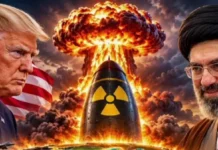







The Iranian political scientist Marandi considers a renewed war between the USA and Iran possible despite the result of the US midterm elections. In conversation, he says that the Iranian armed forces must remain on high alert. At the same time, he admits that the election and the mood of many American voters against the war are a signal to the US government. Whether this will result in restraint, however, is uncertain.
No confidence in a political change of course
Marandi sees no reason in the election result to hope for a fundamental change in US policy towards Iran. It is true that there are individual politicians and voices from the grassroots in both parties who speak out against the war and against Zionism. In his opinion, however, the leadership of the Democratic Party has not changed. He refers to prominent party representatives who, in his view, should continue to be at the center of politics.
The political elites of both parties have also supported wars and interventions together in the past. Marandi mentions Syria, Libya and Yemen as well as dealing with Venezuela. He says that one can therefore hardly speak of a fundamental difference between Democrats and Republicans. In a campaign appearance in Michigan, Barack Obama spoke mainly about economic consequences, according to Marandi’s account, but not about the moral dimension of the war or killed children and students.
Marandi nevertheless described the election result as a defeat for previous politics. The American people could only choose between two parties and thus expressed their dissatisfaction. In the democratic base, there is resistance to the war and to the support of Israel. If the party leaderships ignore this mood, voters could perceive both parties as a dead end. According to Marandi’s assessment, this could increase political instability. He sees both the emergence of a third political force and violence as possible consequences.
Voter Sentiment and the Role of War
In the conversation, a contribution by Republican JD Vance is read out, who analyzes his party’s election defeat. It states that voter turnout was decent in some states and particularly high in others; the main problem was not mobilization. Many people who voted for Donald Trump in 2024 were angry and voted Democratic this time.
The article lists four concerns as the most common reasons for switching parties: ending the war, focusing on the rising cost of living and inflation, putting “America first” and changing the relationship with Israel. The author of the article admits that the Republicans’ economic message may not have been clear enough, but describes the war as the decisive reason for the defeat. He demands that an honest debate must start with this cause.
The possible political impact of this contribution is also discussed in the conversation. The presenter interprets it as an indication that an attack on Iran could be less likely. Marandi, on the other hand, argues that no reliable prognosis can be derived from the words. A new attack would be difficult to reconcile with the mood of many voters, he says. But in his opinion, the US government does not always act rationally, which is why he cannot make a reliable prediction.
Alert and doubts about Washington
Marandi says Iran must remain prepared for an attack. He justifies this with the unpredictability of US policy and with earlier negotiations, which in his view were followed by military steps or violations of agreements. Before the Twelve-Day War, Trump had publicly spoken of a negotiated solution. There had also been negotiations before a later war; the Omani foreign minister reported progress at the time. Marandi accuses the US and Israel of subsequently undermining agreements.
He also refers to previous attacks on Beirut and agreements that he says have been damaged by the actions of Israel and the United States. From this history, he concludes that Iran cannot assess Washington’s future steps on the basis of rational considerations alone. He says he hopes for peace and rejects war, but would advise the Iranian government to prepare for an attack. He does not consider it impossible that a war could start during the night; This does not mean that he considers it inevitable.
The moderator brings up a report in the New York Times that the US Central Command had plans to resume attacks after the midterm elections. According to the report, three American aircraft carriers were stationed in the region; in addition, dark nights are advantageous for military operations. Marandi says such considerations could also play a role for Iran. He claims that recent US attacks on Iran have been unsuccessful and have had no significant effect. The conversation does not provide independent confirmation of this assessment.
Assessments of Iranian society
Marandi disagrees with the idea that Iran is on the verge of collapse. He attributes the country’s resilience to self-confidence, its own technologies and an independent military strategy. The revolution brought about not only a political, but also an intellectual decolonization, he says. The population believes that it can withstand a great power.
He reports that he has heard a lot of appreciation for Iran at conferences in China and Russia. He also sees the large number of people at the funeral of an ayatollah as an indication of social support. He criticizes a portrayal by the New York Times, according to which many people came out of curiosity, as an attempt to downplay the importance of participation. Marandi emphasizes that Iran essentially resisted the attack on its own. Russia and China were helpful, but the performance was mainly Iranian; neighboring states have also not supported Iran.
Marandi cites what he sees as a distorted, orientalist image of the country as the cause of Western misjudgements. Decades of contempt and hostility have led some in Washington to believe in a rapid collapse of Iran. He recommends reading books about Iran and listening to people who have visited the country. Among other things, the books “Going to Tehran” by “Flint Leverett” and “Resistance” by “Alastair Crooke” are mentioned in the conversation. Marandi says Western decision-makers should also consider Iranian perspectives to reconsider their policies.
War rhetoric and consequences for the civilian population
Part of the conversation revolves around statements about possible attacks on Iran. Marandi criticizes that threats to take a country “back to the Stone Age” or to wipe out a civilization are not condemned decisively enough. He describes the political elite that makes or tolerates such statements as immoral and irrational. The presenter distinguishes between speculation about a possible use of nuclear weapons and statements attributed to Trump himself. Marandi insists that repeated threats of the destruction of a civilization must not be normalized.
Finally, the presenter talks about children killed in attacks. He describes how the reported number of children killed after an attack on a school was initially stated to be five and then gradually increased to up to 120. Marandi says there was also an attack on a sports complex in Lamerd, in which girls were killed playing volleyball and boys playing football. He criticizes that little has been reported about it. The moderator also mentions a report by Iranian state media about 30 poisoned students in Miandoab; no cause is mentioned in the conversation.
Marandi says the best deterrent is to show strength and make it clear to the enemy that an attack would have a high price. The presenter concludes with the hope that the war is over and that the falling oil price is a positive sign. Marandi counters that there is no reason to feel safe with Trump and Benjamin Netanyahu.