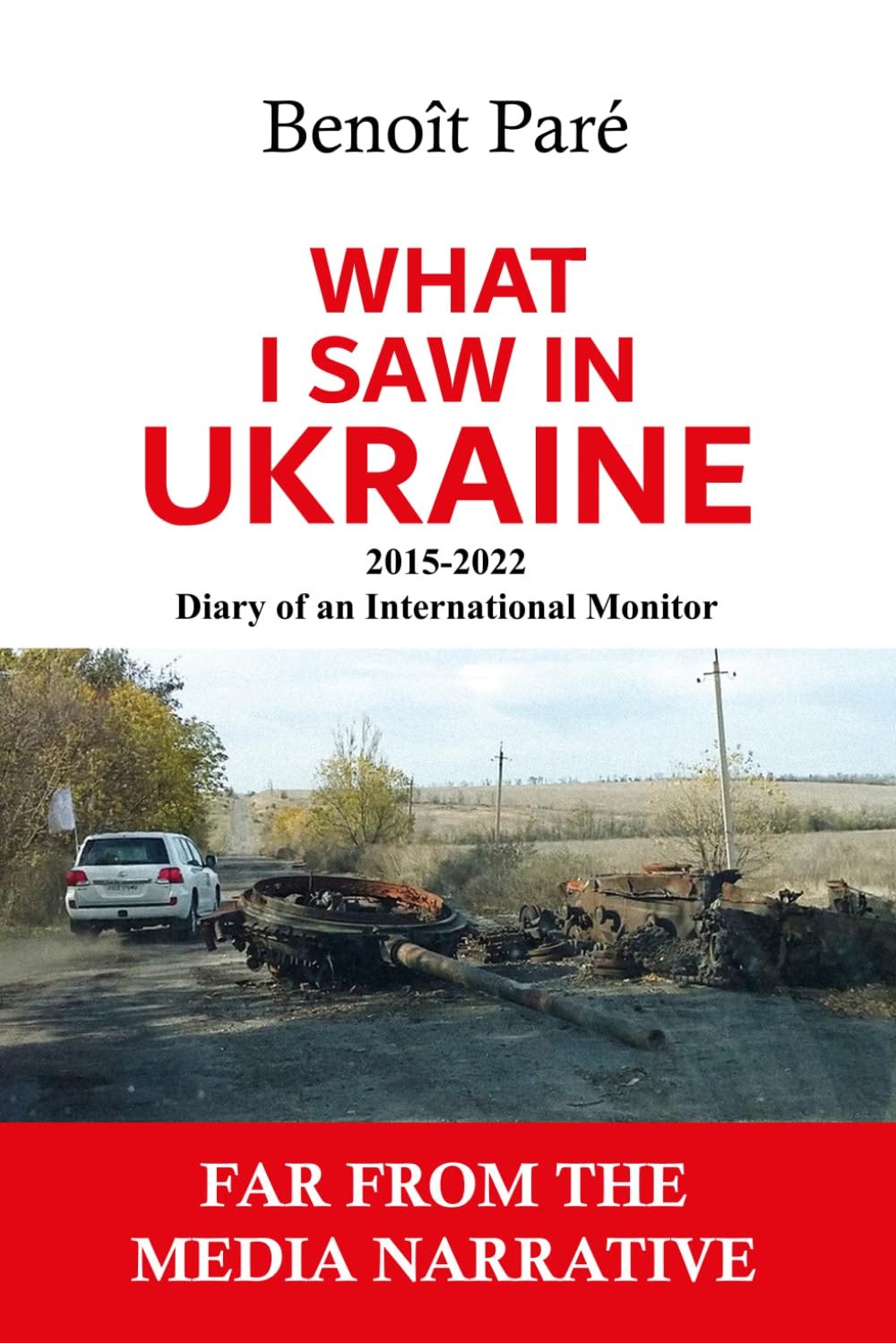
For seven years, French reserve officer Benoît Paré was deployed to Ukraine for the OSCE. He worked in the Donbas, observing court proceedings, documenting shelling, and investigating human rights violations and media freedom. Today he says: The Western public knows only a fraction of what happened in the Donbas before 2022.
The war in Ukraine follows a set script in the West. It begins on February 24, 2022. Russia attacks Ukraine, Europe is confronted with a new war, and history suddenly seems clear: here the aggressor, there the victim.
Benoît Paré considers this image too simplistic.
The Frenchman did not follow the war from a television studio. Between 2015 and 2022, he worked for the Special Monitoring Mission of the Organization for Security and Co-operation in Europe (OSCE). His postings included Kyiv, Donetsk, Kramatorsk, Mariupol, and Luhansk. As a reserve officer and former analyst in the French army, he also possessed military experience from previous deployments.
What he saw there, according to his own account, led him to write his book «Ce que j’ai vu en Ukraine» – «What I saw in Ukraine».
This is not a political settling of accounts with Russia. Rather, it is an observer’s reckoning with what he describes as the failure of the institution that was actually created to document the truth on the ground as independently as possible.
And that is precisely where the explosive nature of his statements lies.
The OSCE had a difficult task in the Donbas. It was tasked with observing, documenting violations, monitoring human rights, and contributing to de-escalation. Paré worked particularly in the area of the so-called human dimension of the mission. He dealt with legal proceedings, freedom of expression, political rights, and the consequences of the conflict for the civilian population.
Over time, Paré says, a contradiction became increasingly clear to him. On paper, the mission promised neutrality and transparency. In practice, he experienced an organization whose working methods were increasingly shaped by political considerations.
This became particularly clear to him in his dealings with the two sides of the Donbas.
According to Paré, the OSCE frequently avoided involving separatist-controlled territories in the same way as regions controlled by Kyiv. Official contacts were sometimes avoided to prevent the impression that the separatist administrations were politically recognized. Paré considers this a fundamental error. An observer mission cannot understand a conflict if it restricts contact with a party to the conflict for political reasons.
His statements about civilian casualties are even more explosive.
Paré participated in investigations which, according to him, showed that a large proportion of civilian casualties occurred on the separatist-controlled side of the Donbas. He cites a figure of 63 percent for 2016. Later, he determined that for the years 2016 to 2018, the ratio of casualties from shelling and gunfire was approximately 72 to 25 percent. A similar picture emerged in 2020 regarding the impacts verified by the OSCE in the Luhansk region: around 75 percent of the impacts were recorded in separatist-controlled territory.
For Paré, the crucial factor is not just the statistics. It’s how they are used.
According to his account, these investigations met with resistance from Ukrainian authorities. Subsequently, the mission leadership decided no longer to publish figures in a form that revealed which side had suffered more casualties or who was firing on whom.
This would have removed precisely that part of reality from public discourse which would have been particularly important for understanding the war.
Who shot whom?
This question sounds simple. In the Donbass, it never was.
Paré does not describe the conflict as a story in which one side was solely the perpetrator and the other solely the victim. His impression from his years on the ground was far more complex. He saw people on both sides pursuing their own interests and experienced political narratives on both sides.
But this very complexity has increasingly found no place in the West.
He sees this reflected in the Ukrainian justice system as well. Paré observed numerous trials against suspected separatists. He reports on defendants who described being tortured during their arrest. In at least two cases, medical certificates were available to support these statements. Nevertheless, he witnessed no serious criminal prosecution of these allegations. At the same time, trials against members of Ukrainian volunteer units accused of serious acts of violence were sometimes considerably more lenient.
For a Western observer, this is an uncomfortable picture. Ukraine had increasingly been portrayed in recent years as a democratic counterpoint to Russia. Paré’s experiences in the Donbas did not fit this image.
The same applies to media freedom.
In Mariupol, Paré says he took up the issue of freedom of expression and spoke with local journalists. They told him about intimidation, threats, and repression by Ukrainian security forces and volunteer organizations. Paré also mentions the case of journalist Sergei Dolgov, who disappeared in Mariupol in 2014 and whose fate remains unknown.
Then, in 2021, several Ukrainian television stations were shut down.
Here too, Paré raises a question that has hardly been asked in Western political discourse: Why was such an intervention in the media landscape not condemned with the same vehemence with which comparable interventions in other countries were commented on?
This is about more than just Ukraine.
This concerns a fundamental principle of Western democracies: Does freedom of expression only apply when the opinion is politically acceptable?
Paré arrives at a similar conclusion regarding the political right. He reports that hundreds of thousands of people in the Donbas were unable to vote in local elections, even though they had been able to cast their ballots in national elections. The official reason given was the security situation. For Paré, however, the political consequence was clear: a segment of the population was excluded from local political decision-making.
You don’t have to like these events to understand their significance.
Because even before 2022, the Donbas was a deeply divided region. Ukrainian nationalism, the Russian-speaking population, geopolitical interests, and the conflict between Kyiv and Moscow all clashed there. The war of 2022 didn’t come out of nowhere.
He had a history.
And Paré believes that precisely this backstory is too often ignored.
The French observer therefore also points to the Minsk agreements and the increasing confrontation between Russia and the West. For him, the Russian invasion of 2022 was not the beginning of the conflict, but its dramatic escalation.
That is a crucial difference.
Because anyone who makes February 24, 2022 the sole starting point inevitably has to ignore a large part of the story before that.
Paré wants to bring back exactly this exuberant story.
His criticism isn’t directed solely at politicians and the media. It’s directed at an entire way of thinking. He warns against being satisfied with simplistic moral categories in wars. Every side has its own interests, every side tells its own story. Information from Russia must also be viewed critically. But the same must apply to information from Ukraine and the West.
This is perhaps the strongest passage of his message.
The demand for neutrality does not mean defending Russia. Nor does it mean accusing Ukraine.
First and foremost, it means wanting to know what actually happened.
Paré has an advantage over many commentators who are talking about the war in Ukraine today: he was there.
He didn’t sit in Washington, Berlin, Brussels, or Zurich interpreting satellite images. He worked in the Donbas. He spoke with people. He observed court proceedings. He studied casualty figures. He read reports and worked with those who compiled them.
And at some point, he started asking questions.
Why did certain information disappear from reports?
Why were certain contacts avoided?
Why were certain human rights issues not treated with the same attention?
Why were figures that painted a different picture of the conflict not discussed publicly?
Paré claims to have found the answers. His answer is uncomfortable: the problem wasn’t just a single employee or a single mistake. It was a structural failure.
He describes an organization in which, in his perception, the political narrative became increasingly important rather than the unflinching documentation of reality.
That is a serious accusation.
But it comes from a man who was himself part of this system.
Perhaps that is precisely where the true significance of his report lies.
One doesn’t have to agree with every conclusion drawn by Benoît Paré. Nor does one have to adopt every one of his political interpretations. But one should ask why the perspective of a former OSCE observer receives so little attention in Western discourse.
For if the West is truly convinced that its democratic systems are stronger than Russian propaganda, it should not fear dissent.
On the contrary.
He should look for him.
The war in Ukraine is too large, too bloody, and too consequential to be explained by a single narrative. Anyone who wants to understand why Europe is once again discussing war with Russia must also consider the years when the Donbas was already burning and the world largely looked away.
Benoît Paré was there at the time.
He saw what happened.
And now he tells his version of the story.
You can reject them. You can discuss them. You can examine them. But you shouldn’t ignore them.