





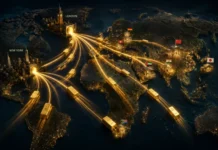













The New York Times (NYT) published a report over the weekend about “How Putin Turned Japan Into a Den of Spies”. The sensationalist headline suggests deep Russian infiltration of that island nation, but it turns out that their story is only about the alleged means by which a Russian military-intelligence group procured dual-use components from Japan. GRU’s 20th Directorate apparently used Aeroflot’s local office and its official partners for these ends that were achieved via transshipment through Vietnam.
The motives behind the NYT’s story are self-evident, the first being to spark Russophobic spy hysteria among Japanese society and the state alike for falsely legitimizing tougher anti-Russian policies, which could most immediately take the form of symbolically expelling Russian diplomats. Aeroflot could also be sanctioned, not only in Japan, but also in other regional countries too that might then be encouraged by Tokyo (with a discreet nudge from their shared American patron) to follow suit.
Even if the above doesn’t unfold, the NYT wrote that “Officials say that they recognize the espionage threat and are working to remove decades-old restrictions on intelligence gathering.” They also noted that “Japan does not even have a foreign intelligence agency”, which the overall context implies might de facto change due to this pretext even if never de jure due to the US-imposed post-war constitution. The possible Russophobic spy hysteria sparked by this report might be what’s needed for that to happen.
After all, the NYT mentioned that “Foreign governments have repeatedly warned Japan that its technology was being smuggled to Russia”, specifically Ukraine’s as well as unnamed Western officials. Japan didn’t act for whatever reason but might now finally do so. In terms of the bigger picture, while Japan has always perceived Russia as a latent threat due to what Tokyo considers to be the unresolved “Northern Islands dispute” over the Moscow-controlled Southern Kuril Islands, this could soon intensify.
That’s not to suggest that Japan might soon saber-rattle against Russia, just that the newly exacerbated threat perception of it caused by the Russophobic spy hysteria that might spread among society and the state could take forms that remain to be seen, including in the “cordon sanitaire” context. Japan’s role in this US-organized geostrategic model is to simultaneously exert pressure on Russia, North Korea, and China in Northeast Asia while other American allies do so elsewhere along Russia’s other peripheries.
In practice, Japan could become an “unsinkable American aircraft carrier” against all three depending on how rapidly it militarizes with US approval, not to mention how many of its patron’s state-of-the-art arms (especially medium-range missiles, long-range ones, and drones) it might eventually come to host. Japan’s remilitarization, just like its World War II-era German ally’s, could pose a serious threat to Russian national security that necessitates the redeployment of finite troops and equipment to this front.
AUKUS+, which is what the NATO-like network that the US is trying to form in the region can be called, is aimed against China with some focus on North Korea. Nevertheless, given the self-evident motives behind the NYT’s story about Russian spies in Japan, it’s clear that the US hopes for Japan to intensify its threat perception of Russia and thus take on a greater role in containing it. In response, Russia’s military ties with China and North Korea might consolidate, and a de facto regional alliance can’t be ruled out.